



The utility and energy sector does not need to borrow a threat model from somewhere else. It already has one. NERC CIP has governed North American grid cybersecurity for over a decade, IEC 62443 shapes OT segmentation requirements internationally, and nation-state actors, including the campaign publicly tracked as Volt Typhoon, have named the grid as a pre-positioning target. Where other industries look to utilities to understand critical infrastructure risk, utilities face that risk directly, every day.
At the same time, the grid itself is being rebuilt underneath the teams responsible for defending it. Distributed energy resources, AI-driven distribution automation, predictive maintenance, and a increasingly mobile field workforce are pulling utilities away from isolated SCADA networks and toward converged, AI-enabled private wireless platforms, often consolidating dozens of legacy single-purpose networks onto one shared infrastructure.
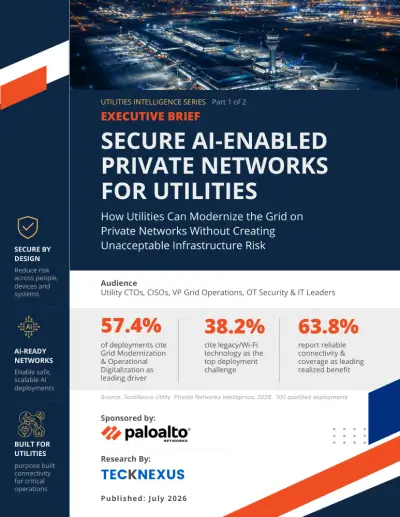
TeckNexus’s new executive brief, sponsored by Palo Alto Networks, introduces the 4-layer security architecture utilities need to make that shift without expanding their attack surface faster than they can defend it. The research draws on the TeckNexus Utility Private Networks Intelligence evidence base of 100 qualified deployments.
Why Private Network Security for Utilities Cannot Wait
Three data points from the evidence base explain why this matters right now:
- 57.4% of qualified deployments cite grid modernization and operational digitalization as the leading business driver, nearly 20 points ahead of the next-ranked driver.
- 38.2% of deployments cite legacy network or Wi-Fi limitations as their primary barrier, meaning incumbent on-premises technology simply cannot meet modern segmentation and reliability requirements.
- 63.8% of deployments report reliable connectivity and coverage as a realized benefit, with 51.1% reporting secure connectivity as a close second. In utilities, reliability and security are not separate wins. They are structurally linked.
IT/OT Convergence Is the Defining Security Boundary
Historically, utility OT such as SCADA, distribution management systems, and teleprotection ran on isolated, purpose-built networks with little connectivity to enterprise IT. That isolation is eroding fast. Utilities are consolidating legacy single-purpose networks onto converged platforms to reduce cost and enable modern analytics, while connecting field workforce devices, AI surveillance, and predictive maintenance sensors to the same infrastructure that carries protection and control traffic.
This is exactly the pattern that made the Volt Typhoon campaign against U.S. critical infrastructure so damaging: an adversary establishes an IT foothold and moves laterally toward OT because the boundary between the two is enforced by policy, not by network architecture. In a utility environment, that lateral path leads directly to systems with physical, life-safety consequences, not just data exposure.
Utilities also operate under a regulatory environment few other sectors match. NERC CIP and IEC 62443 do not treat network security as optional hardening; both frameworks assume it as a baseline condition for continued operation. In wildfire-prone regions, that exposure sharpens further: automated de-energization systems now carry security failure modes measured in acres burned and lives at risk, not just data exposed.
Six Site Archetypes, Six Different Attack Surfaces
Utility private network design spans a wider range of site archetypes than almost any other critical infrastructure vertical, and a single, uniform security posture will not cover all of them:
- Generation sites (power plants, substations, solar and wind): concentrated high-value control systems where one compromised device has plant-wide or grid-wide reach.
- Transmission and distribution infrastructure: thousands of miles of physically unattended assets that cannot be perimeter-secured and depend entirely on network-level authentication.
- Control centers running SCADA, DMS, and OMS: the highest-value target in the architecture, since compromise here has authority over grid-wide operations.
- Gas archetypes (compressor stations, regulator stations, pipeline corridors): remote, often unmanned sites where a command-channel compromise has direct safety consequences.
- Water and wastewater archetypes: treatment and pumping systems where manipulated control commands affect public health, not just service continuity.
- Field workforce (mobile crews, storm restoration teams, meter technicians): the largest population of transient, hard-to-govern devices with potential paths into operational segments.
A single utility may operate across every one of these archetypes at once, across a service territory spanning thousands of square miles. That means no single physical boundary can function as the security perimeter. Segmentation has to be enforced at the network level, regardless of archetype or site remoteness, and regardless of how RF-challenging the terrain is.
Why Public and Legacy Networks Fall Short
Most utilities today run a hybrid of public cellular, legacy VHF/UHF radio, and point-to-point microwave links. Public carrier networks carry a meaningful share of operational traffic despite offering none of the identity verification, segmentation, or auditability that SCADA and protection traffic require. The gap is not primarily one of performance. It is one of security control:
| Security requirement | Public / legacy network | Private mobile network |
|---|---|---|
| Segmentation of SCADA from IT/public traffic | No enforcement; rural substations often fall back to unsegmented public cellular | Network-level segmentation engineered to the utility’s own footprint |
| Command-channel integrity for protection systems | No guaranteed latency or authentication; unsuitable for sub-10ms teleprotection traffic | Tunable for ultra-low-latency SCADA and protection traffic with authenticated command paths |
| Device identity verification | No SIM-based OT or IoT verification; any device can attempt to connect | Every endpoint uniquely identified and verified before network access |
| Availability during disasters | Frequently degraded by the same storms and fires utilities must operate through | Utility-controlled resilience, redundancy, and prioritization during emergencies |
| Regulatory auditability | No native support for NERC CIP or IEC 62443 requirements | Network-level segmentation and audit logging enforced by design |
The 4-Layer Security Architecture for Utilities
The brief introduces a framework built around four layers, each mapped to a distinct requirement shaped by NERC CIP, IEC 62443, and the physical stakes of grid operations:
- Core Security. Encrypted, resilient transport connecting substations, control centers, generation sites, and field operations, with SIM-based authentication, user plane encryption, next-generation firewalls, and zero trust controls preventing unauthorized traffic from crossing between SCADA, workforce, and metering domains.
- Edge Security. Enforcement at the point where OT devices actually live, including SCADA remote terminal units, reclosers, smart meters, and field sensors, with hardened edge routers handling local telemetry processing while enforcing policy close to the data source.
- AI Ecosystem Security. Runtime integrity checks, model scanning, adversarial testing, and model signing to protect predictive maintenance models, digital twin analytics, and distribution automation systems, each of which is its own attack surface.
- Governance and Compliance. Security policy that covers not just the utility’s own systems, but the access policies and security obligations of contractors, cooperative partners, and any third party connecting to utility infrastructure.
A Rapid Self-Assessment for Utility Security Leaders
The brief includes a five-dimension readiness self-assessment covering SCADA/IT segmentation, endpoint identity, third-party governance, AI security, and regulatory alignment, scored Red, Amber, or Green. Utilities that land Red or Amber on SCADA/IT segmentation or endpoint identity specifically should treat those as priority remediation items before scaling AI-driven analytics, predictive maintenance, or distribution automation deployments any further.
What’s Inside the Full Secure AI-Enabled Private Networks for Utilities Brief
This article covers the foundational argument. The full executive brief, Secure AI-Enabled Private Networks for Utilities, goes deeper with:
- A full breakdown of business drivers, deployment challenges, and realized benefits across 100 qualified utility deployments
- A detailed convergence risk diagram showing how an enterprise IT compromise becomes a physical grid consequence
- The complete 4-layer architecture reference
- A three-phase implementation roadmap (Assessment, Foundation, AI Deployment)
- Three recommendations for utility security leaders
This is Part 1 of a two-part series. Part 2, Securing Grid-Scale Network Architecture: Spectrum, Segmentation, and Automated Grid Control, goes further into converged OT network consolidation, network slicing for mission-critical grid traffic, and securing automated grid control and de-energization systems.
Explore more independent research across private 5G, AI, and critical infrastructure security in the TeckNexus whitepaper library.
This brief was produced by TeckNexus and sponsored by Palo Alto Networks. The research, analysis, and recommendations are solely those of TeckNexus and reflect the independent judgement of TeckNexus analysts.
FAQ
- Who is this brief for? Utility CTOs, CISOs, VP Grid Operations, and OT security and IT leaders evaluating or already operating private wireless infrastructure.
- Is this brief vendor-specific? No. TeckNexus is a vendor-neutral research platform. Palo Alto Networks sponsored this brief but did not contribute to, review, or approve the editorial content prior to publication.
- Does this brief require prior context on NERC CIP or IEC 62443? No. The brief explains both frameworks and how they shape network segmentation and auditability requirements for utility private networks.
- How does this relate to Part 2 of the series? Part 1 establishes the foundational 4-layer architecture. Part 2 applies that framework to three specific, harder implementation questions: converged OT consolidation, network slicing, and automated grid control.




