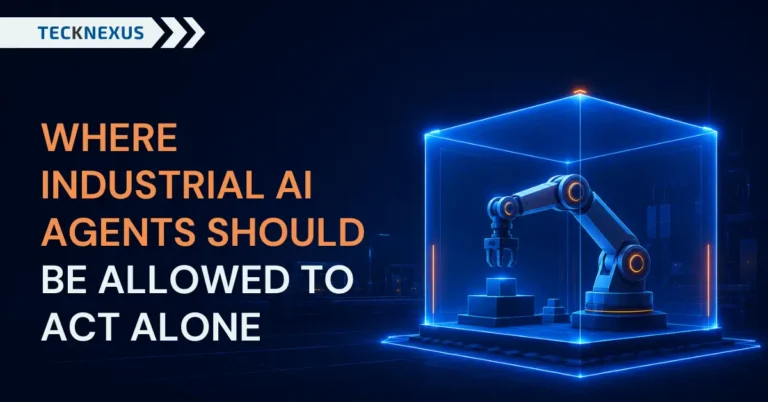
Most coverage of AI agents moving onto the factory floor stays at the level of a framing shift — from copilots that suggest to agents that act. That framing is true but not, on its own, actionable. What’s more useful is a specific answer to the question every industrial operator evaluating agentic AI actually needs answered: which tasks, specifically, are safe to hand to an autonomous agent today, and which still require a human in the loop. Honeywell’s publicly stated position, profiled by BizTech Magazine this August, is one of the more concrete answers to that question currently in circulation.

The Case for Bounded Autonomy in Closed-Loop Operations
Honeywell’s framing draws a specific line: agents should execute approved workflows, interact directly with operational technology systems, and verify their own outcomes — but only within deterministic engineering and safety constraints defined in advance. That’s a materially narrower scope than general-purpose agentic autonomy. The agent isn’t being asked to reason about novel situations or exercise judgment about what action to take; it’s being given a pre-approved set of workflows, with pre-defined boundaries, and permission to execute and verify those specific workflows without waiting for a human sign-off at each step. The autonomy is bounded by design, not by the agent’s own judgement about when to ask for help.

The Named Use Cases Worth Building a Prioritisation Framework Around
The recommended early use case list is specific enough to be genuinely useful as a starting point for any operator building its own agentic AI roadmap: sensor fault handling, routine startup and shutdown sequences, weather-driven operational responses, field communications, shift handovers, logbook updates, and process optimisation within known parameters. What unites this list is that every item is a well-defined, repeatable, low-ambiguity task with a clear correct outcome — a sensor fault has a known diagnostic and remediation path, a startup sequence follows a fixed procedure, a shift handover has a defined information set that needs to transfer. None of them require the agent to make a judgement call about ambiguous or competing priorities.
That’s precisely where Honeywell draws the human-oversight line back in: ambiguous situations, safety-critical decisions, regulatory matters, and genuinely novel scenarios remain reserved for human judgement. The distinction being made isn’t complexity in the general sense — some of the named autonomous use cases, process optimisation for instance, can be technically sophisticated — it’s whether the situation has a well-defined correct answer that the agent can execute against. Ambiguity, not difficulty, is the actual boundary condition, and it’s a more precise way of drawing the line than the common industry shorthand of reserving autonomy for ‘low-risk’ tasks, which rarely specifies what low-risk actually means in an operational technology context.
Why the Security Framing Matters as Much as the Autonomy Framing
The recommended cybersecurity posture accompanying this bounded-autonomy model is worth reading as inseparable from the autonomy scope itself, not as a separate add-on concern. The stated controls — segmented networks, tightly managed access, continuous monitoring, and system validation — are specifically about making sure an agent operating with real execution authority over OT systems can’t act outside its intended scope even if something goes wrong upstream, whether that’s a compromised credential, a manipulated input, or a bug in the agent’s own logic. Segmentation limits blast radius if an agent is compromised or misbehaves; tightly managed access limits what any given agent instance can actually touch; continuous monitoring and system validation catch deviation from expected behaviour quickly rather than after damage has occurred.
None of these are agentic-AI-specific security practices — they’re standard OT security hygiene — but applying them specifically as a precondition for granting an agent real execution authority is the more disciplined framing than treating agentic AI security as a separate workstream from the autonomy decision. An operator that grants an agent execution authority over a bounded workflow without first confirming the underlying network segmentation and access control are in place has effectively adopted the autonomy benefit without the corresponding containment, which is a materially worse position than either full manual control or fully bounded, properly contained autonomy.
A Useful Starting Framework, Not a Finished Standard
Honeywell’s position is a vendor’s stated view, not an independent standard, and it should be read that way — as one credible industrial automation player’s articulation of where the line currently sits, rather than a settled industry consensus. But the specificity is genuinely useful for any operator building an internal framework for what to hand to agents first. A prioritisation approach built around well-defined, repeatable, low-ambiguity, bounded-outcome tasks — with the named examples as a starting checklist — gives industrial buyers a more actionable starting point than the more common advice to start with low-risk use cases, and it gives procurement teams a concrete list of questions to put to any vendor pitching broader agentic autonomy: which of these bounded categories does your platform actually cover today, and what deterministic constraints govern each one.
Why Precisely Bounded Autonomy Is the Harder Engineering Achievement
Honeywell’s deliberately bounded framing is worth appreciating on its own technical merits: precisely defining and reliably enforcing the boundaries around what an agent can act on autonomously is a harder and more valuable engineering achievement than building broad, general-purpose autonomy. It draws on Honeywell’s decades of experience in industrial safety-critical systems, where the discipline of scoping automation tightly and verifiably has always been central to how safety cases are built. For an operator building its own agentic AI roadmap, a tightly bounded set of named use cases with explicit deterministic constraints is a genuinely strong foundation to build from, and it’s the kind of specificity worth looking for and valuing when comparing how different platforms approach industrial autonomy.
Explore the full TeckNexus Intelligence Platform — independent, buyer-neutral tools for private network and industrial AI decisions. https://tecknexus.com/intelligence/