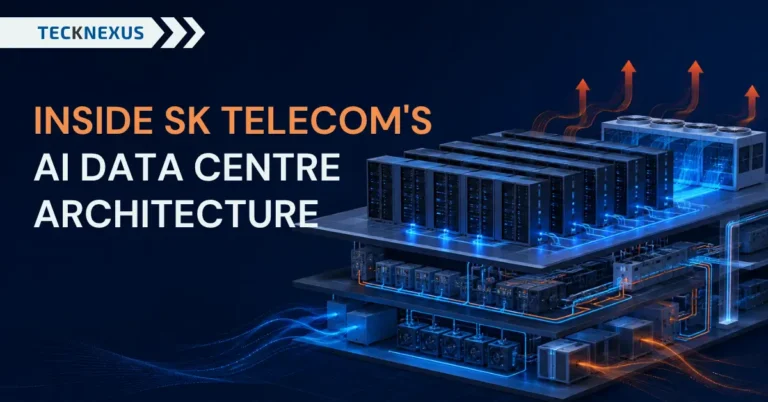
AI data centre announcements from telecom operators tend to follow a predictable pattern: a capacity target in gigawatts, an investment figure, and a timeline. SK Telecom’s SK Hyper AI data centre unit, detailed in Korean trade reporting this August, includes all of that — 5 gigawatts of capacity targeted by 2029, scaling to 15 gigawatts by 2035, backed by a stated 750 billion won investment through 2030 — but it also includes something considerably rarer: specific technical architecture detail about how the compute, memory, and cooling layers are actually being built.

The Compute Layer: A Multi-Silicon Server Platform, Not a Single-Vendor Build
SK Telecom is integrating Arm’s AGI CPU architecture with Rebellions’ Rebellcard AI inference accelerator on a common server platform, a deliberate multi-silicon approach rather than standardising on a single chip vendor across the compute layer. That detail is worth noting against the backdrop of an AI infrastructure market where Nvidia‘s GPUs dominate headline coverage: SK Telecom‘s architecture pairs an Arm-based CPU platform with a domestic Korean AI inference accelerator, Rebellions, rather than defaulting to a single dominant vendor’s full stack, which points at a deliberate strategy to diversify compute supply and reduce single-vendor dependency at the silicon level, not just at the systems-integration level.

That diversification strategy is worth reading alongside the broader industry backdrop of semiconductor and memory capacity increasingly being financed at infrastructure scale, since a multi-silicon approach is one of the more direct hedges an individual operator can build into its own architecture against exactly that kind of supply concentration risk. An operator that has deliberately built its server platform to support more than one AI accelerator vendor is better positioned to shift volume if pricing, availability, or performance shifts meaningfully in either direction, than one that has standardised entirely on a single chip vendor’s roadmap.
The Memory Layer: CXL-Based Pooling to Improve Utilisation
The more technically distinctive element is SK Telecom’s development of a CXL-based architecture, built with Panmnesia, specifically to pool CPU, GPU, and memory resources across the data centre rather than having each server’s compute and memory tied together as fixed, dedicated units. CXL, Compute Express Link, is an interconnect standard that allows memory to be disaggregated from any single server and shared dynamically across multiple compute nodes, the practical benefit being significantly improved utilisation, since memory that would otherwise sit idle attached to one underused server can instead be allocated to whichever workload actually needs it at a given moment. For AI inference workloads specifically, where memory bandwidth and capacity are frequently the binding constraint rather than raw compute, a CXL-based pooling architecture is a meaningful efficiency lever, and naming a specific technology partner, Panmnesia, for this layer is a level of architectural transparency well beyond a typical capacity announcement.
The Power and Cooling Layer: Named Industrial Partners
SK Telecom is working with Supermicro and Schneider Electric specifically on power and cooling efficiency, a detail worth including because power and cooling, not compute, is increasingly the binding physical constraint on AI data centre scale-up globally. Naming both an established server hardware manufacturer, Supermicro, and an established power management and industrial automation firm, Schneider Electric, for this layer signals SK Telecom is treating power and cooling as a specialist engineering problem requiring dedicated partners, rather than an incidental facilities consideration layered on top of a compute-first build.
SK Telecom is also co-developing an AI data centre in Ulsan directly with AWS, and aligning capabilities across the wider SK Group, drawing on SK Hynix for memory supply and SK Broadband for connectivity, which points at a group-level, vertically coordinated infrastructure strategy rather than SK Telecom building its AI data centre capability in isolation from its sister companies’ capabilities.
Why This Level of Detail Is a Useful Reference for Capacity Planning
Most operators and enterprises building or planning AI-adjacent infrastructure, whether a full data centre or a smaller edge compute deployment supporting industrial AI workloads, don’t get this level of published architectural detail from peers or competitors to benchmark against. SK Telecom’s disclosed architecture gives a genuinely useful reference point on three specific design decisions any AI infrastructure planner has to make: whether to standardise on a single compute vendor or deliberately diversify across CPU and accelerator suppliers, whether to invest in memory-pooling architecture like CXL to improve utilisation rather than over-provisioning fixed memory per server, and how much dedicated engineering attention power and cooling warrant relative to the compute layer itself. None of these decisions transfer directly from a hyperscale telecom operator’s build to a smaller industrial AI deployment, but the underlying design logic, diversify compute supply, pool memory rather than fixing it to underused servers, and treat power and cooling as a specialist problem, scales down usefully even where the absolute numbers don’t.
How This Compares to Peer Operators’ AI Infrastructure Strategy
SK Telecom’s approach is worth reading alongside its domestic peers rather than in isolation, since KT and LG Uplus are pursuing comparable AI infrastructure buildouts in the same market over the same period, with KT reportedly planning a roughly $12.6 billion investment programme to reposition around AI infrastructure and LG Uplus committing close to $1 billion in additional capital expenditure toward AI data centre capacity. None of the public reporting on KT’s or LG Uplus’s plans includes the same level of named-partner technical architecture detail SK Telecom has disclosed for SK Hyper, which makes SK Telecom’s build the more useful public reference for now, but it’s a reasonable expectation that comparable architectural decisions, multi-silicon compute diversification, memory pooling for utilisation, and dedicated power and cooling partnerships, are being made across all three operators given the scale of capital involved and the shared regional supply chain and infrastructure constraints they’re all operating within. Buyers without direct visibility into any single operator’s architecture should treat SK Telecom’s disclosed approach as a reasonable proxy for what a well-resourced, technically rigorous AI data centre build in this market currently looks like.
Explore the full TeckNexus Intelligence Platform — independent, buyer-neutral tools for private network and industrial AI decisions. https://tecknexus.com/intelligence/