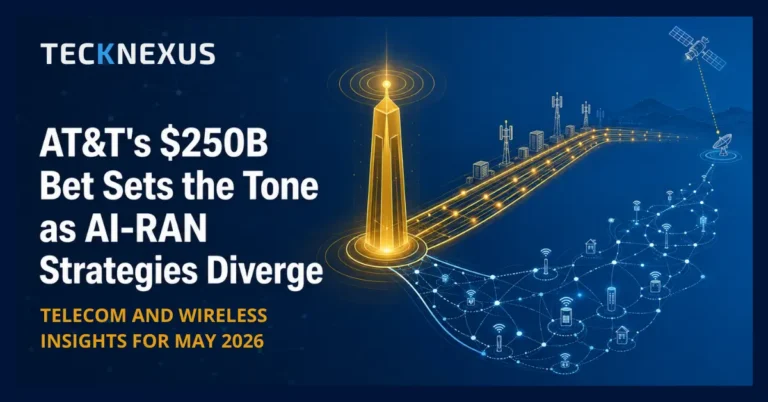
Telecom and Wireless Insights – March 2026’s inaugural roundup: AT&T commits $250B to fiber, 5G, and AI-era infrastructure through 2030, Ericsson and Nokia diverge on AI–RAN strategy at MWC Barcelona, 6G‘s roadmap firms up around a 2029 target, and satellite direct-to-device edges toward commercial launch.
At a glance – Advanced Connectivity Insights for March 2026
- AT&T announced a five-year, $250B commitment (2026–2030) spanning fiber, 5G, satellite convergence, and AI-era infrastructure, targeting more than 60 million fiber endpoints (up from 36 million today) and roughly 3,300 miles of new fiber per month.
- Ericsson and Nokia took notably different approaches to AI-RAN at MWC Barcelona, with Ericsson pushing a 6G-aligned “intelligent fabric” spanning radios, RAN compute, transport, OSS/BSS, and the core, while Nvidia partnered directly with T-Mobile and Nokia to embed GPUs into RAN sites.
- T-Mobile and Qualcomm expanded their 6G collaboration, targeting 2029 commercialization across Giga-MIMO, integrated sensing, and AI-native compute — aligning with 3GPP‘s first implementable 6G specifications, also targeted for 2029.
- AT&T is preparing a beta direct-to-device satellite broadband service as operators align with satellite partners, while AST SpaceMobile faces timing risk on a planned 2026 satellite launch.
- SDMC and Huawei both pushed AI natively into home and hospitality Wi-Fi — an AI-native Wi-Fi 8 gateway with edge inference, and a Wi-Fi 7 hotel campus solution with AI-driven spatial sensing.
- Broadcom, Comcast, AMD, and Equinix all retooled telco cloud and edge infrastructure for AI-era 5G/6G traffic, from VMware’s Telco Cloud Platform 9 to Nvidia-powered edge “AI grid” trials.
1. AT&T’s $250B buildout sets the capital tone
The month’s largest single capital commitment reframes fiber, 5G, and satellite as one converged program:
- AT&T — $250B commitment: committed $250B over five years (2026–2030) to expand fiber, 5G, and AI-era infrastructure across the US, targeting more than 60 million fiber endpoints (up from 36 million today) and roughly 3,300 miles of new fiber installed per month, alongside investment in network resilience, public safety, and workforce development.
- AT&T — AI-assisted buildout: is using AI to support field technicians, optimize fiber deployment planning, and assist cell-site planning as part of the program — positioning the company as a converged connectivity platform underpinning US commerce and AI workloads rather than a traditional telecom operator.
- AT&T — first AI Grid adopter: separately named as the first operator to bring the Cisco/Nvidia AI Grid reference architecture to market, starting with wireless access (see Section 2).
Why it matters for buyers: AT&T’s program is the single largest capital commitment in this month’s roundup, and it explicitly frames fiber, 5G, and satellite as one converged infrastructure layer rather than three separate build programs. For buyers and competitors alike, this sets a capital and pace benchmark for the rest of the 2026–2030 window. → Model comparable buildout economics with TeckNexus ROI/TCO tools.
2. AI-RAN becomes the dominant RAN architecture debate — and vendors diverge
AI-RAN moved from a shared talking point to a genuine strategic fork at MWC Barcelona:
- Ericsson & Nokia: took notably different approaches to applying AI in the RAN, with operator voices including BT and Verizon weighing in on AI’s role in network operations — signaling contrasting product and deployment strategies for AI-enabled RAN features.
- NVIDIA, T-Mobile & Nokia: partnered to embed GPUs directly into RAN sites for on-site AI inference and interaction with physical systems, expanding NVIDIA’s footprint at the network edge.
- SynaXG & Highway 9 Networks: launched an AI-RAN solution powered by NVIDIA AI Aerial; separately, SynaXG integrated Eridan’s Ultra-Clean Signal radios with its full-stack CU/DU software, demonstrating FR1/FR2 radios operating alongside AI applications on shared GPU infrastructure at MWC.
- Keysight, Samsung & NVIDIA: demonstrated an automated end-to-end AI-RAN validation workflow for PUSCH channel estimation, integrating Keysight‘s AI-RAN Simulation Toolset with NVIDIA’s Aerial Testbed and Omniverse Digital Twin.
- Cisco & NVIDIA: unveiled the Cisco AI Grid reference architecture for service-provider edge inferencing, integrated with Cisco’s Mobility Services Platform, with AT&T named the first operator adopter.
- Wind River & Vodafone: tested AI-driven RAN automation aimed at simplifying Open RAN operations and lifecycle management.
Why it matters for buyers: AI-RAN moved from a shared industry talking point to a genuine strategic fork this month, with Ericsson and Nokia publicly diverging on approach while Nvidia deepens direct partnerships with both RAN vendors and operators simultaneously. Buyers evaluating AI-RAN should treat vendor selection as an architecture decision, not a feature checkbox — the underlying approaches are not converging. → Compare RAN architecture options with the TeckNexus Technology Selector and Network Planning tools.
3. 6G’s roadmap firms up around a 2029 target
6G moved from a vague future date to a shared, concrete horizon this month:
- Ericsson: showcased AI-native 6G building blocks at MWC Barcelona, progressing from 5G Standalone/5G Advanced toward an “intelligent fabric” spanning radios, RAN compute, transport, OSS/BSS, and the core, in collaboration with Intel and participation in the Linux Foundation‘s OCUDU initiative — aligned with 3GPP‘s first implementable 6G specifications targeted for 2029.
- T-Mobile & Qualcomm: expanded their 6G collaboration to run pre-commercial trials and standards work spanning wider bandwidths, Giga-MIMO, new waveforms, integrated radio-based sensing, and energy-efficient AI-native compute in virtualized RAN, targeting 2029 commercialization on T-Mobile’s US network.
- e& UAE & Khalifa University: released a joint white paper in Abu Dhabi outlining AI-centric approaches for future 6G network architecture and operations.
- Nokia & Broadcom: outlined a collaboration combining Nokia’s telecom software with Broadcom’s silicon to support cloud-native transformation, AI in network operations, and the path to 6G.
Why it matters for buyers: with 3GPP’s implementable 6G specifications and two major operator commercialization targets both now pointing to 2029, buyers finally have a real planning horizon rather than a moving target — a meaningful shift from prior years’ vaguer 6G timelines. → Map your network’s multi-year lifecycle against this horizon with TeckNexus Network Planning tools.
4. Satellite and NTN edge toward direct-to-device commercialization
Direct-to-device satellite moved from pilot messaging toward genuine mobile broadband — with schedule risk still attached:
- AT&T: is preparing a beta direct-to-device (D2D) satellite mobile broadband service as operators align with satellite partners to extend coverage beyond terrestrial networks.
- AST SpaceMobile: faces timing risk on a planned 2026 satellite launch, a reminder that D2D satellite capacity remains constrained by launch schedules even as operator demand accelerates.
- AWS: outlined a 6G vision in which agentic AI and non-terrestrial network (NTN) integration jointly define the next generation of telco value creation, positioning NTN as a core pillar rather than a supplementary coverage layer.
Why it matters for buyers: direct-to-device satellite is moving from pilot messaging services toward genuine mobile broadband, but launch schedule risk (AST SpaceMobile) is a reminder that satellite capacity commitments still depend on physical launch cadence, not just commercial agreements. Buyers planning coverage strategies that depend on D2D should build in schedule contingency. → Assess satellite and NTN options within your broader coverage plan using TeckNexus Network Planning tools.
5. Fixed wireless, Wi-Fi, and home broadband get an AI-native refresh
AI moved into the home and campus network edge as a standard spec, not an add-on:
- SDMC: introduced an AI-native tri-band Wi-Fi 8/10G fiber gateway with an integrated AI NPU for traffic classification and dynamic spectrum management, plus Wi-Fi Sensing for presence detection, and is moving its “Cedar” Home AI Agent from cloud to edge for local inference and offline voice assistance.
- Huawei & Bittel: launched the Xinghe AI SafeStay hotel campus network solution using Huawei AirEngine Wi-Fi 7 access points, delivering dual 10 Gbps wired/wireless access with AP-based spatial sensing for temperature control (claiming 20% energy savings) without additional infrared or mmWave sensors.
- MTN & Huawei: expanded their partnership to roll out AI-driven network operations and fixed wireless access solutions across African markets, pairing operational efficiency gains with FWA coverage expansion.
Why it matters for buyers: AI is moving into the home and campus network edge, not just the core RAN — gateways and access points are now shipping with onboard AI NPUs and edge inference as standard rather than optional. For FWA and broadband buyers, this changes the baseline spec to evaluate against. → Compare architecture options with TeckNexus Network Planning tools.
6. Telco cloud and edge infrastructure retool for AI-era 5G/6G traffic
The infrastructure layer underneath 5G and 6G traffic is being rebuilt around AI workloads as a first-class citizen:
- Broadcom: introduced VMware Telco Cloud Platform 9, targeting deployment of 5G network workloads alongside AI workloads on the same telco cloud stack for communications service providers.
- Comcast: is trialling a Nvidia-powered “AI grid” at edge locations, deploying GPU-accelerated compute at the network edge for AI workloads.
- AMD: joined GSMA‘s Open Telco AI initiative at MWC 2026, supplying Instinct GPUs with the ROCm software platform for training and inference and introducing EPYC 8005 CPUs optimized for distributed edge and vRAN workloads.
- DriveNets: highlighted a shift among communications service providers toward GPU-as-a-Service models to support AI and GenAI workloads.
- Equinix: proposed neutral metro interconnection hubs to simplify last-mile access, orchestrate distributed infrastructure across clouds, and place AI inference closer to end users.
Why it matters for buyers: the infrastructure layer underneath 5G and 6G traffic is being rebuilt around AI workloads as a first-class citizen, not an add-on — from silicon (AMD’s edge vRAN chips) through the cloud stack (VMware Telco Cloud Platform 9) to interconnection (Equinix’s metro hubs). Buyers scoping multi-year infrastructure investments should factor AI workload support into every layer, not just the RAN. → Plan capacity and architecture across the full stack with TeckNexus Network Planning tools.
Every March item, with full source detail, is on the curated Telecom and Wireless Monthly Insights page →
What this means if you’re planning connectivity infrastructure
March’s throughline, in this inaugural edition of Advanced Connectivity Insights, is convergence: fiber, 5G, satellite, RAN silicon, and AI compute are increasingly discussed and built as a single infrastructure layer rather than separate programs — AT&T’s $250B commitment is the clearest expression of that, but AI-RAN’s vendor divergence (Ericsson vs. Nokia) is a reminder that convergence in ambition doesn’t yet mean convergence in architecture. Five moves follow directly from the month:
- Benchmark your own infrastructure buildout economics against AT&T’s stated pace ($250B, >60M fiber endpoints, ~3,300 fiber miles/month) — it’s now the reference point competitors and vendors will be measured against.
- Treat AI-RAN vendor selection as an architecture decision, not a checkbox — Ericsson and Nokia are genuinely diverging, and switching costs will compound over a multi-year deployment.
- Plan network lifecycles against 2029 as a real 6G horizon, not a vague future date — both 3GPP’s specification timeline and major operator commercialization targets now converge there.
- If direct-to-device satellite is part of your coverage strategy, build in launch-schedule contingency — commercial agreements don’t eliminate physical launch risk.
- Evaluate FWA, Wi-Fi, and home gateway vendors on their AI-native specifications (onboard NPUs, edge inference) as a new baseline, not a premium feature.
This is the inaugural edition of Advanced Connectivity Insights — future editions will build forward from here, covering 5G, 6G, FWA, broadband, and satellite/NTN month by month.
→ Start with the TeckNexus Intelligence Platform — independent, buyer-neutral tools for spectrum, TCO, architecture, and RFP decisions.
This analysis is drawn from TeckNexus’s full curated Telecom and Wireless Monthly Insights for March 2026. See every deployment, product, and partnership update →
The TeckNexus Intelligence Platform is buyer-neutral and TeckNexus-authored. Vendor co-branded Intelligence Packs are labelled as such and kept separate from the neutral core tools.
| RELATED TOOL
Which connectivity architecture — AI-RAN, 6G, satellite, or FWA — fits your buildout? With AT&T setting a $250B capital benchmark, AI-RAN vendors visibly diverging, and 6G’s timeline firming up around 2029, the decisive question is which architecture choices to commit to now versus which to keep flexible. TeckNexus’s Technology Selector and Network Planning tools map architecture, spectrum, and capacity decisions against your deployment horizon, while ROI/TCO tools model the buildout economics. |