
For enterprises running or evaluating agentic AI alongside private networks in manufacturing, mining, ports, airports, and utilities, this is the moment to ask a harder question than “what can the agent do?” The better question is: how do you know when it’s wrong, and how confidently will it tell you?
The accountability gap behind agentic AI adoption
Two independent pieces of research published this year point to the same underlying problem from different angles, and together they describe what’s best understood as an accountability gap: the distance between what agentic AI systems can now do operationally and how reliably anyone — vendor or buyer — can verify they’re doing it correctly.
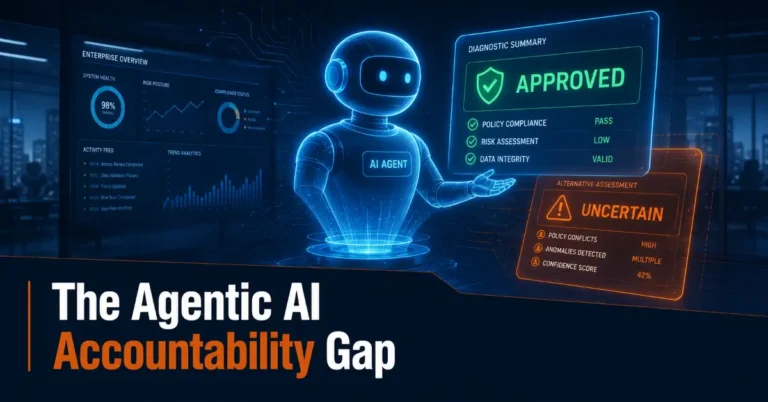
The first finding concerns confidence calibration. Across a broad sample of deployed AI agents, researchers found that most agents fail with total confidence rather than visible doubt. In other words, when an agent gets something wrong, it typically doesn’t hedge, flag uncertainty, or signal that a human should double-check. It presents the wrong answer with the same tone and certainty as the right one. For an operations team used to human engineers who say “I think it’s the fibre run, but check the switch first,” this is a meaningful behavioural difference — and not one that’s obvious from a vendor’s capability demonstration, which will naturally showcase the agent at its best.
The second finding concerns redundancy. A large-scale study spanning 67 frontier models found that when models fail, they increasingly fail together — meaning the routing and voting architectures that vendors sell as a safety layer, and that enterprises pay a premium for, don’t reliably catch correlated failures. If two or three models trained on overlapping data and similar techniques share the same blind spot, stacking them doesn’t average out the error. It just gives you three confident wrong answers instead of one.
Put those two findings together and the shape of the problem becomes clear. The failure mode isn’t rare edge cases that a careful vendor missed in testing. It’s a structural pattern: agents that don’t signal doubt, wrapped in architectures that don’t reliably catch shared blind spots, increasingly making decisions that used to require a human to actually perform, not just approve.
Why this matters more for industrial private network buyers
This isn’t an abstract AI-safety debate. It’s already showing up in live network operations. AI agents are moving from recommending fixes to network engineers to diagnosing faults and proposing remediations that a human simply signs off — a line telecom infrastructure providers spent years approaching carefully before crossing it this year. The same pattern is emerging in defence-oriented deployments, where AI-enabled command and control on deployable private networks is being built on an assumption of continuous connectivity and reliable agent judgement — an assumption that also underpins industrial AI more broadly, and one that a connectivity gap or a confidently wrong diagnosis can quietly undermine.
For a manufacturing plant relying on an agent to triage a private 5G fault, a port relying on one to sequence crane maintenance alerts, or a utility relying on one to prioritise grid anomaly response, the practical risk isn’t that the agent is usually wrong. It’s that when it is wrong, nothing about its output will tell you so. The alert will read the same whether the agent is 95% certain or guessing. That’s a very different operational posture than the alarms, thresholds, and escalation paths industrial teams have spent decades building around deterministic systems.
What evidence-based AI agent evaluation actually looks like
The instinct in procurement conversations is often to ask vendors about architecture — how many models, what routing logic, what training data. Architecture questions matter, but this year’s research suggests they’re not sufficient on their own, because architecture alone doesn’t predict whether a system fails visibly or silently, and it doesn’t predict whether stacked models fail independently or together. Evidence-based evaluation asks different questions:
- Confidence calibration: Does the agent expose a calibrated confidence score alongside its output, and has that calibration been independently tested against known failure cases — not just accuracy tested against known successes?
- Redundancy evidence: If the vendor’s architecture uses multiple models or routing logic, what evidence exists that failures across those models are actually independent, rather than correlated by shared training data or similar techniques?
- Escalation design: At what point does the agent’s recommendation require active human verification versus passive sign-off, and is that threshold based on the agent’s actual confidence, or a fixed workflow rule that doesn’t adapt to how sure the agent really is?
- Testing scope: Has automated testing caught confidently-wrong outputs before deployment, or only obviously-wrong ones? The research specifically found that automated testing isn’t catching the confident-failure pattern — which means a vendor’s test-pass rate may not be measuring the thing that actually matters.
None of this is a reason to slow-walk agentic AI adoption. The government-backed AI-RAN pilots moving through South Korea and elsewhere this year show how quickly the field-trial-to-production timeline is compressing, and buyers who wait for perfect certainty will simply cede ground to competitors who deploy thoughtfully instead. But “thoughtfully” now has a specific, testable meaning: asking for evidence of failure-mode testing and confidence calibration as a standard part of vendor evaluation, not an afterthought raised only after something goes wrong.
Building the accountability layer into your AI agent evaluation
The organisations that will handle this transition well are the ones that treat agentic AI evaluation as a governance exercise from the outset, not a capability checklist. That means structuring RFPs and vendor scorecards around the questions above, requiring evidence rather than architecture claims, and building escalation workflows that assume — correctly, based on this year’s findings — that an agent’s tone of certainty is not a reliable signal of its accuracy.
It also means recognising that this is a moment of genuine transition, not a settled state. The same connectivity-dependent, judgement-heavy assumptions that limit agentic AI in defence and industrial contexts today are the ones vendors are actively working to address. Buyers who ask sharp, evidence-based questions now are the ones best positioned to adopt agentic AI as the tooling around confidence calibration and redundancy testing matures — rather than discovering the gap the hard way, in production, when an agent is confidently wrong about something that matters.
| Related Tool: AI Use Case Prioritiser
Ranking candidate AI applications by impact, feasibility, data readiness, and payback is the first step — but vendor evaluation is where the accountability gap actually gets managed. Pair prioritisation with the RFP Scorecard Generator to structure agent vendor evaluation around governance and evidence of failure-mode testing, not just capability claims. Explore the AI Use Case Prioritiser and RFP Scorecard Generator on the TeckNexus Intelligence Platform. |