BT’s 5G Network Slicing Launch: Enterprise Implications for the UK Market
After years of technical groundwork and limited trial deployments, BT is preparing to bring commercial 5G network slicing services to market — a milestone that signals a meaningful shift in how UK operators are beginning to monetize their 5G Standalone investments.

How BT Moved 5G Network Slicing from Pilot to Commercial Service
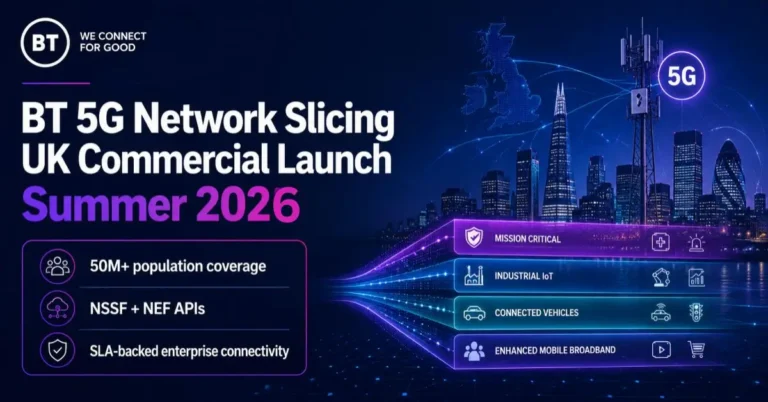
BT has confirmed it will launch 5G network slicing services before the end of summer 2026, marking one of the most significant steps forward for advanced 5G services in the UK market. The announcement, made at Wembley Stadium alongside news of BT’s role as official telecommunications partner for UEFA Euro 2028, underscores how major sporting events are increasingly serving as proving grounds for next-generation network capabilities.
Greg McCall, BT’s Chief Security and Networks Officer, noted that the carrier has spent years validating the technology before committing its brand to a commercial offer. That caution is deliberate — and arguably appropriate. Network slicing on 5G Standalone (SA) infrastructure promises dedicated, isolated performance lanes for specific applications, but delivering that consistently at national scale requires a level of core network maturity that most operators have only recently achieved.
Inside BT’s 5G Slicing Architecture: Core Network Capabilities Explained
BT’s ability to offer commercial slicing rests on a set of foundational capabilities built in partnership with Ericsson, whose dual-mode 5G Core runs on BT’s Network Cloud infrastructure.
How NSSF Enables Dynamic, Real-Time 5G Slice Management
The introduction of the Network Slice Selection Function represents a meaningful upgrade to BT’s slicing architecture. Rather than statically assigning users to predefined slices, NSSF enables dynamic, real-time slice selection based on variables including time of day, geographic location, subscription type, current network load, and application requirements. Critically, it can redistribute traffic intelligently when a slice becomes congested — a capability that directly addresses one of the most persistent concerns enterprise buyers have about 5G slicing: whether guaranteed performance can actually be guaranteed under real-world conditions.
NEF and Programmable Network Access: Turning BT’s Core Into an API Platform
Alongside NSSF, BT has deployed the Network Exposure Function, which opens up core network capabilities to external developers and enterprise customers through secure, standardized APIs. This is strategically significant. NEF effectively transforms BT’s network from a passive connectivity layer into a programmable platform — one that businesses can integrate directly into their applications and workflows without requiring deep telecom expertise. Use cases span quality-of-service controls, device authentication, and location-aware connectivity management. A logistics operator, for instance, could programmatically request low-latency connectivity for a fleet of vehicles in a specific corridor; a financial institution could leverage real-time device authentication to harden fraud prevention during mobile transactions.
BT’s participation in the GSMA‘s Open Gateway initiative — through which it has already delivered CAMARA-certified APIs including SIM-Swap and Know Your Customer — provides additional context for how NEF fits into a broader API monetization strategy that is gaining traction across the global operator community.
BT’s 5G SA Coverage Strategy: Why the 90% Threshold Matters for Enterprises
One of the more strategically interesting details in BT’s announcement is its definition of “national” slicing. The carrier has set a threshold of 90% population coverage within a given area before claiming 5G SA availability — a deliberate quality benchmark designed to avoid the fragmented experience that has undermined confidence in earlier 5G rollouts. BT’s 5G SA network currently covers approximately 50 million people in the UK, with a target of exceeding 60 million by the time UEFA Euro 2028 begins, and 99% population coverage by 2030.
This coverage discipline matters for enterprise buyers. Service level agreements for sliced connectivity are only credible if the underlying network footprint is both broad and consistent. BT’s willingness to set and publicize these thresholds suggests a degree of commercial confidence that distinguishes its approach from operators still treating slicing primarily as a proof-of-concept exercise.
UEFA Euro 2028: BT’s High-Stakes Proving Ground for 5G Network Slicing
The UEFA Euro 2028 tournament — co-hosted by the UK and Ireland across cities including London, Glasgow, Liverpool, Manchester, Cardiff, and Newcastle — provides BT with a high-profile, high-stakes deployment window. The carrier has already committed to providing dedicated network slices at 24 training grounds, with prioritized connectivity reserved for players and coaching staff. BT also projects a 20% improvement in mobile network performance across host cities by the time the tournament begins.
This is not simply a marketing exercise. Large-scale sporting events generate extreme, concentrated demand spikes that stress-test network architecture in ways that routine commercial traffic does not. BT’s prior experience deploying multiple simultaneous 5G SA slices at events including the SailGP championship in Portsmouth — supporting connectivity for racing boats, point-of-sale systems, and broadcast crews — demonstrates that the operational playbook is already in development. Euro 2028 will scale that playbook significantly.
UK 5G Slicing Competition: How BT Stacks Up Against Vodafone and What to Monitor
BT is not operating in isolation. Vodafone Business moved in early 2026 to claim the distinction of being the first UK operator to offer 5G network slicing backed by a formal service level agreement — a competitive signal that the commercial race for enterprise slicing customers is already underway. For enterprise technology and procurement leaders, this competitive dynamic is worth monitoring closely: pricing models, SLA structures, and API ecosystem depth are likely to become key differentiators as multiple UK operators bring slicing offers to market within the next 12 to 18 months.
BT’s decision to make slicing available to both business and consumer segments is also noteworthy. While the near-term revenue opportunity is clearly weighted toward enterprise and broadcast use cases — where willingness to pay for guaranteed performance is highest — extending the offer to consumers positions BT to capture premium ARPU in a market where network differentiation has historically been difficult to monetize.
What BT’s 5G Slicing Launch Means for Enterprise IT and Connectivity Strategy
For telecom executives, solution architects, and enterprise IT leaders, BT’s summer 2026 slicing launch represents a credible inflection point — not just for BT, but for the broader UK 5G market. The combination of NSSF-driven dynamic slicing, NEF-enabled programmability, and a nationally scaled 5G SA footprint creates the conditions for genuinely differentiated, application-aware connectivity services. Organizations evaluating private 5G, hybrid connectivity strategies, or network-integrated application development should treat BT’s commercial launch as a signal that the window for early-mover advantage in enterprise 5G services is beginning to close.