Why trusted AI voice is central to CX
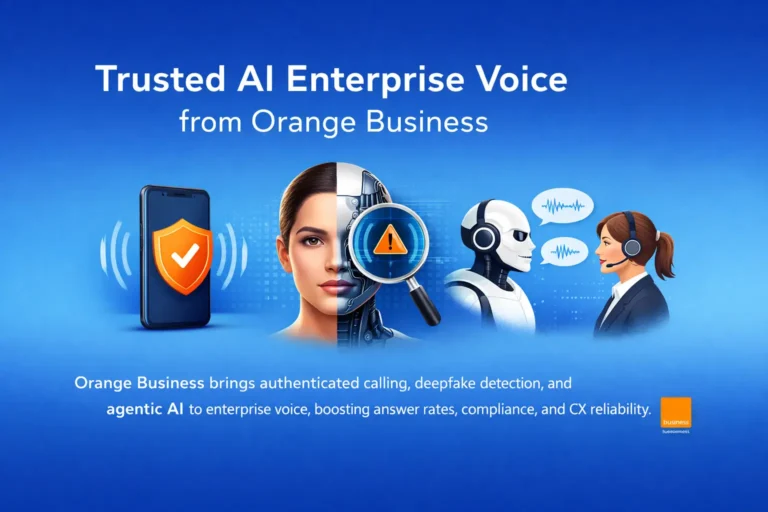
Orange Business is putting authenticated, AI-augmented voice back in the critical path of CX and employee workflows as enterprises confront fraud, fatigue, and falling answer rates.

Closing the trust gap in phone calls
As digital touchpoints proliferate, the phone channel faces a crisis of confidence: spoofed identities, impersonation scams, and AI-generated content have eroded user trust and pushed customers to ignore legitimate calls. For enterprises, this translates into missed revenue opportunities, rising operational costs, and higher risk exposure. Orange Business is responding with a portfolio that treats trust as a product feature—anchoring identity, provenance, and authenticity into every voice interaction.
Why voice solves complex, high-stakes issues
Despite surging chat and self-service volumes, voice remains the preferred medium for resolving complex or high-stakes problems, and the most-used channel for many service agents. With more than 7,000 enterprise customers and over 100,000 locations on its global assets, Orange Business is retooling enterprise telephony so calls connect faster, agents get AI assistance in real time, and every interaction is verifiable, recorded, and governed.
Inside Orange Business’s AI-powered voice stack
The new capabilities combine authenticated caller identity, deepfake detection, generative AI in the contact center, and agentic telephony that can autonomously manage call flows.
Branded calling to boost verified answer rates
Orange Business is rolling out branded calling initially in France and the United States, with Europe to follow, enabling enterprises to display their name, logo, and call intent on the recipient’s mobile screen. This approach aligns with authenticated caller frameworks—such as STIR/SHAKEN and Rich Call Data where supported—to curb spoofing, reduce abandoned or ignored calls, and strengthen customer engagement. For industries like banking, healthcare, and logistics, verified identity plus clear call context can materially improve conversion, consent capture, and first-contact resolution.
Deepfake detection built into CX workflows
As voice cloning and synthetic media become mainstream attack vectors, Orange Business is integrating deepfake detection directly into collaboration and CX stacks. Through partners like Sensity and Reality Defender, enterprises can screen audio, images, video, and documents within established workflows. The goal is to spot anomalies before they reach agents or customers, reduce social-engineering risk, and preserve brand integrity—without adding friction for legitimate users.
Live Intelligence for AI-augmented customer care
To counter hallucinations and improve reliability, Orange Business embeds generative AI within contact center and CRM environments rather than relying on disconnected bots. Built on its Live Intelligence platform, the solutions handle tasks such as call transcription, summarization, real-time recommendations, sentiment analysis, and post-call wrap-ups, and they can automate end-to-end CX journeys from triage to resolution. Orange Business reports managing tens of millions of AI conversations in 2025, underscoring the platform’s maturity and scale.
Agentic telephony for autonomous call routing
Agentic AI adds an intelligent layer over cloud telephony to interpret context, plan next-best actions, and autonomously steer an entire call journey. In co-innovation with Microsoft, Orange Business is piloting Microsoft 365 Copilot agents in Teams—such as Interpreter—to make Microsoft Teams Phone outcomes more predictable and efficient, with plans to extend agentic capabilities to platforms like Cisco Webex. The upside is faster response, personalized handling, and optimized staffing, as the system can pre-qualify intent, route with higher accuracy, and close routine cases without escalation.
Built on sovereign, scalable cloud infrastructure
The voice innovations ride on a broader Orange Business strategy that couples agentic platforms with robust, compliant infrastructure and data residency options.
Data sovereignty and compliance by design
Orange Business’s trust proposition is reinforced by sovereign cloud and operations in key markets. In France, for example, collaboration services run on Cloud Avenue SecNum, qualified SecNumCloud 3.2 by ANSSI and operated in Orange Business’s sustainable Grenoble datacenter. Beyond application features, this delivers concrete governance advantages: clear data location, auditable access controls, integrated security operations, and single-operator accountability across performance and resilience.
Edge-ready infrastructure for low-latency AI inference
Agentic AI workloads tend to be inference-heavy and latency-sensitive, pushing compute closer to users and data sources. Orange Business highlights a dense footprint of mobile sites (via Totem), virtualized points of presence, and internet-first connectivity options that shorten round trips between applications and data. This infrastructure stance matters as enterprises scale AI-assisted calling, real-time verification, and multimodal analytics that are sensitive to jitter, packet loss, and tail latency.
Implications for CIOs, CX leaders, and network teams
Trusted voice is becoming a security, revenue, and brand issue—not just a telephony feature—and requires coordinated action across CX, security, and infrastructure domains.
Where to start: high-impact pilots
Prioritize branded calling for revenue-critical and fraud-prone journeys, instrument answer and completion rates by campaign, and quantify lift from authenticated identity. Embed deepfake screening at intake points for high-risk processes such as payments, claims, and account changes. Pilot agentic telephony on one or two contact reasons with clear automation guardrails, then scale to adjacent intents as accuracy and containment improve.
Vendor due-diligence questions
Ask how caller authentication is implemented across markets and how it aligns with STIR/SHAKEN and Rich Call Data. Validate deepfake detection performance, escalation paths, and false-positive governance. For AI in the contact center, require transparency on models, prompt security, data retention, and observability. For agentic flows, demand step-by-step audit trails, cost controls, and rollback mechanisms. Confirm data residency options (e.g., SecNumCloud-grade hosting) and integration with existing SIEM and identity stacks.
Metrics that matter for trusted voice
Track verified-contact answer rates, time-to-answer, containment and deflection rates for agentic calls, average handle time reduction from AI assist, fraud-loss avoidance, and customer satisfaction on authenticated interactions. Tie KPIs to business outcomes such as recovered revenue, reduced chargebacks, and lower cost-to-serve.
Competitive landscape and ecosystem implications
Orange Business’s approach blends application innovation with control over infrastructure, setting a bar for trusted communications that spans identity, AI governance, and sovereignty.
Cross-platform collaboration strategy
By co-innovating with Microsoft for Teams Phone and extending to Cisco Webex, Orange Business positions agentic telephony as a cross-platform capability rather than a single-vendor add-on. Its broader ecosystem—spanning eXo Platform, BlueMind, Pexip, Mailinblack, Linphone, and OnlyOffice in collaboration, plus Sensity and Reality Defender in security—signals a modular strategy where customers can tune functionality and compliance per use case.
Standards and interoperability to watch
Enterprises should monitor progress of branded calling and caller authentication across regions, including STIR/SHAKEN and Rich Call Data adoption, as well as emerging ETSI guidance on identity assurance and media integrity. Keep an eye on agentic orchestration frameworks and developer stacks like LangChain—already present in Orange Business’s Live Intelligence Studio—for observability, cost management, and quality guardrails as autonomous workflows scale.