The significance of that clarification is what it reveals about the architecture Verizon is now building toward. The scripting layer was not wasted effort; Tenorio credits it as the foundation without which the agentic layer would not be possible. But it was categorically different from what Level 4 autonomy requires: a system that can reason through a situation it was never explicitly programmed for, identify a root cause it has never encountered before, and act on that reasoning without waiting for a human to write the next script. Getting from one to the other required Verizon to make a decision that most operators have not made, and to make it first: before trying to automate the network, turn everyone in the technology organisation into a software developer.
The developer-first sequence lesson from Verizon’s Road to Network Autonomy
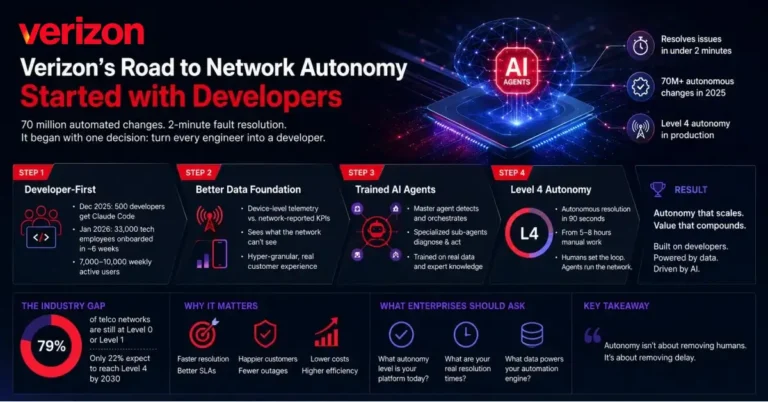
In December 2025, Verizon gave its core group of roughly 500 application developers access to Claude Code. In January 2026, the company extended that access to all 33,000 people in its technology organisation over a period of about six weeks. The scope covered teams working across network modelling, capacity planning, capital deployment, operations, forecasting and engineering. By the time the expansion was complete, Verizon was reporting between 7,000 and 10,000 weekly active users of the tool.
The intent was deliberately foundational. Tenorio describes it not as a productivity enhancement but as a prerequisite: before trying to make the network autonomous, find out what happens when every person in the organisation can build software. The mantra that emerged — if you can imagine it, Claude can code it for you — is less a marketing slogan than a description of what changed operationally. Engineers who previously depended on specialist developers to translate domain knowledge into working tooling could now build their own. The institutional expertise that existed in people’s heads began to exist in code.
That matters for autonomy because autonomous AI agents are not programmed in the traditional sense. They are trained. The skills, judgment and pattern recognition that Verizon’s network teams have built over decades do not disappear when an agentic system takes over routine operations. They get encoded into the agents’ capabilities. The humans who built those capabilities remain the architects of how the agents behave, even as the agents increasingly execute without human instruction in the loop.
The data problem that had to be solved first
The second foundational piece Tenorio identifies is a common data layer — and the way he describes the problem it solves is the most revealing part of the whole account. Traditional network key performance indicators, he explains, measure what the network reports about itself. They tend to skew toward favourable conditions and miss what the network cannot see. A customer in a Manhattan basement with no signal was, in the previous telemetry model, simply invisible: no connection attempt existed as far as the network was concerned. The coverage gap was real; the data did not reflect it.
Verizon’s solution moves to device-level telemetry, collecting anonymised performance signals from handsets rather than from network equipment. A phone that fails to connect in a dead zone cannot report in real time, but another device recovering signal in the same location moments later will. Aggregated across millions of devices, the result is a hyper-granular picture of actual service quality, including floor-by-floor visibility in indoor environments that traditional KPIs never captured. This common data layer, which Verizon began rolling into production in early June 2026, feeds the continuous optimisation loop that autonomous agents depend on. An autonomous system is only as good as the live data feeding it, and data that reflects what the network reports rather than what customers experience is structurally inadequate for the task.
The agentic architecture: trained, not programmed
The operational architecture Verizon has built on top of these two foundations runs as a live hierarchy of agents operating continuously. A master agent monitors network conditions, detects anomalies and, when something warrants investigation, immediately spins up a set of specialised sub-agents focused on the specific domain and network element involved. Work that previously required engineering teams several hours to manually diagnose and resolve is now addressed in under two minutes — long before most users would notice a service impact.
A demonstration Tenorio showed reporters this week depicted a simulated network outage in midtown Manhattan resolved in 90 seconds, compressed from a five-to-eight-hour manual process last year. The WatchTower system running that demonstration is one product of the developer-first programme: tooling built by domain experts who could, for the first time, translate their operational knowledge directly into software without an intermediary.
Tenorio is careful about what Level 4 autonomy actually means in practice. He does not describe it as removing humans from the picture. Even a fully autonomous network still requires people dispatched to base stations and premises for hardware replacement or physical adjustments that cannot be done remotely. What becomes autonomous is the loop that runs the network day-to-day. The loop that decides how agents should behave continues to run through human judgement. He resists the goal of Level 5 autonomy — a network with no human element anywhere — as neither realistic nor necessarily desirable, noting that industry players tend to overclaim their autonomy levels across the board.
The 79 percent problem
The gap between Verizon’s trajectory and the industry’s baseline is substantial. Accenture research has found that 79% of telco networks remain at Level 0 or Level 1 automation, with only 22% expecting to reach Level 4 by 2030. TM Forum‘s most recent assessment describes most of the industry as moving past years of tinkering at the edges, but only gradually. The competitive context includes T-Mobile claiming Level 4.5 autonomy for specific AI-powered applications, and China Mobile reporting more than 30% reductions in fault resolution time after reaching Level 4 in its network operations centres. But those are the exceptions in an industry whose baseline is still largely reactive and script-dependent.
AWS has argued publicly that telcos will not see real return on investment from autonomy programmes until they stop automating individual processes and connect those efforts into domain-level intelligence. Tenorio’s architecture — a unified agent framework designed to run across the entire network rather than within separate radio, transport, core or optical domains — is specifically built to avoid that trap. The domain-specific agents sit on top of a shared data layer and a shared skills repository, meaning the investment in each new agent compounds the value of everything already in place.
What enterprise buyers should take from this
Verizon’s enterprise AI guidance, published separately, articulates four criteria it uses to prioritise AI use cases: strategic importance, value at stake, technological feasibility, and risk. That framework is directly transferable to how private network operators in manufacturing, mining, ports, airports and utilities should approach their own AI deployment decisions. The sequence matters as much as the criteria: Verizon spent time building the data foundation and the developer capability before layering agentic reasoning on top. Enterprises that skip to the agents without addressing their telemetry gaps and institutional knowledge encoding tend to find that the automation is only as good as the incomplete picture feeding it.
The SLA implications of the resolution-time improvements Verizon describes are also worth tracking. A shift from multi-hour fault remediation to sub-two-minute autonomous resolution changes what an operator or managed service provider can credibly commit to in a service level agreement. Enterprises in procurement conversations with managed private network providers should be asking explicitly what autonomy level the underlying management platform operates at — and what the evidence is for the resolution times being quoted.
| Related Tool: Private Network SLA Mapper
Autonomous network management promises dramatically reduced fault-resolution times — but those promises need to translate into contractually enforceable SLA commitments before they appear in a procurement decision. The TeckNexus Private Network SLA Mapper helps enterprise buyers define, structure and stress-test SLA terms for private network deployments, mapping uptime, latency and resolution-time requirements to the management architecture and vendor capability that underpins them. Run the SLA Mapper → |