US Telecom Industry Unites to Build a Collective Cyber Defense Framework
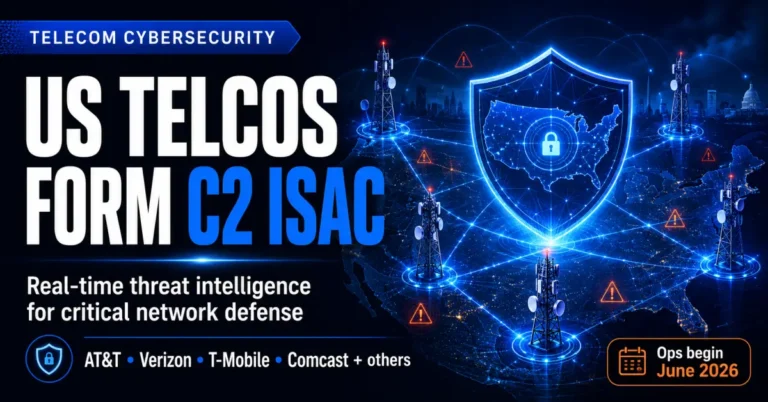
The formation of the Communications Cybersecurity Information Sharing and Analysis Center (C2 ISAC) marks one of the most significant coordinated responses to cyber threats the U.S. telecommunications industry has ever undertaken.

The Eight Founding Carriers and Their Governance Structure
Eight of the most influential names in U.S. communications have come together to establish C2 ISAC as a formal, non-profit entity: AT&T, Charter, Comcast, Cox, Lumen Technologies, T-Mobile, Verizon, and Zayo. These are not peripheral players — collectively, they operate the backbone of America‘s wireline, wireless, and enterprise connectivity infrastructure. The Board of Directors will be composed of the chief information security officers (CISOs) from each founding company, ensuring that strategic cybersecurity leadership is embedded directly into the organization’s governance from day one.
Executive Leadership Rooted in Federal Cybersecurity Experience
Valerie Moon has been appointed as executive director, bringing a career spanning CISA, the FBI, and other federal cyber organizations. Her appointment signals that C2 ISAC is designed to operate at the intersection of private-sector speed and government-grade intelligence — a combination that has historically been difficult to sustain. Rich Baich, serving as inaugural board chairperson, has framed the initiative as a direct response to a threat landscape that is no longer just evolving, but accelerating. C2 ISAC is expected to begin operations in June 2026.
Why Telecom Cybersecurity Coordination Has Become Urgent
The timing of C2 ISAC’s formation is not coincidental — it reflects a convergence of escalating threat vectors, AI-enabled attack sophistication, and the hard lessons learned from recent high-profile breaches targeting critical communications infrastructure.
How AI Is Expanding the Attack Surface Across Telecom Networks
Cyber adversaries are no longer relying solely on conventional intrusion techniques. Artificial intelligence is now being weaponized to automate reconnaissance, generate highly convincing phishing campaigns, and identify zero-day vulnerabilities at scale. For telecom operators managing millions of endpoints, dynamic network slices, and increasingly open architectures like Open RAN, the attack surface has expanded dramatically. No single carrier — regardless of the size of its security team or the sophistication of its tooling — has full visibility into the threat landscape. That structural blind spot is precisely what C2 ISAC is designed to address.
From Government-Coordinated to Industry-Led Cyber Defense
C2 ISAC does not emerge in a vacuum. It builds on the foundation laid by the National Coordinating Center for Communications, also known as COMM-ISAC, which has facilitated government-industry information sharing since 1984. What distinguishes C2 ISAC is its industry-led governance model and its explicit focus on real-time, actionable intelligence sharing among peers who are simultaneously competitors and co-defenders of national infrastructure. This shift from government-coordinated to industry-driven collaboration reflects a maturation in how the sector thinks about collective defense.
What C2 ISAC Means for Network Security Standards and Enterprise Risk
For executives and architects operating across telecom, enterprise IT, and adjacent technology sectors, the emergence of C2 ISAC carries implications that extend well beyond the founding eight members.
How Shared Threat Intelligence Will Tighten Security Requirements Across the Ecosystem
When carriers of this scale align on shared threat intelligence frameworks and coordinated defense strategies, it tends to drive upward pressure on security standards across the broader ecosystem. Vendors, managed service providers, and enterprise customers that rely on these networks should anticipate that security posture requirements — particularly around supply chain integrity, software bill of materials (SBOM) compliance, and incident reporting timelines — will tighten. Organizations that have deferred investment in zero-trust architecture or network detection and response capabilities may find themselves under increasing scrutiny from carrier partners.
C2 ISAC as a Catalyst for Maturing Communications Sector Security Coordination
The communications sector has long been considered critical infrastructure, but its cybersecurity coordination mechanisms have lagged behind sectors like financial services, where ISACs have operated with greater operational maturity. C2 ISAC’s formation signals a recalibration. For enterprise IT leaders and solution architects, this is a moment to reassess how their own organizations engage with sector-specific information sharing bodies — and whether they are positioned to benefit from the intelligence flows that C2 ISAC will generate.
Protecting Distributed 5G and Edge Architectures Through Coordinated Intelligence
The stakes are particularly high in the context of 5G and edge computing deployments. As carriers accelerate network slicing, multi-access edge computing (MEC), and private 5G rollouts, the security perimeter becomes increasingly distributed and complex. A coordinated threat intelligence capability like C2 ISAC could prove critical in identifying and neutralizing threats that exploit the disaggregated nature of next-generation network architectures before they propagate across multiple operators or enterprise tenants simultaneously.
Key Indicators That Will Define C2 ISAC’s Operational Effectiveness
The real measure of C2 ISAC’s impact will be determined not by its formation, but by its operational execution in the months ahead.
Key indicators to monitor include the speed and depth of threat intelligence sharing between members, the mechanisms established for extending participation beyond the founding eight to smaller regional carriers and managed service providers, and whether C2 ISAC develops formal coordination protocols with CISA, the FCC, and international counterparts. The appetite for expanding membership will also be telling — a closed consortium of eight, however powerful, captures only a fraction of the U.S. communications ecosystem.
For telecom strategists and enterprise security leaders, C2 ISAC represents a structural shift worth tracking closely. Collective defense is no longer a concept reserved for government agencies. It is becoming a competitive and operational necessity for the companies that keep the world connected.