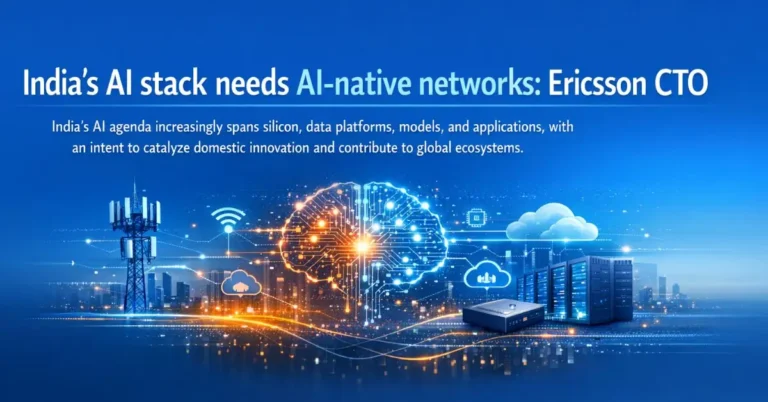
India’s AI ambition demands AI-native networks
Ericsson CTO Erik Ekudden’s take on India’s AI trajectory underscores a full-stack push—and puts advanced networks at the center of value creation.

India’s full-stack AI vision with global reach
India’s AI agenda increasingly spans silicon, data platforms, models, and applications, with an intent to catalyze domestic innovation and contribute to global ecosystems. For telecom leaders, the message is clear: AI is not a bolt-on capability but a system-level transformation that touches RAN, core, transport, cloud, and the enterprise edge. Strength will come from local co-innovation—across operators, vendors, startups, and universities—augmented by global collaboration on standards, tooling, and interoperable architectures.
Networks as the AI substrate for growth
The AI economy runs on connectivity—low-latency access to data, assured bandwidth, location-aware processing, and programmable control. While 5G is already powering AI-enabled services and network automation, the shift toward AI-native 6G will embed intelligence into every layer: sensing, inference, control loops, and energy optimization. The operators that can fuse connectivity, compute, and data into a cohesive platform will set the pace for India’s next wave of digital growth.
AI-native networks in practice
Moving from AI-assisted to AI-native networks demands architectural and operational changes across the telco stack.
5G-Advanced to 6G: intent, autonomy, continuous learning
With 3GPP Release 18/19 (5G-Advanced), the industry is formalizing capabilities like intent-based networking, closed-loop automation, and RAN/Core analytics. In parallel, service management and orchestration (SMO) and RAN Intelligent Controller (RIC) frameworks—championed in the O-RAN Alliance—enable near-real-time optimization via rApps/xApps. The 6G research agenda goes further: native AI/ML pipelines, integrated sensing/communication, and self-optimizing control planes. Expect LLM-powered assistants for operations, dynamic policy engines tied to business intents, and continuous-learning models that adapt to traffic, interference, and energy profiles.
Edge, slicing, and network APIs for enterprise AI use cases
Enterprises building AI agents, digital twins, and real-time analytics will demand deterministic networking and locality of compute. Edge cloud nodes colocated with 5G RAN, combined with network slicing, can assure latency and jitter for safety-critical workloads. Exposure via standardized network APIs (e.g., GSMA Open Gateway/CAMARA) will let developers request QoS, device location, or slice access on demand. Operators that industrialize this “programmable connectivity” with clear SLAs and developer toolchains will expand beyond connectivity into platform revenue.
Data, observability, and MLOps for carrier-grade AI
AI-native operations hinge on robust data engineering: high-fidelity telemetry, feature stores, labeling pipelines, and governance tied to India’s Digital Personal Data Protection (DPDP) Act. Telcos need standardized data models (TM Forum Open APIs/ODF), lineage, and real-time observability across multi-vendor domains. On the ML side, reproducible training, model registries, bias/drift detection, and safe rollout (canary, shadow, rollback) must be built into CI/CD pipelines. Security must span supply chain, models, and runtime, including guardrails against prompt injection and model exfiltration.
Agentic and physical AI: network impact
As AI shifts from content generation to autonomous action, connectivity becomes a design constraint, not an afterthought.
Agentic AI reshapes traffic patterns and control loops
Autonomous agents coordinating workflows, APIs, and devices will require reliable event streams, fine-grained policy enforcement, and fast feedback loops. Expect bursty east–west traffic between edge, regional clouds, and on-prem sites; more importance on publish–subscribe fabrics; and dynamic prioritization via QoS and slices. Deterministic performance for control messages, not just throughput for content, will drive how operators architect transport and MEC placement.
Physical AI demands ultra-low latency and high reliability
Robots, drones, and humanoid systems introduce stringent requirements for ultra-reliable low-latency communications (URLLC), time-sensitive networking (TSN), and precise positioning. 5G already supports TSN integration and industrial-grade reliability; 6G research targets sub-5 ms end-to-end latency, centimeter-level localization, and joint communication-sensing. Enterprises will need co-design of application logic and network policies, with on-site edge for safety functions and wide-area slices for coordination across facilities and fleets.
India’s market dynamics: partnerships, policy, capacity
India’s scale, policy push, and talent pool are aligning—but execution will depend on ecosystems and infrastructure readiness.
Local co-creation with global leverage in India
Vendors like Ericsson are deepening collaboration with Indian operators and universities to accelerate 5G optimization, RAN intelligence, and early 6G research. Joint labs, spectrum trials, and field-grade AI pilots can compress innovation cycles while aligning solutions to India’s cost and scale realities. This collaboration should plug into global standards bodies (3GPP, ETSI, O-RAN Alliance) to ensure interoperability and supplier diversity.
Policy tailwinds and safeguards for AI and networks
Initiatives such as the IndiaAI Mission and Digital Public Infrastructure create demand signals for AI services, while the DPDP Act shapes data governance. Spectrum roadmap clarity, right-of-way acceleration for fiber, and incentives for edge data centers will be pivotal. Harmonizing cross-border data flows with compliance needs will influence where AI training and inference are placed across hyperscale, regional, and on-prem tiers.
Compute, power, and cloud–edge fabric for AI scale
Scaling AI requires GPUs/NPUs, efficient power and cooling, and an elastic cloud–edge continuum. Operators can differentiate by integrating telco cloud (Kubernetes-based NFVI), bare-metal accelerators at the edge, and energy-aware schedulers. Partnerships with hyperscalers and Indian cloud providers should focus on sovereign controls, cost-per-inference optimization, and shared observability across domains.
What telecom leaders should do now on AI-native networks
Translate AI ambition into a pragmatic execution roadmap that ties architecture, operating model, and commercial strategy.
Build the AI-native network foundation
– Upgrade to 5G-Advanced features and RIC/SMO architectures; standardize data pipelines across RAN, core, transport.
– Deploy edge zones at high-demand sites; productize slices and Open Gateway APIs with developer-friendly SLAs.
– Establish telco-grade MLOps with model governance, safety guardrails, and cross-vendor observability.
Monetize with enterprise-aligned AI offers
– Package connectivity, edge compute, and AI toolchains for sectors like manufacturing, logistics, and smart cities.
– Co-create proofs with universities and ISVs on agentic and physical AI; define repeatable blueprints.
– Tie pricing to outcomes (uptime, cycle time, yield) and expose network telemetry for enterprise analytics.
Manage AI risk and operational readiness
– Align with DPDP compliance, supply-chain security, and AI assurance frameworks.
– Plan for power density and cooling; diversify accelerator supply; adopt energy-aware RAN features.
– Track 3GPP timelines for Release 18/19 and 6G research milestones to sequence investments.
Bottom line: India’s AI ambition can deliver outsized impact if the industry treats the network as the AI substrate—evolving 5G into AI-native architectures, productizing edge and APIs, and scaling through local partnerships with global interoperability.