

GDPR

Vodafone Business and Google Cloud expanded their $1 billion, ten-year partnership with two launches aimed squarely at small and mid-sized businesses: a managed detection and response service and an agentic AI concierge. Vodafone Business and Google Cloud are packaging hyperscaler security analytics and agentic AI into carrier-delivered services that SMBs can adopt quickly. The launch markets, technology choices, and managed wrap indicate a pragmatic path to better protection and always-on customer engagement. Leaders should pilot now with tight KPIs, validate compliance early, and build an integration roadmap that scales across markets as the offer expands through Europe.
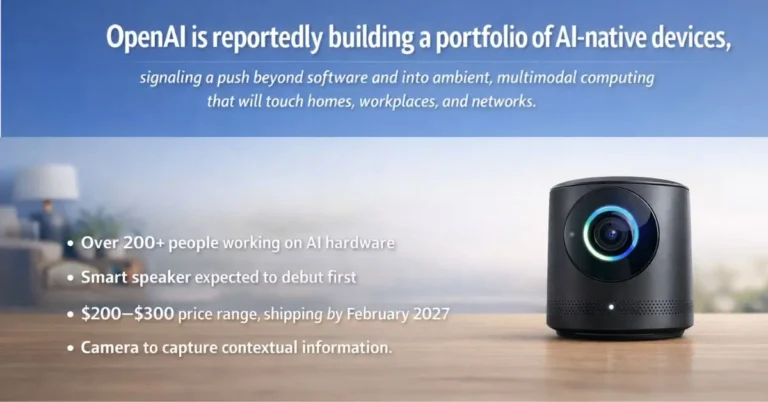
OpenAI is reportedly building a portfolio of AI-native devices, signaling a push beyond software and into ambient, multimodal computing that will touch homes, workplaces, and networks. Multiple reports indicate OpenAI has over 200 people developing a family of AI-enabled hardware, with a smart speaker expected to debut first. Early guidance points to a price in the $200–$300 range and a ship window no earlier than February 2027. The device is said to include a camera to capture contextual information about users and surroundings—an explicit bet on multimodal AI that fuses voice, vision, and environment for richer interactions.
A new partnership between Telefónica Tech and Fermax brings managed 4G IoT connectivity to video door entry systems across Spain, France, and Portugal, turning access control into a connected service. Fermax, a long-standing leader in video door entry and access control, has selected Telefónica Tech to connect its new generation of panels via mobile networks. Telefónica Tech is delivering managed IoT connectivity through its Kite platform, providing centralized visibility and real-time control of devices equipped with 4G modules and non-removable SIM-IoT cards.
Two German heavyweights are in advanced discussions to co-build large-scale AI data centre capacity in Germany, a move that would tap European Union funding and accelerate sovereign AI infrastructure. Deutsche Telekom and the Schwarz Group are exploring a joint bid to develop EU-supported “AI Gigafactory” facilities, data centres purpose-built for high-density AI training and inference. According to multiple reports, the talks are well progressed but not yet final. Infrastructure investor Brookfield has been flagged as a potential financial partner alongside EU capital, adding balance-sheet depth and construction expertise to the consortium.
Deutsche Telekom’s T-Systems has secured a multi-million-euro contract from Leibniz University Hannover to power SOOFI, a flagship initiative to build a 100-billion-parameter, European-operated large language model. The SOOFI (Sovereign Open Source Foundation Models) project will train a next-generation, open-source LLM focused on European languages and industrial requirements, replacing the current 7-billion-parameter Teuken7B with a model two orders of magnitude larger. T-Systems will host and operate the training environment in its new Industrial AI Cloud—an NVIDIA-powered facility that DT and NVIDIA unveiled as part of a €1 billion partnership.
Cisco’s intent to acquire Seattle-based NeuralFabric signals a decisive shift toward practical, domain-specific AI that meets real-world constraints around data, compliance, and infrastructure. Cisco plans to acquire NeuralFabric, an enterprise AI platform focused on building small language models (SLMs) from proprietary data with deployment across SaaS and on-premises environments. By focusing on SLMs trained on enterprise data and deployable in hybrid environments, Cisco aims to shorten time-to-value while keeping control where it belongs—inside the business. They reduce inference cost, improve latency, and can be deployed on-premises or at the edge—critical for sectors like telecom, financial services, and healthcare.
Alphabet will invest €5.5 billion in Germany through 2029 to expand AI-capable cloud infrastructure and office capacity, anchoring new buildouts in the Frankfurt Rhine-Main region. Google will construct a new data center in Dietzenbach, near Frankfurt, and continue scaling its Hanau campus opened in 2023. With Frankfurt’s role as Europe’s interconnection hub—home to DE-CIX—placement in Rhine-Main positions Google to serve latency-sensitive AI, analytics, and financial services workloads. Google Cloud will bring expanded capacity for services such as Vertex AI and Gemini models into its German regions, enabling enterprises to run training, fine-tuning, and inference closer to users and data.
Germany’s largest operator is turning e-waste into engagement currency with a take-back drive that mixes material recovery with headline incentives. Deutsche Telekom estimates 195 million unused phones are sitting idle in Germany, locking up valuable materials and ESG progress. The company is reframing those devices as an urban mine—rich in gold, copper, and critical minerals—and as a lever to scale circularity ahead of its 2030 ambition to make all IT and network technology, and most end-user devices, recyclable or reusable. By the end of 2024, the operator had already taken back more than 11 million phones across the group.
Sweden’s largest passenger rail operator SJ is consolidating its communications estate with Telia to accelerate 5G, IoT, and crisis-readiness across trains, stations, depots, and corporate operations. The partnership positions Telia as SJ’s primary provider for nationwide mobile and fixed communications, combining public 5G/LTE coverage with managed services that support day‑to‑day rail operations and passenger experience. For passengers, more consistent Wi‑Fi backhaul and seamless digital services are the immediate wins; for operations, the prize is reliability and faster recovery when incidents occur. European operators are scaling beyond discrete connectivity pilots toward platforms that unify onboard systems, station sensors, and back‑office analytics.
A sprawling social engineering campaign tied to the Lapsus$/Scattered Spider/ShinyHunters ecosystem is extorting enterprises after allegedly siphoning close to a billion records from Salesforce customer environments. Attackers claim broad theft of personally identifiable information from organizations that use Salesforce, while the vendor states its core platform and code were not breached. Evidence points to identity-led social engineering, followed by misuse of sanctioned tools and APIs to quietly extract large data volumes. For telecom and enterprise IT, CRM data now sits on the front line of extortion economics, raising urgent questions about identity controls, SaaS hardening, and third-party risk.
AI is everywhere in telecom, yet most pilots never make it into production because the industry’s data, tooling, and operating models are not ready for scaled automation. Recent industry research suggests that about 95% of AI pilots in telecom fail to scale beyond proofs of concept. Leaders are moving from pilots to platforms by embedding AI in the systems that run the business and anchoring every initiative to measurable outcomes. Telecom AI will not scale through pilots alone; it scales when embedded in the systems that run revenue, experience, and networks.
Two narratives are converging: Silicon Valley’s rush to add gigawatts of AI capacity and a quiet revival of bunkers, mines, and mountains as ultra-resilient data hubs. Recent headlines point to unprecedented AI infrastructure spending tied to OpenAI. The draw is physical security, thermal stability, data sovereignty, and a narrative of longevity in an era where outages and cyber‑physical risks are rising. Geopolitics, regulation, and escalating outage impact are reshaping site selection and architectural choices. The AI build‑out collides with grid interconnection queues, water scarcity, and rising scrutiny of carbon and noise. Set hard thresholds on PUE and WUE; require real‑time telemetry and third‑party assurance.
Sponsored by Palo Alto Networks
⚡ Utilities ⏱ 8 min ✓ Free
This tool is built and hosted by TeckNexus.
Launch Tool →
Whitepaper
Airports are deploying AI surveillance, biometrics, and autonomous vehicles faster than most networks can secure them. See what 100 real-world airport deployments reveal about the airside/landside security gap — and the 4-layer framework built to close it....
Palo Alto Networks
Scroll to Top