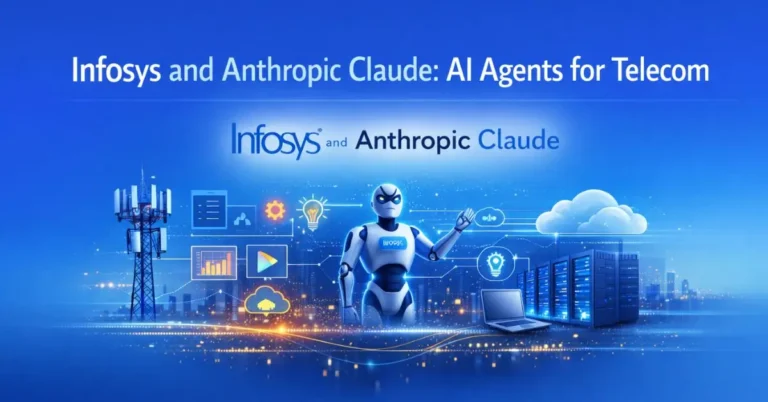
Infosys and Anthropic partner on AI agents for telecom
A new partnership between Infosys and Anthropic brings agentic AI into regulated, process-heavy industries, with telecom squarely in scope.

Partnership scope and rollout
Infosys will integrate Anthropic’s Claude models and Claude Code with its Topaz portfolio to build and operate enterprise-grade AI solutions across telecom, financial services, manufacturing, and software engineering. The collaboration emphasizes agentic AI—systems that can plan, call tools, and execute multi-step workflows with oversight—delivered with the controls, auditability, and policy enforcement that regulated sectors demand. Infosys is among Anthropic’s first scaled partners in India as Anthropic expands its presence in the market, where developer adoption of Claude is growing rapidly for application development and system modernization.
Telecom drivers for AI adoption now
Telcos are under pressure to cut opex, accelerate product delivery, and monetize networks as 5G, fiber, and edge scale. Legacy OSS/BSS stacks, fragmented data, and stringent compliance slow progress. Agentic AI can orchestrate complex back-office tasks, triage incidents, and modernize codebases—without ripping and replacing everything at once. Pairing Infosys’s domain depth with Claude’s reasoning and long-context capabilities gives operators a path to pragmatic automation that respects regulatory, safety, and transparency requirements.
Claude + Infosys Topaz: governed agent stack
The joint stack combines Claude for reasoning and code generation with Infosys Topaz’s accelerators, governance, and delivery frameworks.
Governed AI agents with policy and audit
The collaboration targets AI agents that can persist across long-running tasks like compliance reviews, claims processing, or order fallout remediation. Infosys plans to use Anthropic’s model family and Agent SDK for tool-use orchestration, policy controls, and human-in-the-loop checkpoints. Expect integration patterns that log every action, enforce separation of duties, and bind agents to enterprise policies—key for audits. For global deployments, availability of Claude via platforms such as Amazon Bedrock and Google Cloud’s Vertex AI helps align with data residency and security requirements.
Faster modernization with Claude Code
Claude Code is positioned to accelerate modernization and software delivery. Infosys can apply it to refactor legacy services, generate tests, port code, and document APIs—reducing technical debt in OSS/BSS, mediation, and billing stacks. Coupled with Topaz delivery blueprints, teams can stand up bounded pilots, codify guardrails, and move to production faster than traditional modernization programs. For telcos wrestling with COBOL, PL/SQL, or monolithic Java estates, this is a tangible path to incremental decomposition.
High-impact telecom AI use cases
Early value will come from automating repeatable, rules-heavy processes that span multiple systems and teams.
AI for OSS/BSS modernization and ODA migration
AI agents can assist with inventory normalization, catalog mapping, and migration of product definitions when shifting toward TM Forum Open Digital Architecture (ODA) or introducing new CPQ and order management systems. Code agents help translate integration logic to TM Forum Open APIs, generate test harnesses, and produce lineage documentation. The outcome is lower risk during phased cutovers and faster time to sunset legacy modules.
AI agents for NOC and assurance
NOCs can deploy agents for incident summarization, root-cause hypothesis generation, and auto-remediation playbooks that leverage telemetry from 3GPP-compliant management interfaces, SDN controllers, and vendor OSS. Agents can open, enrich, and resolve tickets; simulate change impacts; and escalate with recommended actions. Over time, closed-loop automations can fuse LLM reasoning with existing rules engines and AIOps, improving MTTR while preserving control through human approval gates.
AI for care, sales, and revenue ops
In care and sales, agents can handle intent detection, next-best-action, and personalized troubleshooting using knowledge retrieval from policy catalogs and device manuals. In the back office, they can perform KYC checks, contract variance analysis, and compliance reviews—useful for B2B, wholesale, and SLA-heavy accounts. For partner ecosystems, aligning with GSMA Open Gateway and MEF LSO interfaces allows agents to expose standardized capabilities and speed interop.
Risks and mitigation for compliant telecom AI
Success hinges on controlling model behavior, securing data flows, and proving ROI with disciplined change management.
Reliability, explainability, and compliance
LLMs can hallucinate or overgeneralize. Mitigate with retrieval-augmented generation for authoritative answers, tool-use for structured tasks, and strict grounding to network and policy systems of record. Enforce human-in-the-loop for high-risk actions, and maintain audit logs of prompts, tools invoked, and outcomes. Align governance with regulatory expectations on explainability, fairness, and records retention across jurisdictions.
Data security, access control, and integration
Protect PII and network-sensitive data through data minimization, redaction, and attribute-based access controls. Deploy models through enterprise channels that support encryption, key management, and regional hosting. Integrate via TM Forum Open APIs and event buses to reduce bespoke connectors, and isolate agent execution with well-scoped permissions to OSS/BSS, ticketing, and CI/CD systems.
Change management, KPIs, and ROI
Start with clear KPIs: MTTR reduction, first-contact resolution, order fallouts avoided, or modernization velocity. Redesign workflows to embed agents rather than simply bolting on chat. Retrain teams on agent supervision and exception handling. Track cost-to-serve and defect rates to guide expansion from pilot to scale.
Telecom next steps: roadmap and pilots
Operators should translate the partnership’s capabilities into a concrete roadmap with staged value and hard guardrails.
Prioritize workflows and agent roles
Prioritize 3–5 workflows where policy is codified, data is available, and business impact is measurable—incident triage, order orchestration, and test automation are common starts. Define roles for planner, executor, and reviewer agents, and map them to existing tools and APIs.
Launch guardrailed pilots with RAG and HITL
Use Topaz blueprints and Claude Agent SDK to launch bounded pilots with synthetic data, RAG over approved knowledge, and human approval steps. Incorporate offline evaluation, red-teaming, and bias testing before moving to production traffic. Budget early for observability and prompt/runtime governance.
Track models, clouds, and standards
Track Infosys’s accelerators for TM Forum ODA and Open APIs, Anthropic model updates, and availability via Amazon Bedrock and Google Cloud regions that match your data residency. Monitor alignment with GSMA Open Gateway and MEF LSO to extend agents across partner networks. Expect rapid iteration in tool-use, long-context windows, and cost-performance that will widen eligible workloads.
The Infosys–Anthropic tie-up signals a shift from generic chatbots to governed, multi-step AI agents embedded in telco operations; leaders who pair domain-safe design with disciplined pilots will move fastest from proofs to production value.