Connected Aviation

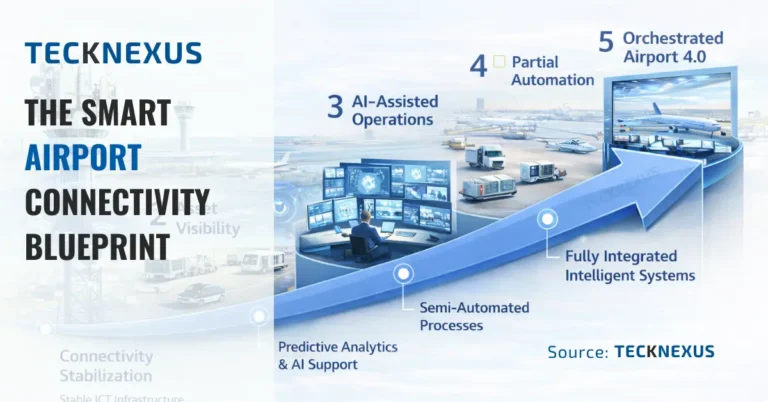
From Singapore to Schiphol, airports are embracing private networks for airports alongside AI and digital twins to drive operational efficiency, predictive maintenance, sustainability, and smarter passenger flows. This article explores 12 real-world deployments showcasing how private network deployments for aviation are shaping the future of Airport 4.0 globally.
Connectivity is transforming aviation from the ground up. Airports are deploying private 5G, Wi-Fi 6, edge computing, and IoT to deliver two major outcomes: smoother passenger experiences and lower operating costs. Travelers enjoy real-time updates, biometric check-in, and AR wayfinding — while operators benefit from predictive maintenance, smarter gate usage, and energy optimization. This dual-value framework positions connectivity as more than infrastructure, it’s a strategic differentiator that enhances revenue, reduces OPEX, and elevates the brand.
Aviation is no longer a siloed industry - it’s a globally connected ecosystem where airports, airlines, regulators, telecom operators, and tech vendors must work in sync. As digital transformation accelerates, connectivity becomes a critical layer for collaboration, enabling real-time decision-making, safety, operational alignment, and a seamless passenger experience. From private 5G and edge computing to biometric boarding and IoT, the aviation industry must co-invest, co-develop, and co-govern digital infrastructure. Case studies from Heathrow, Changi, and DFW show that stakeholder alignment leads to measurable gains in efficiency, innovation, and trust. Connectivity is the enabler, but collaboration is what makes it scalable and sustainable.
Airport ground operations — from baggage handling and fueling to aircraft turnaround - are undergoing rapid digital transformation. Powered by IoT, automation, private 5G, and edge computing, airside workflows are becoming more predictive, efficient, and sustainable. Sensors track assets, optimize vehicle dispatch, and enhance worker safety. Autonomous tugs, computer vision, and AI-driven maintenance cut delays and reduce manual errors. Private networks and edge computing provide the real-time connectivity needed for mission-critical applications. Leading airports like Schiphol, Changi, and DFW are already adopting these technologies, proving that digital transformation on the ground isn't just possible, it's essential for next-gen airport performance.
Airports are shifting from physical-first to connectivity-first infrastructure. Legacy systems are no longer enough to manage modern expectations for speed, safety, and digital experience. Leading airports are deploying Wi-Fi 6, 5G, private mobile networks, and edge computing — not as standalone upgrades but as a hybrid network foundation. Each technology serves a purpose: Wi-Fi 6 supports high-density passenger areas; public 5G offers mobile bandwidth for travelers; private networks ensure operational reliability; and edge computing enables real-time decision-making. Together, they form a resilient architecture built for scalability, cybersecurity, and future growth. Airports like Heathrow, Changi, and DFW are already implementing these layers, proving that connectivity is now core infrastructure, just like runways or terminals.
Airport terminals are evolving into connected, intelligent environments powered by biometrics, IoT, and scalable infrastructure. These technologies are helping airports manage increasing passenger volumes, improve security, and deliver seamless experiences. From facial recognition at check-in to IoT-based baggage tracking and AR navigation, the connected terminal offers faster processing, predictive safety, and energy-efficient operations. Scalable, cloud-native systems future-proof infrastructure for demand surges and enable rapid integration of emerging tech like AI, digital twins, and virtual queuing. As global air travel rebounds, the connected terminal represents a blueprint for smarter, safer, and more sustainable airport growth.
Airports are no longer just transit points - they’re evolving into intelligent, connected environments powered by AI, private 5G, and digital twins. These technologies enable predictive maintenance, real-time baggage tracking, and biometric check-ins, while optimizing operational efficiency and sustainability. Private 5G ensures low-latency, high-reliability communication across airport systems, from autonomous luggage handling to AR-powered passenger navigation. Digital twins create real-time simulations of airport environments, helping operators plan, respond, and allocate resources more effectively. This digital transformation is redefining how passengers experience travel — with less stress, fewer delays, and more personalization, while equipping operators with tools to boost resilience, performance, and environmental responsibility.
Connected aviation is transforming airports with secure private networks, IoT, and real-time data. This article unpacks how smart airports boost efficiency, safety, and passenger experience while unlocking new business value with real-world case studies from Heathrow, Changi, Dubai, and more.
Connected aviation is reshaping airports into smart, seamless ecosystems inside and outside the terminal. This case study reveals how hubs like Changi, Schiphol, and SAN use private networks, IoT, and cross-team collaboration to improve passenger flow, airside operations, sustainability, and safety.
Connected aviation is reshaping airports with autonomous systems, from security drones to robotic baggage vehicles and self-driving tugs. Automation improves safety, cuts turnaround times, and delivers a smoother passenger experience. Learn how airports use AI and robotics to stay competitive.
IoT and digital transformation are reshaping aviation by turning traditional airports into smart, data-driven ecosystems. From predictive maintenance to autonomous vehicles and real-time passenger insights, connected sensors and AI power safer, more efficient, and sustainable airport operations.
Connected aviation is transforming airports into smart cities in the sky. With private LTE and 5G networks, airports ensure safe, secure, and efficient operations for billions of passengers, enabling automation, smart security, terminal digitization, and sustainable growth.

Partner Hubs

Download content, access intelligence tools, and hear from executives.

Partner Events

  • M360 ASEAN
  • FutureNet Asia 2026
  • Network X Vienna 2026
Scroll to Top