




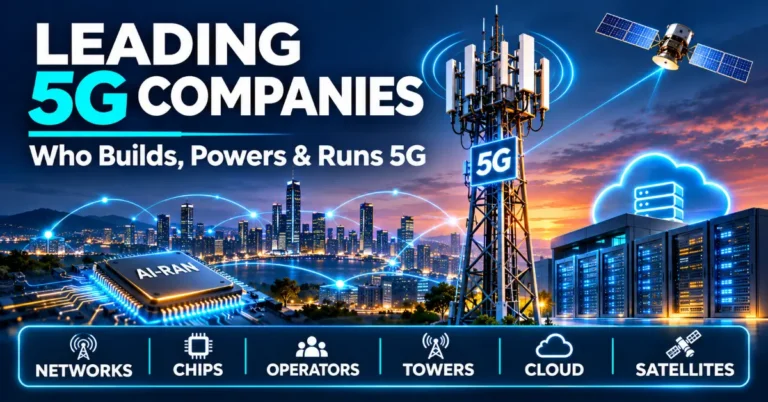
Who Are the Leading 5G Companies in 2026?
The leading 5G companies in 2026 are Ericsson, Nokia, Huawei, ZTE and Samsung in network equipment; Qualcomm, MediaTek and NVIDIA in chipsets and AI–RAN; China Mobile, Reliance Jio, T-Mobile, Verizon and AT&T among operators; American Tower, Cellnex and Crown Castle in towers; AWS and Microsoft in telco cloud and edge; and SpaceX, AST SpaceMobile and Amazon in satellite direct-to-device.

This guide focuses on what each company does in 5G today, backed by named market data, rather than on investment picks. For deals reshaping this list, see our Telecom and Tech M&A Tracker.
Explore the Leading 5G Companies by Category
This guide is the overview. Each category below has its own in-depth TeckNexus guide with full company profiles.
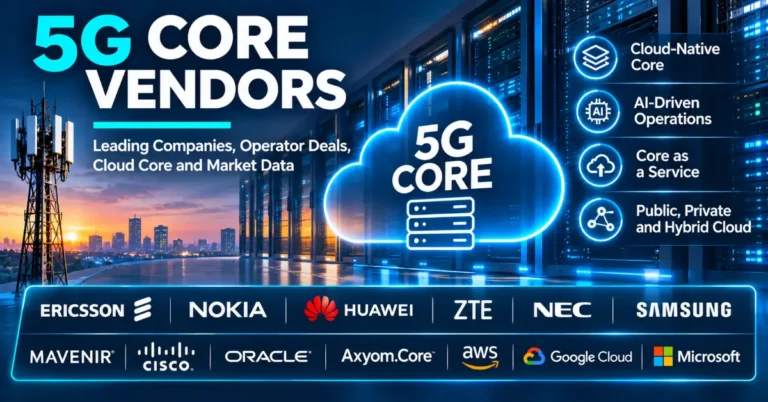
- 5G core vendors: the companies supplying 5G standalone cores, from Ericsson, Nokia and Huawei to cloud-native challengers.
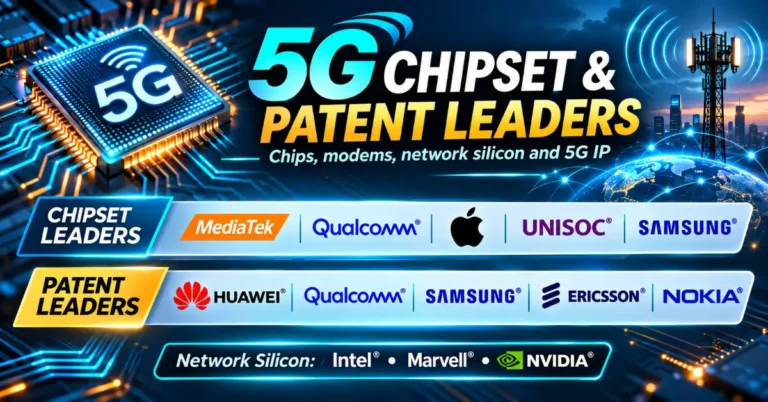
- 5G chipset and patent leaders: who makes 5G modems and network silicon, and who holds the most 5G standard essential patents.
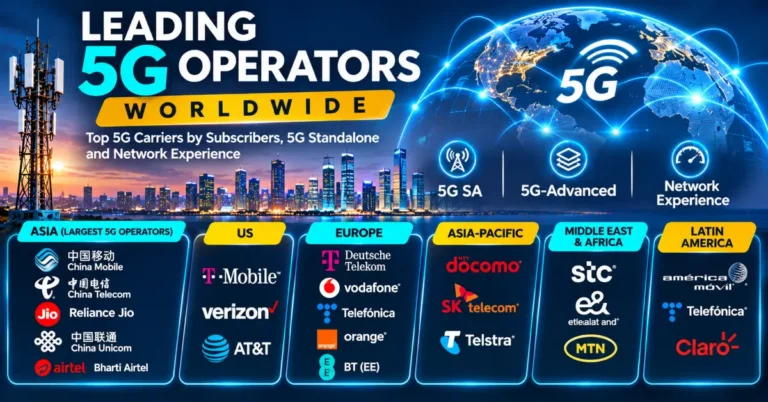
- Leading 5G operators worldwide: the largest 5G carriers by subscribers and the leaders in 5G standalone, 5G-Advanced and network experience, region by region.
- Open RAN vendors by category: radio, software, integration and RIC suppliers, plus Open RAN deployments by country and operator.
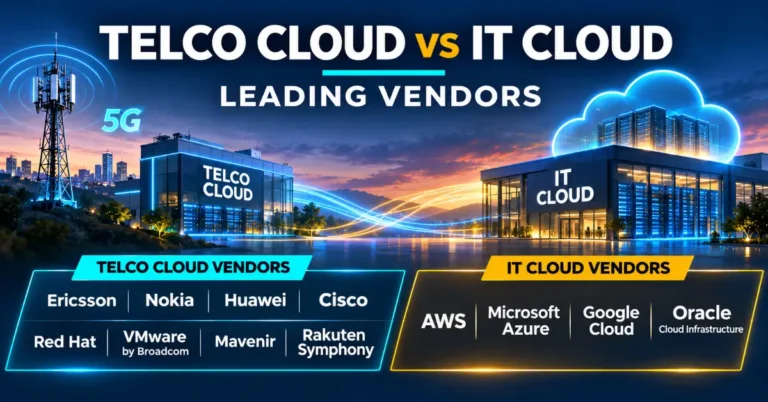
- Telco and IT cloud vendors: the hyperscalers, cloud platforms and IT companies running telco workloads.
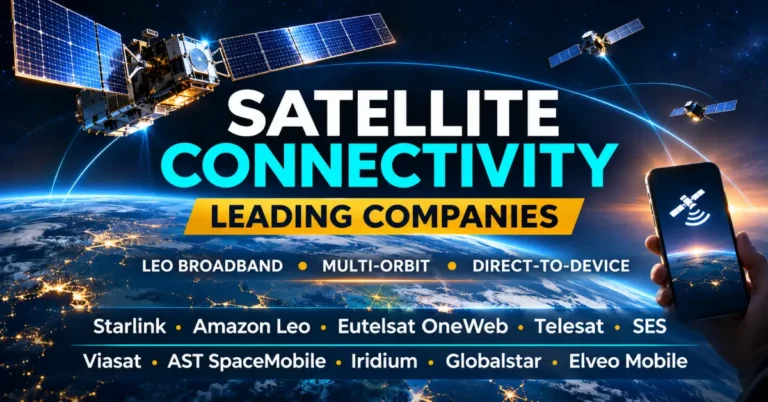
- Satellite connectivity companies: satellite broadband and direct-to-device operators joining mobile coverage.
- Private network ecosystem players: the vendors, integrators and operators building private 5G and LTE networks for enterprises.
- 5G towers and tower companies: the largest tower owners worldwide, plus our explainer on macro cells, small cells and DAS.
Why the Leading 5G Companies Matter Now
5G has moved from launch to maturity. Most of the world’s large operators have switched it on, and the competitive questions are now about standalone (SA) cores, network slicing, fixed wireless access (FWA), AI in the radio network and satellite coverage. The companies below shape how quickly each of those arrives.
Three shifts are reshaping which companies lead 5G.
- From coverage to capability: 5G SA, slicing and 5G-Advanced now separate operators more than headline coverage does.
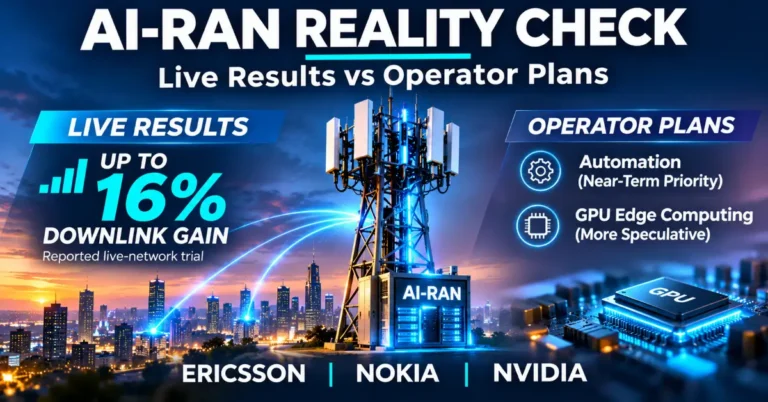
- AI enters the radio network: AI-RAN brings GPU computing to cell sites, adding chip companies to the RAN supplier conversation.
- Satellites join the 5G map: direct-to-device services and spectrum deals have made satellite operators part of mobile coverage plans.
How We Selected the Leading 5G Companies
Companies were included on three criteria, using public data available in November 2026.
- Scale in 5G, measured by market share, subscribers, sites or deployments reported by the company or an independent analyst.
- A distinct role in a 5G category: network equipment, chipsets, operators, towers, cloud and edge, or satellite.
- Visible 2026 activity, such as new contracts, launches or transactions.
Within each category, companies are listed by reported scale where data allows. Figures are company-reported unless an analyst source is named.
Leading 5G Network Equipment Companies
The radio access network (RAN) is where most 5G capex goes, and five vendors dominate it. Dell’Oro Group’s ranking by worldwide RAN revenue has been unchanged through 2025 and 2026, and its Q3 2026 report notes that Ericsson’s share for the first three quarters of 2026 is up about one percentage point on 2025.
| Company | Headquarters | Role in 5G in 2026 | Proof point |
| Huawei | China | Largest RAN supplier by worldwide revenue; end-to-end 5G RAN, core and transport | Ranked first by Dell’Oro in 2025 and H1 2026 |
| Ericsson | Sweden | Largest RAN vendor outside China; RAN, 5G core, network APIs and private 5G | Ranked second by Dell’Oro; publishes the Ericsson Mobility Report |
| Nokia | Finland | RAN, core, optical and IP networks; anyRAN software for Cloud RAN and AI-RAN | Ranked third; AI-RAN pilots with T-Mobile, BT, Deutsche Telekom, Elisa and Orange |
| ZTE | China | RAN, core and transport, with a growing AI computing business | Ranked fourth by Dell’Oro |
| Samsung Networks | South Korea | vRAN and Open RAN, AI-RAN and private 5G | Ranked fifth; signed contracts with KT and SK Telecom in September 2026 |
Leading 5G Chipset and AI-RAN Companies
Chip companies power 5G in two places: in devices, through modems and system-on-chips, and increasingly in the network itself, through accelerated computing for AI-RAN.
| Company | Headquarters | Role in 5G in 2026 | Proof point |
| Qualcomm | United States | Snapdragon 5G modems and mobile platforms; RF front end; expanding into data centre | Snapdragon platforms power many flagship Android phones |
| MediaTek | Taiwan | Dimensity 5G system-on-chips for smartphones, tablets and FWA devices | Largest 5G smartphone chipset supplier by shipments in Q3 2026 (Counterpoint) |
| Apple | United States | In-house C1-series 5G modems | Used in iPhone 16e, iPhone Air and iPad Pro |
| UNISOC | China | 5G system-on-chips for entry-level and mid-range phones | Fourth-largest 5G smartphone chipset supplier in Q3 2026 (Counterpoint) |
| NVIDIA | United States | Aerial RAN Computer (ARC) platform for AI-RAN; invested $1 billion in Nokia in 2025 | With Nokia and T-Mobile, completed the first AI-RAN call on a commercial network |
Our 5G chipset and patent leaders guide covers market shares, network silicon and the 5G patent rankings.
Leading 5G Mobile Operators
Operators are where 5G becomes a service. The largest 5G operators by subscribers are in China and India, while US operators lead in FWA and standalone-based services.
| Company | Headquarters | Role in 5G in 2026 | Proof point |
| China Mobile | China | World’s largest mobile operator by customers | 687 million 5G network customers at end-June 2026; 702 million at end-September |
| Reliance Jio | India | Largest 5G operator outside China; 5G SA network and JioAirFiber FWA | 300 million 5G users and 15.1 million AirFiber subscribers at end-September 2026 |
| T-Mobile US | United States | Nationwide 5G SA, network slicing (T-Priority) and AI-RAN trials | First AI-RAN call on a commercial network with Nokia and NVIDIA |
| Verizon | United States | 5G Ultra Wideband, FWA and private 5G; AWS Wavelength edge partner | AWS Wavelength’s partner for edge zones in the US |
| AT&T | United States | 5G and FWA (AT&T Internet Air), expanded with mid-band and low-band spectrum bought from EchoStar | FCC approved the EchoStar spectrum purchase in May 2026 |
Our leading 5G operators worldwide guide profiles operators across Europe, Asia Pacific, the Middle East, Africa and Latin America. Enterprises comparing operator 5G with their own networks can use our guide to private versus public wireless networks and our map of private network ecosystem players.
Leading 5G Tower and Infrastructure Companies
Towercos host the radios that operators deploy, and their leasing activity is a useful indicator of 5G densification. Our guide to 5G towers and tower companies ranks the largest owners globally, and our macro cells, small cells and DAS explainer covers the infrastructure types.
| Company | Headquarters | Role in 5G in 2026 | Proof point |
| American Tower | United States | Global multitenant towers plus US data centres | Over 148,000 communications sites |
| Cellnex | Spain | Europe‘s largest independent tower company, active in 10 countries | 115,476 sites at end-June 2026; H1 2026 results |
| Crown Castle | United States | Only large US-focused, publicly traded pure-play tower company | Completed sale of fibre and small cells in May 2026; about 40,000 towers |
| SBA Communications | United States | Towers in the Americas, refocusing on core markets | Sold its Chile and Ecuador towers in September 2026 |
Leading 5G Cloud and Edge Companies
Hyperscalers bring cloud services to the edge of operator networks and host parts of the 5G core.
| Company | Headquarters | Role in 5G in 2026 | Proof point |
| Amazon Web Services | United States | AWS Wavelength edge zones inside operator networks; telco workloads on AWS | Wavelength partners include Verizon, Vodafone, KDDI, SK Telecom, Bell and BT |
| Microsoft | United States | Azure Operator Nexus hybrid cloud platform for network functions | AT&T runs its 5G near-edge network functions on Operator Nexus |
Leading Satellite and Direct-to-Device 5G Companies
Satellite-to-phone services are the newest category in this list. GSA counts 97 operators investing in direct-to-device satellite technology, and spectrum has become the deciding asset.
- SpaceX (Starlink): acquired EchoStar’s AWS-4 and H-block spectrum (FCC-approved in May 2026) and agreed in October 2026 to buy Grain Management’s 800MHz spectrum for a hybrid satellite and terrestrial Starlink Mobile service.
- AST SpaceMobile: building a space-based cellular broadband network that connects directly to standard phones, with operator partners including AT&T and Verizon.
- Amazon: agreed in April 2026 to acquire Globalstar to add direct-to-device services to Amazon Leo.
- Elveo Mobile: formed in August 2026 from the merger of Lynk Global and Omnispace, combining Lynk’s satellites with Omnispace’s S-band spectrum.
Our satellite connectivity companies guide covers the wider satellite market.
Listed 5G Companies at a Glance
Readers often ask where these companies are listed. The table below gives primary listings for reference only; it is not investment advice.
| Company | Category | Primary listing |
| Ericsson | Network equipment | Nasdaq Stockholm (ERIC B); Nasdaq US (ERIC) |
| Nokia | Network equipment | Nasdaq Helsinki (NOKIA); NYSE (NOK) |
| ZTE | Network equipment | Shenzhen (000063); Hong Kong (0763) |
| Samsung Electronics | Network equipment, chips, devices | Korea Exchange (005930) |
| Huawei | Network equipment | Not listed (employee-owned) |
| Qualcomm | Chipsets | Nasdaq (QCOM) |
| MediaTek | Chipsets | Taiwan Stock Exchange (2454) |
| NVIDIA | AI-RAN computing | Nasdaq (NVDA) |
| China Mobile | Operator | Hong Kong (0941); Shanghai (600941) |
| T-Mobile US | Operator | Nasdaq (TMUS) |
| Verizon | Operator | NYSE (VZ) |
| AT&T | Operator | NYSE (T) |
| American Tower | Towers | NYSE (AMT) |
| Crown Castle | Towers | NYSE (CCI) |
| SBA Communications | Towers | Nasdaq (SBAC) |
| Cellnex | Towers | Bolsa de Madrid (CLNX) |
| Amazon | Cloud and satellite | Nasdaq (AMZN) |
| Microsoft | Cloud | Nasdaq (MSFT) |
| AST SpaceMobile | Satellite D2D | Nasdaq (ASTS) |
The 5G Market in 2026 by the Numbers
These industry figures set the context for the company rankings that follow.
| Indicator | Figure | Source |
| Global 5G subscriptions | 3.1 billion at the end of Q1 2026 after 162 million additions; close to 3.3 billion after Q2 | Ericsson Mobility Report, June 2026 |
| 5G subscriptions forecast | Two-thirds of all mobile subscriptions expected to be 5G by the end of 2031 | Ericsson subscriptions outlook |
| Operators with launched 5G networks | 392, up 14% from March 2025 | GSA State of the Market, April 2026 |
| Operators with 5G standalone service | 95, up 42% since Q1 2025 | GSA, April 2026 |
| Commercial 5G SA slicing offerings | 84 worldwide, up from 65 in November 2025 | Ericsson Mobility Report, June 2026 |
| RAN vendor concentration | Huawei, Ericsson, Nokia, ZTE and Samsung held 96% of the RAN market in H1 2026 | Dell’Oro Group, August 2026 |
Six Shifts Reshaping the Leading 5G Companies
Six developments explain how the leading 5G companies are changing as the market moves from rollout to maturity.
- EchoStar becomes a hybrid operator: after selling spectrum to AT&T and SpaceX, EchoStar’s Boost Mobile now operates as a hybrid mobile network operator, running its own 5G core on AT&T’s radio network.
- Chips move into the network: NVIDIA’s AI-RAN platform and its investment in Nokia have added accelerated computing to the RAN supplier list.
- Apple builds its own modems: Apple’s C1-series modems are now in several iPhone and iPad models.
- Towers refocus: Crown Castle became a pure-play tower company, American Tower exited several markets, and the Cellnex portfolio passed 115,000 sites.
- Hyperscalers narrow their telco role: Microsoft wound down its Affirmed Networks core portfolio and focuses on Azure Operator Nexus, while AWS has extended Wavelength with more operator partners.
- Satellite becomes a 5G category: spectrum purchases by SpaceX and Amazon’s Globalstar deal have brought satellite operators into mobile coverage strategies.
For more analysis like this, subscribe to the TeckNexus Newsletter, explore our 2027 programs, or partner with us to share your perspective and generate leads.