




Who Are the 5G Chipset and Patent Leaders in 2026?
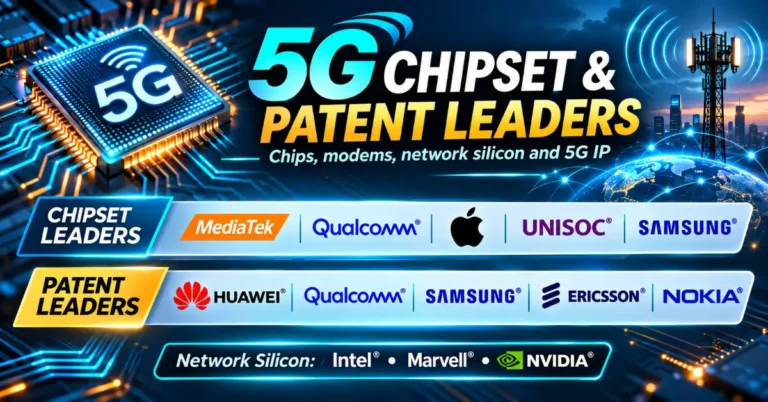
MediaTek and Qualcomm lead 5G smartphone chipsets, with Apple, UNISOC and Samsung next as more phone makers design their own chips. In 5G patents, Huawei, Qualcomm, Samsung and Ericsson lead the 2026 rankings, with Ericsson and Nokia ranking second and third for contributions to the 3GPP standard. In network silicon, Intel, Marvell and Nvidia supply the chips inside 5G base stations alongside Ericsson’s own designs.

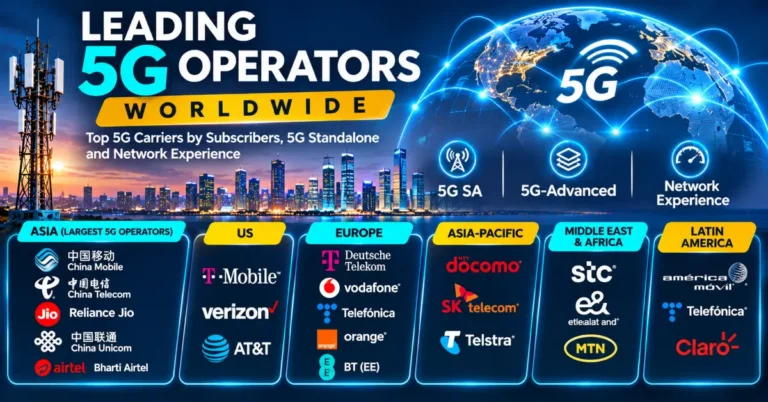
Chipsets and patents are two sides of the same leadership. Chip companies decide which 5G features reach devices and when, while patent owners shape the standard itself and collect royalties on every 5G device sold. This guide is part of our series on the 5G ecosystem; see also our guides to 5G core vendors and Open RAN vendors by category, and our 5G companies infographic.

Why 5G Chipset and Patent Leadership Matters
Four forces make 5G silicon and patents a strategic issue in 2026, not just a technical one.
- Phone makers are bringing chips in-house. Apple now ships its own 5G modem in its Pro iPhones, and Samsung and Google are taking more of their own chip supply, which reshapes the market for MediaTek and Qualcomm.
- 5G-Advanced and 6G are being defined now. The companies that contribute most to 3GPP Releases 18, 19 and 20 will hold the patents and the product lead for the next decade.
- Patent royalties are a large, contested market. Cellular royalties run to billions of dollars a year, and courts increasingly rely on patent data to set fair, reasonable and non-discriminatory (FRAND) rates.
- Network silicon is shifting to general-purpose and AI chips. Virtualised RAN and AI-RAN are moving base stations from custom chips towards server processors and GPUs, changing who supplies network silicon.
How We Selected the 5G Chipset and Patent Leaders
We looked at three groups of companies, using public information available in November 2026.
- Smartphone chipset leaders: ranked by smartphone system-on-chip (SoC) shipment share from Counterpoint Research.
- Modem and network silicon leaders: companies whose 5G modems, RF systems or base station chips are in commercial products in 2026.
- Patent leaders: ranked by the LexisNexis 2026 5G patent study, which combines declared patent families, portfolio quality and 3GPP technical contributions, and cross-checked with the Patently 100 ranking from Questel.
Figures are from the named sources; product specifications are company-reported.

5G Smartphone Chipset Leaders
Six companies supply almost all smartphone chips. The table shows their share of global smartphone SoC shipments in the third quarter of 2026, according to Counterpoint Research, in a market that shrank 21% year on year as memory costs rose.
| Company | Q3 2026 share | Q3 2025 share | Main 5G platforms |
| MediaTek | 28% | 34% | Dimensity 9600 Pro and 9600M |
| Qualcomm | 22% | 25% | Snapdragon 8 Elite Gen 6 with X105 modem |
| Apple | 21% | 17% | A20 Pro with C2 modem (in-house) |
| UNISOC | 13% | 14% | Entry-level and mid-range 5G platforms |
| Samsung | 8% | 6% | Exynos 2600 (in-house) |
| Others combined | 8% | 4% | Includes smaller and in-house chip designers |
MediaTek
Role: Largest smartphone chipset supplier by volume
MediaTek has led smartphone chip shipments for several years, built on strong positions in the mid-range and with Chinese phone makers. Its share fell in 2026 as memory costs hit entry-level and mid-range phones hardest. In September 2026 it launched the 2nm Dimensity 9600 Pro, whose integrated 5G-Advanced modem supports five-carrier aggregation and downlink speeds above 7.4 Gbps, with AI built into the modem to save power.
Qualcomm
Role: Premium smartphone chips, standalone 5G modems and RF systems
Qualcomm leads the premium Android market and is a leading supplier of standalone 5G modems and RF systems. At MWC 2026 it launched the X105 5G Modem-RF, which it calls the first modem ready for 3GPP Release 19, with peak downloads of 14.8 Gbps. The X105 powers the 2nm Snapdragon 8 Elite Gen 6 platforms in late-2026 flagships. Qualcomm’s share of iPhone modems is falling as Apple moves to its own, and the company is expanding into data centre, PC and automotive chips.
Apple
Role: In-house smartphone processors and, since 2025, in-house 5G modems
Apple gained the most share of any chip vendor in Q3 2026, helped by strong iPhone sales and its own silicon. It began replacing Qualcomm modems with its own C1 in 2025, followed by the C1X, and in September 2026 introduced the C2 modem in the iPhone 18 Pro and its foldable iPhone Duo, adding mmWave 5G. In the US, the iPhone 18 Pro Max still uses a Qualcomm modem.
UNISOC
Role: Entry-level and mid-range 5G and 4G smartphone chips
Shanghai-based UNISOC is the main low-cost alternative to MediaTek, with a strong position in emerging markets. Its share slipped in 2026 because entry-level phones were most affected by rising memory prices.
Samsung
Role: Exynos smartphone chips and 5G modems
Samsung increased its share in 2026 by using its own 2nm Exynos 2600 alongside Snapdragon chips in the Galaxy S26 series. Its Exynos Modem 5410 supports peak 5G downloads of almost 14.8 Gbps across sub-6 GHz and mmWave bands.
HiSilicon (Huawei) and Google
Role: In-house chips for their own phones
Huawei’s HiSilicon designs Kirin chips for Huawei phones in China, and Google’s Tensor chips power Pixel phones. Both are growing as phone makers use more of their own silicon.
5G Modem and RF Leaders
The modem and radio frequency (RF) front end decide how fast and efficiently a device connects to 5G. Leadership here is narrower than in processors.
- Modems: Qualcomm, MediaTek, Samsung, Apple, UNISOC and HiSilicon design 5G modems, most of them integrated into the main processor. Qualcomm and Samsung currently claim the highest peak speeds, while MediaTek and Apple emphasise power efficiency.
- RF front end: Qualcomm, Qorvo, Skyworks, Broadcom and Murata supply the filters, amplifiers and antenna modules that sit between the modem and the antenna.
- IoT and module chips: Qualcomm, MediaTek, UNISOC, Sequans and Nordic Semiconductor supply chips for 5G and LTE-M IoT modules, including lower-cost 5G RedCap devices.
5G Network Infrastructure Silicon Leaders
Inside 5G base stations, the chip market is changing as operators move from purpose-built hardware to virtualised and AI-enabled RAN.
- Intel supplies Xeon 6 processors with built-in vRAN Boost acceleration. It is the production silicon partner for Ericsson’s Cloud RAN and Samsung’s virtualised RAN, where Samsung is the global leader in deployments.
- Marvell supplies OCTEON baseband processors and custom chips used in Nokia‘s ReefShark portfolio and in Samsung’s purpose-built RAN.
- Nvidia supplies GPUs and its Aerial software for AI-RAN. After investing $1 billion in Nokia in October 2025, it is becoming a key silicon partner for Nokia’s next-generation RAN.
- Ericsson continues to design its own custom RAN silicon for most of its base stations, while keeping its software portable across Intel, AMD, Arm and Nvidia platforms.
- AMD and Arm-based suppliers are gaining design wins in virtualised RAN and 5G core servers, including Samsung’s work with AMD across RAN and core.
For the vendors that build radio networks on this silicon, see our guide to Open RAN vendors by category.
5G Patent Leaders
There is no single 5G patent ranking, because analysts measure leadership in different ways. The LexisNexis 2026 study combines three views, shown below for the top five owners.
| Company | HQ | Rank by declared 5G patent families | Rank by portfolio quality (Patent Asset Index) | Rank by 3GPP technical contributions |
| Huawei | China | 1 | 2 | 1 |
| Qualcomm | US | 2 | 1 | 4 |
| LG Electronics | South Korea | 3 | 4 | 10 |
| Samsung | South Korea | 4 | 3 | 5 |
| Ericsson | Sweden | 5 | 5 | 2 |
Taking all three measures together, LexisNexis names Huawei, Qualcomm, Samsung and Ericsson as the overall 5G patent leaders for 2026. Nokia ranks third for 3GPP technical contributions, and Ericsson and Nokia both sit in the top ten on all three measures.
Huawei
Role: Largest 5G patent portfolio and largest contributor to the 3GPP standard
Huawei holds the most declared 5G patent families and ranks first for technical contributions, leading every major RAN and core working group in 3GPP by family count. It licenses its portfolio to phone, vehicle and IoT makers.
Qualcomm
Role: Highest-value 5G patent portfolio and largest licensing business
Qualcomm ranks first on portfolio quality and second by volume. Its Qualcomm Technology Licensing unit earned about $5.6 billion in fiscal 2024, making it the most licensing-focused of the large 5G patent owners.
Ericsson
Role: Top-tier 5G patent owner and second-largest standards contributor
Ericsson ranks second for 3GPP technical contributions and fifth by both volume and portfolio quality, reflecting its long role in defining 5G radio and core standards. It licenses its portfolio to most major phone makers.
Nokia
Role: Major 5G patent licensor and third-largest standards contributor
Nokia ranks third for 3GPP technical contributions and stays in the top ten on every measure. It has more than 7,000 declared 5G standard essential patents, a figure confirmed by Patently, and licenses across phones, vehicles, video and consumer electronics.
Samsung and LG Electronics
Role: Large 5G portfolios from Korean device and network leaders
Samsung ranks in the top five on all three LexisNexis measures. LG Electronics ranks third by declared families, and the 2026 Patently 100 ranking places LG ahead of Samsung in 5G.
ZTE and others
Role: Further top ten owners and value-focused licensors
ZTE ranks among the top ten owners and is strong in RAN working groups. Smaller licensors such as InterDigital, Fraunhofer and Ofinno rank higher on value-based measures than their portfolio size suggests.
Why 5G patent rankings differ
Rankings vary because they count different things. Declared patent families measure volume, but companies decide for themselves which patents to declare to ETSI, and the raw ETSI data contains errors. Quality indexes weight patents by citations and market coverage, while contribution counts measure work on the standard itself. Licensing discussions increasingly use verified data and several measures together.
Other 5G Chipset and Patent Players to Watch
Beyond the leaders above, these companies are active in specific parts of 5G silicon and licensing.
| Segment | Companies |
| In-house smartphone chips | Apple, Samsung, Google, Huawei (HiSilicon), Xiaomi (XRING) |
| RF front end | Qorvo, Skyworks, Broadcom, Murata, Qualcomm |
| IoT and RedCap chips | Sequans, Nordic Semiconductor, UNISOC, MediaTek, Qualcomm |
| Network and vRAN silicon | Intel, Marvell, Nvidia, AMD, Arm, EdgeQ |
| Patent licensing and pools | InterDigital, Avanci, Sisvel, Via LA |
Five Shifts Reshaping 5G Chipsets and Patents
Taken together, 2026 activity points to five shifts in 5G silicon and patents.
| Shift | What it looks like in 2026 |
| Vertical integration | Apple’s C2 modem, Samsung’s Exynos 2600 and Google’s Tensor take volume from merchant chip suppliers |
| 2nm flagship chips | Apple A20 Pro, Dimensity 9600 Pro and Snapdragon 8 Elite Gen 6 all move to 2nm |
| Modems built for 5G-Advanced and satellite | Qualcomm X105 is ready for Release 19, with 5G over satellite support |
| RAN silicon moves to servers and GPUs | Intel for vRAN, Nvidia for AI-RAN at Nokia, while Ericsson keeps custom silicon |
| Patent data drives licensing | Verified declaration data, portfolio quality scores and standards contributions now inform FRAND rates |
5G Chipsets and Patents in 2026 by the Numbers
These figures from market analysts and patent researchers frame the 5G silicon and licensing markets.
| Indicator | Figure | Source |
| Smartphone SoC shipments, Q3 2026 | Down 21% year on year; MediaTek 28%, Qualcomm 22%, Apple 21% | Counterpoint Research |
| Smartphone SoC shipments, Q2 2026 | MediaTek 31%, Qualcomm 23%, Apple 19% | Counterpoint Research |
| 5G share of cellular baseband shipments, Q4 2025 | 50% | TechInsights |
| Active granted 5G patent families | More than 66,000 by October 2025, up from 53,000 a year earlier | LexisNexis, 5G Patent Race 2026 |
| 3GPP technical contributions | Record of more than 90,000 in 2024 | LexisNexis, 5G Patent Race 2026 |
| Total cellular royalty market | About $15.1 billion (conservative estimate) | LexisNexis, 5G Patent Race 2026 |
| Top 50 5G patent owners by headquarters | China 14, Japan 9, US 9, Europe 7, Taiwan 5, South Korea 5, Canada 1 | LexisNexis, 5G Patent Race 2026 |
| 5G SEP ownership ranking, 2026 | Huawei leads cellular; LG overtakes Samsung in 5G | Patently 100, Questel |
5G Chipset and Patent Leaders: Frequently Asked Questions
Which company holds the most 5G patents?
Huawei holds the most declared 5G patent families and leads in contributions to the 3GPP standard. Qualcomm ranks second by volume and first by portfolio quality, while Ericsson ranks second for standards contributions and Nokia third.
Which company makes the most 5G smartphone chips?
MediaTek ships the most smartphone chips by volume, with 28% of global smartphone SoC shipments in Q3 2026, followed by Qualcomm at 22% and Apple at 21%.
Who is leading the 5G race?
Leadership depends on the layer. MediaTek and Qualcomm lead chipsets, Huawei, Qualcomm, Samsung and Ericsson lead patents, and Ericsson, Nokia and Huawei lead network equipment. Our hub on leading 5G companies brings these layers together.
Does Apple make its own 5G modem?
Yes. Apple introduced its first in-house 5G modem, the C1, in 2025 and launched the C2, with mmWave support, in the iPhone 18 Pro and iPhone Duo in September 2026. Some models, including the US iPhone 18 Pro Max, still use Qualcomm modems.
What is a 5G standard essential patent?
A standard essential patent (SEP) covers technology that any product must use to comply with a standard such as 5G. Owners declare these patents to standards bodies and commit to license them on fair, reasonable and non-discriminatory (FRAND) terms.
For the other categories of 5G suppliers and operators, see our overview of the leading 5G companies.
For more analysis like this, subscribe to the TeckNexus Newsletter, explore our 2027 programs, or partner with us to share your perspective and generate leads.