






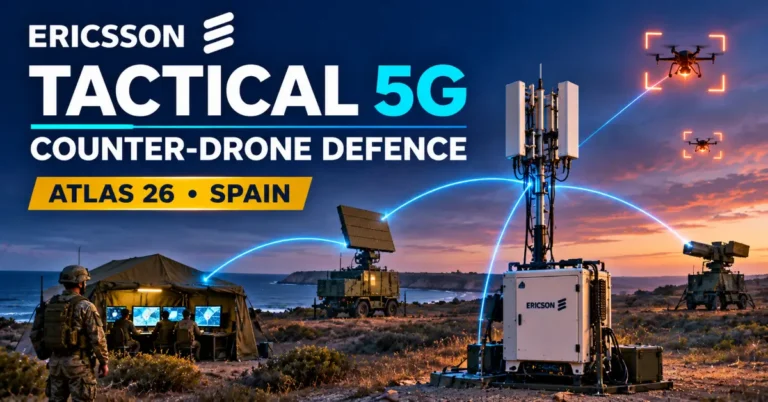
What did Ericsson’s tactical 5G achieve at Spain’s Atlas 26 exercise?
At Atlas 26, the Spanish Armed Forces’ main joint exercise of 2026, an Ericsson tactical 5G network wirelessly connected counter-drone and air-defence sensors, radars, command posts and effectors. According to Ericsson, it was the first time Spain’s forces linked counter-drone systems using only a tactical 5G network instead of fixed cabling. The network ran on Ericsson’s Ultra Compact Core over military-exclusive spectrum.

Atlas 26 took place from 19 to 23 October at the Médano del Loro training area in Huelva, and Ericsson announced the results on 24 November. The exercise was led by the Chief of the Defence Staff (JEMAD), Admiral General Teodoro Esteban López Calderón, and brought the Army, Navy, Air and Space Force, Guardia Civil and National Police together under a single command. Its focus was the response to unmanned aerial threats. The tactical 5G network was operated by the 5G Spanish Cyber Defence Centre of the Joint Cyberspace Command, which means the armed forces ran the network themselves rather than relying on a commercial operator.

On the final day of the exercise, the JEMAD toured the operational posts with Admiral Pierre Vandier, NATO’s Supreme Allied Commander Transformation. The Spanish Defence Staff said the exercise had tested 5G for interconnecting counter-drone defences and integrating them into the command and control structure. Allied interest at that level shows that the network question is now part of how counter-drone capability is judged.
Why tactical 5G matters for counter-drone defence
Counter-drone defence is a chain. A sensor detects an object, a command post classifies it and decides on a response, and an effector, such as a jammer, interceptor or gun, acts on that decision. Each link adds time, and against small, fast and often numerous drones, time is the scarcest resource. The value of a counter-drone system therefore depends as much on how quickly data moves between its parts as on the quality of any single radar or jammer.
Fixed cabling has traditionally carried that data. Cables are reliable, but they take time to lay, they tie equipment to set positions, and they make it slow to reposition a battery when the threat moves. Separate point-to-point radio links avoid the cabling but can leave a patchwork of connections that is harder to manage. A tactical 5G network offers a third model: one standards-based, centrally managed network that every element can join and leave as the operation changes.

Ericsson highlighted three properties of the Atlas 26 deployment:
- Dedicated connectivity: defence traffic ran isolated from commercial networks.
- Resilience to interference: military-exclusive spectrum reduced exposure to electromagnetic interference and congestion.
- Low latency: data moved continuously between distributed sensors, radars, command posts and effectors.
Juan Olivera, Country Manager of Ericsson Spain, described the approach as “commercial 5G innovation, hardened for defense”. That phrase captures the main point. The forces are not building a bespoke military radio system. They are adapting the same 5G technology that carries public mobile traffic, with its scale, supply chain and roadmap, to a defence role.
How the Atlas 26 tactical 5G network was built
The published details describe a compact, pre-integrated deployment rather than a fixed installation. The main components are set out below.
| Component | What was used at Atlas 26 | Role |
| 5G core | Ericsson Ultra Compact Core (UCC) | Compact, mobile, defence-grade 5G core designed for rapid deployment |
| Software platform | Ericsson Container-as-a-Service | Runs the core’s cloud-native functions on the deployed hardware |
| Integration | Pre-integrated solution with supporting hardware infrastructure | Shortens set-up time in the field |
| Spectrum | Bands reserved exclusively for military use | Isolates defence traffic and limits interference |
| Network operator | 5G Spanish Cyber Defence Centre, Joint Cyberspace Command | Military-run operation of the network |
| Connected elements | Sensors, radars, command posts and effectors | Counter-drone and air-defence data exchange |
Ericsson describes the Ultra Compact Core as a dual-mode 5G core in a very small form factor, built on the same core software it supplies to commercial operators. For a tactical network, that matters because the core is the part that manages devices, sessions and security. Packaging it so it can travel with a unit is what turns 5G from a fixed-site technology into a deployable one.
The choice of operator is just as significant. The Joint Cyberspace Command has been building Spain’s military 5G capability for some time. In December 2025, the Spanish Defence Staff reported that Armed Forces 5G nodes had been connected for the first time via the SPAINSAT satellite, with user services running on national infrastructure and no dependence on civilian internet providers. That test linked 5G bubbles on the amphibious ship Castilla, at the Sierra del Retín training ground and at the Retamares base, working with partners including Hisdesat, Telefónica, Accenture, XRF, MENPRO and COAS. Atlas 26 extends that sovereign, military-operated model from command and control services into the counter-drone kill chain.
Tactical 5G inside the wider Atlas 26 counter-drone architecture
Atlas 26 was an integration exercise, and several industrial partners showed how their systems fit together. Indra and EM&E reported that their ARACNE counter-drone system was integrated into Spain’s air defence system through Indra’s COAAAS+ anti-aircraft artillery operations centre, coordinating counter-drone systems with anti-aircraft artillery. ARMMO and GDELS Santa Bárbara Sistemas demonstrated the launch of the BANDIT-X interceptor from an ASCOD armoured vehicle. The companies have not said which specific systems were carried over the 5G network, so these are best read as parallel parts of the same goal: an integrated, layered air defence.
The common thread is that counter-drone capability now depends on systems from different suppliers sharing one tactical picture. Command and control software, radars, electronic countermeasures and interceptors each come from specialist vendors. A tactical 5G network gives them a common, managed transport layer that can be moved and re-formed as quickly as the units it serves. Seen this way, the network is not a supporting utility. It is the part of the architecture that allows everything else to move.
How Atlas 26 fits the shift to 5G sensing and tactical 5G for drone defence
Earlier this month, TeckNexus examined how Nokia Federal and Ericsson are turning 5G networks into drone sensors. That analysis covered detection: Nokia Federal Solutions’ US Department of War RAPID contract to prototype integrated sensing and communications (ISAC), and Ericsson’s ISAC System, which uses existing mobile network infrastructure to detect and track drones, including those not connected to the network. Ericsson introduced that system on 2 November, with sensing-only pilots for selected customers planned for 2027 and wider deployments from 2028.
Atlas 26 addresses the other half of the problem. Detecting a drone is only useful if the detection reaches a decision-maker and an effector in time. Put together, the two developments describe a network that can both sense the threat and carry the response. The table below shows where each strand stands.
| Layer | Development | Status |
| Detection | Ericsson ISAC System for drone detection on 5G networks | Launched 2 November 2026; pilots planned for 2027 |
| Detection prototyping | Nokia Federal Solutions RAPID contract, US Department of War | Contract awarded 13 November 2026 |
| Sensor-to-effector connectivity | Ericsson tactical 5G at Atlas 26, Spain | Demonstrated in exercise, 19 to 23 October 2026 |
| Permanent experimentation | Telefónica private 5G for a NATO-mandated centre in Slovakia | Contract awarded; three years of operations |
It also fits a pattern TeckNexus identified in Spain’s NATO experimentation centre in Slovakia: defence private 5G is moving from short-lived tactical bubbles towards roles that matter operationally. At Atlas 26, 5G was not just carrying voice and video for personnel. It was carrying data between the systems that defend against an attack.
Ericsson is continuing the theme this week at PMRExpo in Cologne, running from 24 to 26 November, where it is demonstrating its ISAC drone detection system alongside deployable 5G for mission-critical operations.
What Atlas 26 completed and what comes next for tactical 5G
Separating what was demonstrated from what is intended keeps the picture clear.
| Item | Status |
| Wireless interconnection of counter-drone and air-defence systems over tactical 5G | Completed during Atlas 26, 19 to 23 October 2026 |
| Operation on military-exclusive spectrum by the Joint Cyberspace Command | Completed during the exercise |
| Wider adoption of tactical 5G across Spain’s and Europe‘s future operations | Stated aim, not yet a programme |
| Named systems connected, frequency bands, performance figures and hardware supplier | Not publicly disclosed |
The public material describes capabilities rather than measurements, which is common for defence exercise disclosures. Readers should treat Atlas 26 as a validated operational demonstration of the architecture, with performance data likely to stay within defence channels.
Four developments will show how quickly this moves beyond exercises:
- Procurement. Whether Spain or other European forces turn exercise results into fielded tactical 5G for air defence units, through national programmes or frameworks.
- Sensing and connectivity converge. Whether ISAC detection and tactical 5G connectivity are combined in the same deployed network, so one system both sees the drone and carries the response.
- Allied interoperability. Whether national tactical 5G networks are designed to connect with allied forces, given NATO’s visible interest in Atlas 26.
- Spectrum for defence 5G. Whether military-exclusive bands for tactical 5G become a consistent planning assumption across European forces.
The lessons also reach beyond defence. Airports, ports, energy sites and other critical infrastructure face the same low-altitude drone problem and need the same sensor-to-response speed. A private 5G network that connects detection, control rooms and response teams without fixed cabling is directly relevant to them. Atlas 26 shows that this architecture works under demanding military conditions, which strengthens the case for civilian operators considering similar approaches.
TeckNexus has analysed more than 1,000 private network deployments across defence, critical infrastructure and industry. Explore our private network intelligence for deployment data and decision tools.
For more analysis like this, subscribe to the TeckNexus Newsletter, explore our 2027 programs, or partner with us to share your perspective and generate leads.