


What Have Orange Spain, Skylo and Digitanimal Launched?
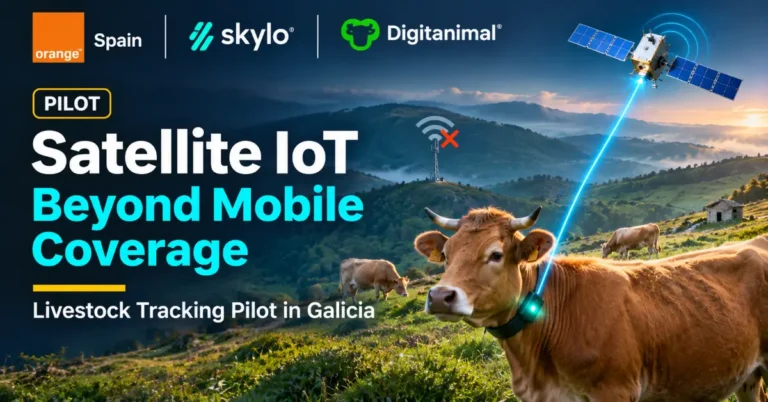
On 19 November 2026, Skylo, Orange Spain and Digitanimal launched a satellite IoT pilot to track free-range livestock in the Serra do Xistral in Lugo, Galicia, one of Spain’s main mountain grazing regions. Digitanimal smart collars send GPS location and activity data over Skylo’s non-terrestrial network, based on 3GPP standards, with Orange Spain orchestrating connectivity across its terrestrial and satellite networks.

The pilot is small in scope, but it is a clear example of a model many operators are now pursuing: satellite connectivity delivered as an extension of the mobile network, through the same SIM and the same operator relationship, rather than as a separate system.

Why Satellite IoT Matters for Rural Coverage
Orange Spain reports 4G coverage of 99% of the Spanish population and 5G coverage of more than 93%. Those figures measure where people are, not where land is used. In mountain grazing areas, animals spend much of the year in places that terrestrial networks were never built to reach.
Skylo’s Nisha Malhan, Business Development Director for EMEA, summed up the problem directly: “Ranchers in northern Spain lose track of their livestock as soon as the animals leave the mobile coverage area.” For farmers, that means manual checks across large, difficult terrain, slower responses to incidents and higher operating costs, which are exactly the outcomes the pilot sets out to improve.
For operators, the same gap applies to any asset that sits beyond the edge of the terrestrial network. In Spain, population coverage is already close to complete. Geographic coverage for devices is the remaining gap, and satellite IoT is one way operators are addressing it.
How the Orange Spain Satellite IoT Pilot Works
Each of the three companies covers a distinct layer of the solution.
| Company | Role in the pilot |
| Orange Spain | Provider and orchestrator of end-to-end connectivity, building on network integration already completed with Skylo |
| Skylo | Non-terrestrial network connectivity based on 3GPP open standards |
| Digitanimal | Smart collars and the livestock monitoring platform, used by more than 20,000 customers |
According to Skylo, the approach uses standard SIM connectivity and does not require specific hardware or an independent network. Collars capture location and activity data from animals grazing year-round, and that data feeds Digitanimal’s platform so farmers can follow herd movements, monitor animal health and reduce time spent on manual checks.
Orange Spain frames the pilot as part of a wider strategy. Víctor del Pozo, Director of B2B, Digital and Growth at Orange Spain, said: “Total connectivity is a strategic pillar for Orange Spain.” He described the goal as combining geostationary and low Earth orbit satellite technologies with 5G in an open, multi-vendor ecosystem.
The Satellite IoT Building Blocks Already in Place
The pilot builds on several pieces of work that were completed before it started:
- Digitanimal’s SAT Collar received Skylo certification, enabling combined terrestrial and non-terrestrial connectivity, in work carried out with Deutsche Telekom.
- DEKRA’s laboratory in Málaga acted as the accredited test house for the device, which switches automatically to Skylo’s non-terrestrial network when mobile coverage drops.
- Orange Spain and Skylo had already completed network integration between the operator’s network and Skylo’s non-terrestrial network.
- Skylo has partnered with other European operators, including Vodafone IoT for NTN NB-IoT connectivity.
Together, these give the pilot a certified device, an integrated operator network and a standards-based satellite layer from the start.
Satellite IoT Pilot: What Is Confirmed and What Is Not Yet Disclosed
The announcement is clear about the partners and the approach, but leaves several operational details open.
| Confirmed | Not yet disclosed |
| Pilot launched in the Serra do Xistral, Lugo, Galicia | Number of animals or collars in the pilot |
| Skylo provides 3GPP standards-based non-terrestrial connectivity | Which 3GPP NTN variant and release the pilot uses |
| Orange Spain orchestrates terrestrial and satellite connectivity | Pilot duration and success criteria |
| Digitanimal provides the collars and monitoring platform | Commercial launch date and pricing |
What Satellite IoT Means Beyond Livestock
Cattle tracking is a good proving ground for satellite IoT because the requirements are clear: small amounts of location and activity data, devices that must last a long time in the field, and locations that terrestrial networks do not cover. Those same characteristics apply well beyond agriculture.
For operators
The pilot shows an operator positioning itself as the orchestrator of coverage rather than just the owner of a radio network. If satellite capacity can be added to an existing IoT contract through the same SIM, operators keep the customer relationship for devices that would otherwise have gone to a separate satellite provider.
For enterprises with remote assets
Utilities, water companies, environmental monitoring programmes and logistics firms all run assets beyond reliable mobile coverage. A standards-based approach means device makers can build one product that works on terrestrial and satellite networks, and buyers can source connectivity through an operator they already use. The open questions for enterprise buyers are the same ones this pilot has yet to answer publicly: reliability at scale, message latency and cost per device.
What Comes Next for Orange Spain’s Satellite IoT Pilot
Five signals will show whether the pilot becomes a commercial service:
- Published results from the Serra do Xistral, including reliability and the effect on farmers’ operating costs.
- A commercial satellite IoT offer from Orange Spain for livestock and other rural use cases.
- Extension of the model to other regions of Spain or other Orange markets.
- Progress on Orange Spain’s stated plan to combine geostationary and low Earth orbit satellite technologies with 5G.
- Growth in the number of certified devices able to switch between terrestrial and satellite networks.
The pilot is modest, but its structure is the important part. One SIM, one operator relationship and standards-based satellite capacity behind it is a model that can travel from Galician hillsides to any asset that sits beyond the reach of the mast.
For more analysis like this, subscribe to the TeckNexus Newsletter, explore our 2027 programs, or partner with us to share your perspective and generate leads.