


What Did the FCC Adopt on Drone Spectrum on 19 November?
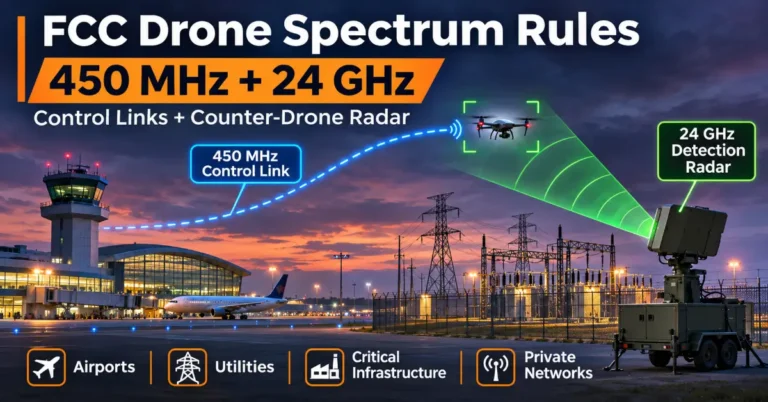
On 19 November 2026, the US Federal Communications Commission voted to adopt final drone spectrum rules. The order opens the 450 MHz band to nationwide, licensed command-and-control links for drones and advanced air mobility, allows ground-based radar in the 24.45 to 24.65 GHz band to detect and track unauthorised drones near critical sites, and updates the 800 MHz air-ground band used for in-flight broadband.

Taken together with the 800 MHz cellular decision adopted three weeks earlier, the vote gives the US drone sector something it has lacked: a set of licensed bands for flying drones safely and for spotting the ones that should not be there.

Why the FCC Drone Spectrum Decision Matters
Most commercial drones in the United States still fly on unlicensed spectrum, the same 900 MHz, 2.4 GHz and 5 GHz bands used by Wi-Fi routers and consumer devices. That is workable for short, visual-line-of-sight flights. It becomes a constraint for beyond-visual-line-of-sight (BVLOS) operations such as pipeline patrols, power line inspection and long-range delivery, where a dropped control link is a safety event rather than an inconvenience.
The detection side matters just as much. The FCC says the new radar rules are intended to help detect and track unauthorised or dangerous drones near airports, borders, prisons, stadiums and critical infrastructure. The decision answers a long-pending industry petition and gives radar suppliers, and the sites that buy from them, a clear spectrum basis to work from.
For TeckNexus readers, the significance is that drone connectivity and drone detection are now spectrum planning questions, sitting alongside the private 5G, CBRS and mission-critical networks that critical infrastructure operators already manage.

FCC Drone Spectrum Rules at a Glance
The November order completes a sequence of decisions on four bands. The table below sets out what each one now allows.
| Band | What changes | Main users | Status |
| 800 MHz Cellular (824 to 849 and 869 to 894 MHz) | Removes a decades-old ban on airborne use, opening 50 MHz of licensed low-band spectrum to cellular-connected drones | Mobile operators and drone operators using cellular links | Adopted 29 October 2026 (FCC 26-72) |
| 450 MHz air-ground | Replaces site-by-site voice rules with a nationwide licence for safety-related data links to crewed and uncrewed aircraft | Drone and advanced air mobility command and control | Adopted 19 November 2026 |
| 24.45 to 24.65 GHz | Allows ground-based radar to detect and track unauthorised or dangerous drones | Airports, borders, prisons, stadiums, critical infrastructure | Adopted 19 November 2026 |
| 800 MHz air-ground (849 to 851 and 894 to 896 MHz) | Updates air-ground rules so providers can deliver broadband to aircraft more efficiently | In-flight connectivity providers | Adopted 19 November 2026 |
In the 450 MHz band, Aura Network Systems holds the licences for all 54 existing ground stations, which makes it the only company eligible for the new nationwide licence, according to the FCC. Aura has described the band as well placed to support command and control and other safety links for drones and advanced air mobility across wide areas.
Counter-Drone Radar Under the FCC Drone Spectrum Rules: Detection Is Not Mitigation
The 24 GHz decision is easy to misread, so the boundaries are worth setting out clearly:
- The rule covers detection and tracking. It authorises radar that finds and follows drones, not equipment that jams or takes control of them.
- The rule does not authorise jamming or other mitigation. The FCC has separately issued waivers so that state, local, tribal and territorial law enforcement and correctional agencies can use counter-drone measures under the SAFER SKIES Act.
- Federal coordination is tightening in parallel. In November, the Departments of Transportation, Defense, Homeland Security, Energy and Justice agreed a memorandum of understanding to coordinate how counter-drone systems are tested and deployed without disrupting civil aviation.
For a utility, port or airport security team, that means the new rules make it easier to see what is in the airspace. They do not change who is allowed to act on what the radar finds.
What the FCC Drone Spectrum Rules Mean for Critical Infrastructure and Private Networks
The decisions touch three groups that overlap heavily with private network buyers.
Airports, ports and critical sites
Fixed detection radar can now be licensed with regulatory certainty, which makes it easier to build into long-term security programmes rather than treat as a pilot. Operators will still need to plan radar locations alongside other spectrum users on the site. Radar tracks are only useful if they reach a security operations centre quickly and reliably, which is a natural workload for the private LTE and 5G networks many airports and ports already run.
Utilities and BVLOS inspection
Electric utilities were among the commenters supporting the 450 MHz proposals, and the reason is practical. Line and substation inspection over long distances needs a dependable control link. Utilities now have two licensed routes: cellular-connected drones using commercial networks in the 800 MHz band, and dedicated aviation links at 450 MHz. The choice between them will depend on coverage at the altitudes they fly, cost and how much control they want over the link.
Private 5G and CBRS network owners
Drones operating over industrial sites typically need two kinds of connectivity: a safety-critical control link and a high-bandwidth payload link for video, LiDAR or thermal imagery. The FCC’s decisions largely address the first. The second is where private 5G networks come in, carrying inspection video and sensor data into on-site analytics. The FCC’s April 2026 request for comment also asked whether bands including CBRS could support drone operations, so private network owners should watch how that question develops.
Airport and utility teams weighing these investments can model the operational case with TeckNexus Intelligence tools, including the Airports ROI Calculator and the Private Network Security Assessment for Utilities.
FCC Drone Spectrum Order: What Is Decided and What Is Still Open
The vote is final, but the detailed rules will only be confirmed when the full order is published.
| Decided | Awaiting the published order |
| Final rules adopted on 19 November 2026 | Full text of the order |
| 450 MHz opened to nationwide licensed drone and aviation data links | Licence obligations for the nationwide licensee |
| 24.45 to 24.65 GHz opened to ground-based drone detection radar | Licensing and coordination procedures for radar sites |
| 800 MHz air-ground rules updated for in-flight broadband | Effective dates |
What Comes Next for FCC Drone Spectrum
Five developments will show how quickly the new rules translate into operations:
- Publication of the full order and its appearance in the Federal Register, which starts the clock on the effective date.
- The nationwide 450 MHz licence application and the coverage commitments that come with it.
- The first site licences for 24 GHz detection radar at airports, prisons and energy facilities.
- Progress on federal BVLOS rules from the FAA, which determine how far operators can actually use the new links.
- Testing under the new interagency counter-drone agreement, which will shape what sites can do once a drone is detected.
The direction is clear. Drone operations are moving from unlicensed spectrum and case-by-case waivers to licensed, planned connectivity. For critical infrastructure operators, that makes drones another part of the site spectrum plan, alongside the private networks that already carry their most important data.
For more analysis like this, subscribe to the TeckNexus Newsletter, explore our 2027 programs, or partner with us to share your perspective and generate leads.