





What Does the US Telecommunications Insecurity Report Reveal?
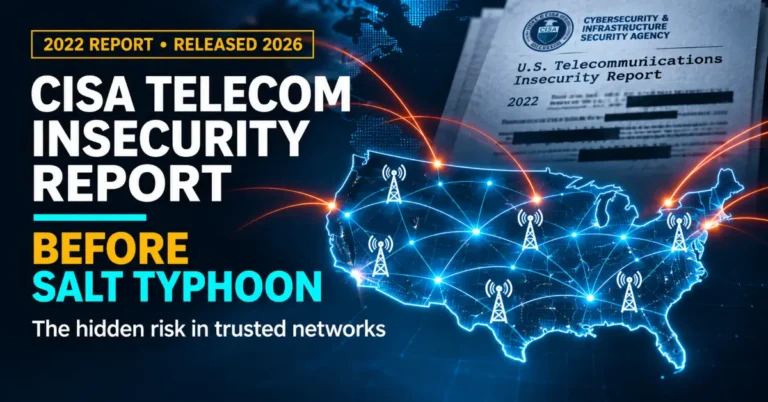
On 19 November 2026, a redacted version of U.S. Telecommunications Insecurity 2022 became public after a Freedom of Information lawsuit by the Electronic Privacy Information Center (EPIC). Prepared for CISA by AdaptiveMobile Security, now part of Enea, with Telecom Defense, the June 2022 report warned that weaknesses in signalling interconnects left US mobile networks open to tracking and interception from abroad, two years before Salt Typhoon came to light.

The report’s central argument is blunt. The model of mutual trust on which operators, roaming hubs and signalling carriers have exchanged traffic for decades is, in the authors’ words, a “failed trust”. They describe US telecom infrastructure as being in a “perilous and untenable situation” and call for the industry to replace implicit trust with zero trust: “trust nothing, verify everything”.
Why the Telecommunications Insecurity Report Matters Now
The timing gives the document its weight. In 2024, US agencies disclosed that Chinese state-linked actors known as Salt Typhoon had compromised several major US telecom networks. Later joint advisories from CISA, the FBI, the NSA and international partners described a campaign built largely on exploiting routers and other network edge devices. That is a different entry route from the signalling attacks the 2022 report documents, but the underlying lesson is the same: the telecom ecosystem extends trust to parties and paths that are not continuously verified.
The report’s path to publication is also part of the story. Senator Ron Wyden says he has sought its release since July 2022. CISA allowed his staff to read it in person in 2023 but marked it “For Official Use Only” and declined to provide copies. EPIC filed a Freedom of Information request in March 2024 and sued in June 2025. In 2025 the Senate unanimously passed the Telecom Cybersecurity Transparency Act, which would require full release, and CISA said that July it intended to publish the report. The version now public is still heavily redacted.
For the industry, the significance is less that the vulnerabilities are new. Weaknesses in SS7 have been discussed publicly for more than a decade. What is new is an independent, government-commissioned assessment that maps how those weaknesses play out across the specific structure of the US interconnect market, with live incident examples.
Key Findings of the US Telecommunications Insecurity Report
The unredacted sections cover the threat picture, three incidents observed at one major US operator, and a detailed review of the US mobile interconnect ecosystem. The main findings are summarised below.
| Area | What the report says |
| Trust model | The traditional trust between interconnected networks has failed; the authors recommend dynamic zero trust that combines AI-supported rules with human threat hunting. |
| Exposure | The authors describe the US as the most targeted country for signalling attacks, based on their analysis of up to 50 billion telecom events a day (vendor-reported). |
| Live incidents, March to May 2022 | A location request against a roaming device likely in Indianapolis via a global title leased by a central European broker; routing requests against three US subscribers apparently from Southeast Asia; more than 9,000 “Global Opcode” violations in a week. |
| Aggregators | Almost all international roaming traffic reaches the US through aggregators, most of them based abroad and paid by traffic volume, which gives little incentive to screen it. |
| Smaller operators | Some rural and small carriers let international third parties appear as US carriers; the review flags non-US number ranges, expired spectrum licences and suspicious vendors. |
| Protocols | SS7 has no native firewalling; Diameter and GTP-C carry similar weaknesses; non-standalone 5G carries legacy exposure forward. |
Two details stand out. The Global Opcode activity was only detected after the operator upgraded its monitoring platform, and the authors say the vendor had flagged that risk in 2019. In the report’s conclusion, the attack on an inbound roamer is assessed as likely to have succeeded. The authors also reject the idea that partial protection is good enough, arguing that “there is no such thing as a 15% problem”.
The Telecommunications Insecurity Report: What Is Documented and What Is Still Unknown
Separating what the report establishes from what it cannot tell us matters, because the document is four years old, partly redacted and marked as preliminary rather than a coordinated DHS position.
| Documented | Redacted or unknown |
| Report completed in June 2022 and released in redacted form on 19 November 2026 | Most of the first recommendation and much of the second are redacted |
| Three incident examples from a nine-week window at one major US operator | Most operator, aggregator and vendor names are withheld |
| A structural review of US aggregators, number ranges, licensing and ownership | Whether the specific weaknesses have been fixed since 2022 |
| Recommendation that aggregators carry primary screening responsibility, drawing a parallel with post-9/11 airline obligations | CISA’s current assessment of the findings |
The traffic analysis and incident data come from AdaptiveMobile Security’s own monitoring and should be read as vendor-reported findings. The report also predates Salt Typhoon, so it documents a related class of exposure rather than the campaign itself.
What the Telecommunications Insecurity Report Means for Operators, Enterprises and Private Networks
The report is written for government, but its implications run across the connectivity value chain.
For mobile operators
Signalling firewalls remain necessary but are not sufficient on their own. The report’s case for dynamic zero trust implies continuous, behaviour-based inspection of interconnect traffic, backed by people who hunt for anomalies, not static rule sets. Standalone 5G reduces dependence on SS7, but roaming and interworking keep legacy protocols in service for years, so the interconnect edge stays a priority even as cores modernise.
For enterprises
Location tracking and message interception are not abstract risks for executives who travel, for organisations that still rely on SMS for authentication, or for fleets of IoT devices running on roaming SIMs. The report specifically flags business models built on IoT, GPS trackers and mobile virtual network enabler services as areas where global titles are leased and traffic is hard to attribute. Enterprises can reasonably ask their connectivity partners how signalling traffic is screened, and how roaming partners are vetted.
For private network owners
A standalone private 5G network with its own core limits exposure to the public interconnect, which is one reason defence, utilities and critical infrastructure operators are choosing that model. The trust boundary does not disappear, however. It moves to the points where a private network meets the outside world: roaming arrangements with public operators, neutral host agreements, SIM and eSIM providers, and managed service partners. The report’s review notes that CBRS uses a light licensing framework that lets more entities deploy networks, and its list of reviewed entities includes some offering private LTE and MVNE services. That does not make private networks the problem, but it does mean their interconnect and supplier relationships deserve the same zero-trust scrutiny as any carrier’s.
Utilities assessing these questions can map their posture against named threat scenarios, including Salt Typhoon, with the TeckNexus Private Network Security Assessment for Utilities.
The Policy Debate After the Report’s Release
The release has revived the argument over how US telecom security should be governed. Senators Ron Wyden and Mark Warner have criticised both the delay and the absence of mandatory federal cybersecurity standards for carriers, and in November 2025 they asked DHS and the Director of National Intelligence to encourage the FCC to set minimum standards. Wyden has said he plans legislation to stop foreign adversaries exploiting SS7.
The question now is whether the report’s structural findings, particularly on aggregator incentives, can be addressed through voluntary industry measures or will require obligations similar to those the authors sketch in their second recommendation.
What Comes Next After the Telecommunications Insecurity Report
Five developments will show whether the report changes practice or remains a historical warning:
- Whether DHS releases a fuller version, or CISA sets out which of the 2022 findings have since been addressed.
- Progress on Senator Wyden’s planned SS7 legislation and any renewed push for mandatory standards.
- Whether aggregators and signalling carriers adopt screening obligations, voluntarily or by rule.
- How quickly operators extend zero-trust controls from IP networks to signalling and roaming interconnects.
- Whether enterprise and private network buyers start writing signalling and roaming security requirements into connectivity contracts.
The report’s most durable line may be its simplest: trust as a 20th century design principle is not fit for a 21st century threat environment. Four years on, that is as true for private networks connecting to the outside world as it is for national carriers.
For more analysis like this, subscribe to the TeckNexus Newsletter, explore our 2027 programs, or partner with us to share your perspective and generate leads.