



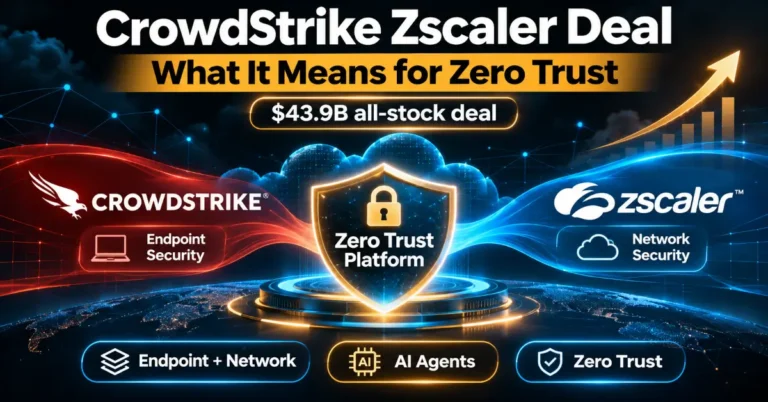
What Has CrowdStrike Agreed With Zscaler?
On 23 November 2026, CrowdStrike and Zscaler announced a definitive agreement under which CrowdStrike will acquire Zscaler in an all-stock deal valuing it at about $43.9 billion. Both boards unanimously approved the transaction, which brings Zscaler’s Zero Trust and network security onto CrowdStrike’s Falcon platform. It is expected to close in the second half of CrowdStrike’s fiscal year 2028, subject to Zscaler shareholder approval and regulatory approvals.

The deal joins CrowdStrike, which protects endpoints, cloud workloads, identity and data, with Zscaler, which describes itself as the pioneer of Zero Trust and secures connections between users, devices and applications. The companies describe the combination as uniting the leaders in securing every device and every connection.
Why the CrowdStrike Zscaler Deal Matters
Security buyers have spent years assembling separate tools for endpoints, identity, cloud and network access, then trying to connect them through integrations and shared data. This agreement puts two of the largest of those categories under one owner, one platform and one contract.
It also marks CrowdStrike’s entry into network security, which the company calls cybersecurity’s largest single addressable segment. CrowdStrike says the deal expands its total addressable market by more than $185 billion in calendar 2029.
For the connectivity industry, the significance is that the network itself is becoming part of a security platform’s data layer. Traffic flowing between users, devices, applications and AI agents is now treated as security telemetry in its own right, alongside what happens on the device.
Why AI Agents Sit at the Centre of the CrowdStrike Zscaler Deal
Both chief executives framed the deal around AI rather than traditional threats. The release argues that users, applications and AI agents now connect directly to the cloud, bypassing the data centre, so legacy firewalls and VPNs cannot see or stop much of that traffic. Zscaler’s Zero Trust Exchange sits inline between every user, agent and application, which is the position CrowdStrike wants on its platform.
CrowdStrike founder and CEO George Kurtz put the shift this way: “Security used to be about keeping the adversary out. Today, safety is required to let AI in.” Zscaler founder, chairman and CEO Jay Chaudhry described the risk directly: “In the AI era, Zero Trust security has become non-negotiable, and AI agents are rapidly becoming the new weakest link.”
The logic is that an AI agent is both software running on a device and a stream of connections to cloud services and data. Securing it fully means seeing both. That is what the companies mean when they talk about owning the endpoint and the network together, and it is why the release positions the combined platform around what it calls Zero Trust for AI Safety.
Two Control Points, One Data Layer: How the CrowdStrike Zscaler Platform Would Fit Together
The release describes the combined Falcon platform as owning two control points. The table below compares them using figures published by the companies.
| Endpoint control point (CrowdStrike) | Network control point (Zscaler) | |
| Where it sits | Falcon sensor on endpoints and cloud workloads | Zero Trust Exchange, inline between users, agents and applications |
| What it protects | Endpoints, cloud workloads, identity and data | Connections between users, devices and applications; SASE, AI security and data protection |
| Scale (company-reported) | Trillions of events a day | More than 750 billion transactions a day across more than 200 service locations and thousands of private edge sites |
| Customer reach (company-reported) | About 8,000 Zscaler customers are not yet CrowdStrike customers | Protects 50% of the Fortune 500 |
After closing, the companies plan to offer Zscaler’s Zero Trust SASE, AI security and data protection through Falcon, combine endpoint and network telemetry in Falcon Next-Gen SIEM, and sell Zscaler products on a single Falcon Flex contract. CrowdStrike also says its AI models would be trained on the full attack path, from device to connection.
Much of the technical groundwork already exists. The two companies share more than 2,000 customers and 16 integrations. In August 2025 they expanded their partnership, with Zscaler selecting Falcon as a preferred partner for customers modernising endpoint detection and response, and in September 2026 they added integrations that share CrowdStrike user risk context with Zscaler’s Adaptive Access Engine in real time.
CrowdStrike Zscaler Deal Terms at a Glance
The main terms are summarised below. Financial figures are company-reported.
| Term | Detail |
| Structure | All-stock; each Zscaler share converts to 1.135 CrowdStrike shares |
| Value | About $43.9 billion, or about $260.41 per Zscaler share, a premium of about 34% to the 20 November 2026 close |
| Ownership after closing | About 84.1% existing CrowdStrike shareholders, 15.9% existing Zscaler shareholders |
| Approvals | Zscaler shareholder approval, regulatory approvals and customary conditions; Jay Chaudhry and affiliates, holding about 34% of Zscaler shares, signed voting agreements |
| Expected close | Second half of CrowdStrike’s fiscal year 2028 |
| Leadership | Jay Chaudhry continues to lead the Zscaler business and joins CrowdStrike’s board |
| Combined scale | More than $10 billion in annual recurring revenue at the start, including Zscaler’s $3.9 billion |
| Revenue synergies | About $1 billion annualised run-rate within 30 months of closing |
| Cost synergies | $500 million annualised run-rate within 18 to 24 months, mainly from data centre, vendor and operations optimisation |
The CrowdStrike Zscaler Deal in the Wider Security Consolidation Wave
The agreement continues a pattern of large security platforms absorbing whole categories rather than adding features. Each of the deals below brought a distinct layer of security under a larger platform.
| Deal | Value | Layer added | Status |
| Cisco and Splunk | About $28 billion | Security analytics and observability | Completed March 2024 |
| Google and Wiz | $32 billion | Cloud and AI security | Announced March 2025; completed March 2026 |
| Palo Alto Networks and CyberArk | About $25 billion | Identity security for human, machine and agentic identities | Announced July 2025; completed February 2026 |
| CrowdStrike and Zscaler | About $43.9 billion | Network security and Zero Trust SASE | Announced November 2026; pending |
Two features stand out. First, AI agents are now the stated reason for consolidation: Palo Alto Networks framed CyberArk around securing every human, machine and agent identity, and CrowdStrike frames Zscaler around securing every agent connection. Second, the target layers are moving closer to the network. Cloud and identity came first. With Zscaler, a platform built on endpoint security is taking ownership of the traffic path itself.
CrowdStrike Zscaler Deal: What Is Agreed and What Is Still to Come
Separating the signed agreement from the plans attached to it shows how much of the story is still ahead.
| Agreed | Still to come |
| Definitive agreement signed and unanimously approved by both boards | Form S-4 registration statement, Zscaler proxy and shareholder vote |
| Exchange ratio, ownership split and leadership role for Jay Chaudhry | Regulatory approvals and closing in the second half of fiscal 2028 |
| Voting agreements covering about 34% of Zscaler shares | All product integration, including Zero Trust SASE on Falcon and a single Falcon Flex contract |
| Existing partnership: more than 2,000 shared customers and 16 integrations | Delivery of the revenue and cost synergy targets |
Until the deal closes, CrowdStrike and Zscaler operate as separate companies.
What the CrowdStrike Zscaler Deal Means for Telecom Operators, OT and Private Networks
The announcement does not mention telecom networks, operational technology or private wireless. Zscaler, however, already has products and partnerships in each of those areas, so the deal touches TeckNexus readers in several ways.
For telecom operators and managed service providers
Managed security service providers are named in the deal’s channel plans, and many operators resell or manage security for business customers. Zscaler also works with telecom companies, including NTT, to deliver Zero Trust as a managed service. A combined platform spanning endpoint, identity, cloud and network access could simplify what operators bundle for enterprises. It also means operators building multi-vendor security portfolios will be weighing a much broader single-vendor alternative.
For OT and industrial sites
In 2024, Zscaler acquired Airgap Networks, which provides agentless segmentation for IT and OT environments. Zscaler said the technology would extend its Zero Trust Exchange to protect east-west traffic in branch offices, campuses, factories and plants with critical OT infrastructure, isolating each device so that it effectively sits on a network of one. That capability would come with Zscaler into the combined company, alongside CrowdStrike’s endpoint and workload protection.
For cellular IoT
In July 2025, Zscaler launched Zscaler Cellular, which extends its Zero Trust Exchange to IoT and OT devices through a SIM card, without software agents or VPNs, and isolates each device so its connections run through Zscaler’s platform. Neither company has said how Zscaler Cellular or the Airgap technology fits into the combined roadmap. If they are brought onto Falcon, policy and telemetry for cellular-connected and OT devices could sit in the same data layer as the rest of an enterprise’s security data. That is TeckNexus analysis rather than a company commitment, and it is one of the integration details worth watching.
For private network owners
Organisations running private LTE or 5G for operations already face the question of how their cellular devices fit into enterprise security policy. Larger platforms reaching into the network layer make that question more pressing. Whichever approach they take, private network owners can usefully ask four questions:
- How are device identity and access policy enforced on the private cellular network itself?
- How does security telemetry from the private network reach the security operations centre?
- How does the approach work alongside existing OT segmentation and network security tools?
- What happens to policy when devices roam between private, public and satellite networks?
What Comes Next for the CrowdStrike Zscaler Deal
Five developments will show how the combination takes shape:
- The Form S-4 registration statement and Zscaler shareholder vote, which will set out more detail on the transaction.
- Regulatory reviews in the markets where both companies operate.
- Product roadmap announcements, including how Zero Trust SASE, network telemetry, Airgap segmentation and Zscaler Cellular are brought onto Falcon.
- Updates from channel and telecom partners on how they will sell and manage the combined portfolio.
- How other platform vendors respond as consolidation reaches the network layer.
Whatever the integration timeline, the direction is clear. Endpoint, identity, cloud and network security are converging into a handful of large platforms, and Zero Trust is extending from users and applications to AI agents and every connected device. For operators and private network owners, security architecture is becoming a connectivity decision as much as a software one.
For more analysis like this, subscribe to the TeckNexus Newsletter, explore our 2027 programs, or partner with us to share your perspective and generate leads.