




What Is the Current State of Open RAN in 2026?
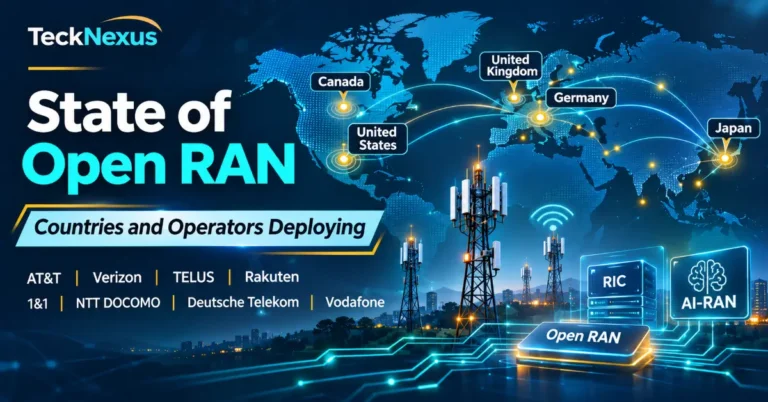
Open RAN in 2026 is a selective, operator-led market rather than an industry-wide shift. AT&T, Verizon, TELUS, Rakuten Mobile, 1&1, NTT Docomo, KDDI, Deutsche Telekom and Vodafone Germany run or are scaling commercial Open RAN, while VodafoneThree and EchoStar‘s Boost Mobile have stepped back. Open interfaces are now standard in vendor portfolios, multi-vendor networks remain a small share, and AI-driven automation is the strongest new reason to adopt.

When TeckNexus last updated this tracker in November 2024, much of the story was still about greenfield networks, rural 4G sites and memoranda of understanding. Two years on, the centre of gravity has moved to large brownfield operators refreshing their existing networks. Most of them have chosen one lead vendor that supports open interfaces, rather than assembling many suppliers at once. That is a narrower outcome than the early Open RAN vision, but it is also more durable, because it is tied to the five to seven year RAN refresh cycles that decide what goes on the mast.

Why the State of Open RAN Matters in 2026
The decisions operators take in 2026 will shape their radio networks well into the 6G era. Vodafone is six months into a five-year RAN programme spanning Europe and Africa, Deutsche Telekom is running a component-based tender across its European footprint, and AT&T is in the final stretch of its programme to move most of its traffic onto open-capable platforms. Whatever architecture wins these refreshes is likely to stay in place until the end of the decade.
The reasons for adopting Open RAN have also shifted. Early arguments centred on lower equipment prices and a wider supplier base. Today, operators that have deployed it most often point to software-driven automation, energy savings, faster feature upgrades and the ability to run third-party applications on the RAN Intelligent Controller (RIC). Supplier optionality still matters, particularly where operators are replacing high-risk vendors, but it is now one benefit among several rather than the whole business case.
Governments are treating open architectures as a question of resilience and sovereignty as well as competition. Saudi Arabia’s Communications, Space and Technology Commission framed it in exactly those terms in its October 2026 report, Open RAN: An Interoperable and Sovereign Architecture. In the United States, standards transposition and new federal security guidance are giving public-sector buyers a clearer path to procure open systems.

State of Open RAN by the Numbers: Analyst and Alliance Indicators
Market data on Open RAN varies widely depending on how each source defines the technology, so the headline indicators are best read together.
- Dell’Oro Group’s February 2026 Open RAN report revised its near-term revenue expectations down while improving its longer-term outlook. It now expects multi-vendor RAN to account for less than 5% of the total RAN market by 2030, down from a previous range of 5% to 10%, and it also lowered its Cloud RAN forecast.
- Dell’Oro’s August 2026 Open RAN report described Open RAN as increasingly a story about interface standardisation rather than supplier diversification, with Open Fronthaul gaining momentum and its long-term Open RAN outlook largely unchanged.
- The O-RAN ALLIANCE completed its Specification Release 5, and has since released 66 new or updated technical documents. Its stated focus for 2026 onwards is consolidating specifications for upgrading existing 5G networks.
- In February 2026, ATIS and the O-RAN ALLIANCE completed the transposition of an initial set of O-RAN specifications into ATIS standards, which supports recognition of open interfaces in North American procurement.
- The O-RAN Global PlugFest Spring 2026 was co-hosted by 13 operators, test centres and institutions across nine labs, with 31 companies taking part, and focused on multi-vendor integration of massive MIMO components.
These figures are not as contradictory as they first appear. Counts that include any O-RAN-compliant or open-capable equipment produce much larger shares; the Information Technology and Innovation Foundation estimated that Open RAN represented 7% to 10% of global RAN revenue in 2024. Counts limited to networks that genuinely mix suppliers in the same site produce small single-digit shares. Both are accurate. The gap between them is the clearest measure of where the market is: open interfaces have been widely adopted, while multi-vendor operation remains the exception.
Open RAN Operator Tracker 2026: Status by Country
The table below summarises the status of each operator covered in detail in this edition as of November 2026, separating scaled commercial networks from rollouts in progress, pilots and programmes that have been paused. Figures are as reported by the operators and vendors involved.
| Operator | Country | Status (Nov 2026) | Key vendors | Change since Nov 2024 |
| AT&T | United States | Scaling commercial | Ericsson, 1Finity (Fujitsu), Mavenir | Over 50% of traffic on open-capable hardware; third-party radio call on live network |
| Verizon | United States | Scaled commercial (vRAN) | Samsung, HPE, Wind River, Qualcomm | 130,000+ O-RAN-capable radios; multi-vendor RIC in production |
| TELUS | Canada | Scaling commercial | Samsung, Wind River | Around a quarter of network on virtualised Open RAN; RIC live from 2026 |
| T-Mobile US | United States | AI-RAN field testing | Nokia, Ericsson, Nvidia | AI-RAN call on commercial network (Oct 2026) |
| EchoStar (Boost Mobile) | United States | Winding down own RAN | Previously Fujitsu, Mavenir, Nokia, Samsung | Spectrum sold; moved to hybrid MNO model |
| Rakuten Mobile | Japan | Scaled commercial (greenfield) | Rakuten Symphony and partners | First full-year EBITDA profit in 2025; 11m+ subscribers |
| NTT Docomo | Japan | Scaled commercial | NEC, Fujitsu, Nokia, Samsung | Nokia multi-vendor base station live Sept 2026; OREX SAI abroad |
| KDDI | Japan | Scaling commercial | Samsung, HPE, Intel, Red Hat | Expanded Samsung vRAN rollout from 2025 |
| SoftBank | Japan | AI-RAN pre-commercial | Nvidia, Nokia, Ericsson | Commercial-network AI-RAN trial with Nokia planned for 2027 |
| 1&1 | Germany | Scaled commercial (greenfield) | Rakuten Symphony, around 100 partners | All 12m+ customers migrated to own network (Nov 2025) |
| Deutsche Telekom | Germany | Scaling commercial | Nokia, Fujitsu | 3,000+ site programme; component-based European tender |
| Vodafone | Germany, wider Europe | Rollout under way | Samsung, Dell, Intel, Wind River | Hannover live; Wismar to be first fully Open RAN city |
| VodafoneThree | United Kingdom | Paused | Ericsson, Nokia (RAN refresh) | Open RAN paused to meet merger site deadlines |
| O2 Telefónica | Germany | Commercial sites | Samsung, Dell, Intel, Wind River | First vRAN and Open RAN commercial site live in 2024 |
| Orange | France, Romania | Field pilots expanding | Samsung, Dell, Intel, Wind River | Next phase of Samsung partnership announced Feb 2026 |
| Vodafone Idea (Vi) | India | Limited; vRAN focus | Samsung, Mavenir (earlier) | 5G launched with Samsung, Nokia and Ericsson |
| Reliance Jio | India | In-house stack | Jio Platforms, Radisys | Own small cells and radio units in network; export plans |
| Indosat Ooredoo Hutchison | Indonesia | AI-RAN trial | Nokia, Nvidia | AI-RAN 5G call on its open platform (MWC 2026) |
| stc | Saudi Arabia | Commercial | Mavenir, solutions by stc | Commercial Open RAN agreement signed in 2024 |
| MTN | Multiple African markets | Rural commercial | Parallel Wireless and others | 5,000-site rural target; partnership with ODC |
Open RAN in North America: Brownfield Operators Lead
North America now hosts the largest brownfield Open RAN programmes, along with the clearest example of a greenfield build being wound down.
AT&T (United States)
AT&T’s five-year programme with Ericsson, valued at roughly $14 billion when it was announced in December 2023, aims to have 70% of its wireless traffic flowing over open-capable platforms by the end of 2026. In March 2026, AT&T reported that it had completed more than half of its radio swap programme and that more than 50% of its traffic was already carried on open-capable hardware. It has also completed an Open RAN call on its commercial network using Ericsson basebands with radios from Fujitsu’s 1Finity subsidiary, and says it was the first operator to run a third-party rApp in its live production network. AT&T has added Fujitsu and Mavenir as third-party radio suppliers for dense urban areas, and is scaling Cloud RAN on Intel Xeon processors.
Verizon (United States)
Verizon has deployed more than 130,000 O-RAN-capable radios as part of a virtualised RAN programme built largely on Samsung software, HPE servers and a Wind River cloud layer. In early 2025, Verizon said around 40% of its network ran on its vRAN platform, and by mid-2026 its leadership described almost half of the network as meeting its open requirements. Verizon has also put a multi-vendor RIC into production, running energy-saving and automation applications from Samsung and Qualcomm. It treats this open, programmable base as a foundation for its 6G strategy.
TELUS (Canada)
TELUS has become the reference brownfield case outside the United States. Having selected Samsung to replace Huawei equipment, it began building Canada’s first commercial virtualised and Open RAN network in February 2024. By mid-2026, TELUS reported that around a quarter of its network was running on the new architecture. It began deploying Samsung’s non-real-time RIC in 2026 to replace its previous centralised SON platform, starting in one market, with a goal of around 40 live applications by 2027.
T-Mobile US
Our 2024 edition recorded that T-Mobile US had no plans to deploy Open RAN. Its focus has since moved to AI-RAN. Through its AI-RAN Innovation Center with Nvidia, Ericsson and Nokia, T-Mobile completed what Nokia and Nvidia describe as the first AI-RAN voice call on a live commercial network in October 2026, using GPU-accelerated compute. T-Mobile is also piloting Nvidia AI infrastructure at mobile switching offices to host physical AI applications at the network edge.
EchoStar and Boost Mobile (United States)
Dish Network, later merged into EchoStar, built one of the world’s most advanced cloud-native Open RAN networks. In 2025, EchoStar agreed to sell its 3.45 GHz and 600 MHz licences to AT&T for around $23 billion and sold further spectrum to SpaceX, resolving regulatory concerns over spectrum use. Boost Mobile is moving to a hybrid MNO model that keeps its own 5G core while using partner RAN, and elements of its own RAN are being decommissioned over time. The outcome reflects spectrum, scale and subscriber economics rather than the performance of the open architecture itself.
Open RAN in Europe: Large Programmes and a Notable Pause
Europe shows the widest spread of outcomes, from the largest Open RAN customer base in the world to a high-profile reversal in the UK.
Vodafone (Germany and wider Europe)
Vodafone selected Samsung in October 2025 as its primary partner for Open RAN at scale in Germany and other European markets, as part of a five-year RAN programme covering 355 million customers across Europe and Africa. The first site went live in Hannover, and Wismar is set to become the first city in Vodafone’s German network fully equipped with Open RAN during 2026. Samsung’s stack runs with Dell servers, Intel processors and Wind River’s cloud platform, and the partners validated Samsung vRAN on Intel Xeon 6 system-on-chip in March 2026. Separately, Ericsson became Vodafone’s sole RAN vendor in Ireland, the Netherlands and Portugal, supplying Open RAN-compatible radios and its Intelligent Automation Platform for multi-vendor RAN management, starting in Germany.
VodafoneThree (United Kingdom)
Vodafone UK was Europe’s earliest large-scale Open RAN adopter, with a Samsung-based programme to replace around 2,500 Huawei sites in Wales and the South West of England. Following the merger with Three UK, VodafoneThree awarded its national RAN refresh to Ericsson for more than 10,000 sites and Nokia for around 7,000 sites. In October 2026, the operator explained that the Open RAN roadmap available today could not meet the site and spectrum deadlines attached to the merger, and that it had paused Open RAN in the UK network for now. The decision applies to the UK only; Vodafone’s Samsung programme continues in Germany.
Deutsche Telekom (Germany)
Deutsche Telekom’s Open RAN network is live in the Neubrandenburg area, with Nokia supplying O-RAN-compliant AirScale basebands and massive MIMO radios and Fujitsu supplying mid-band radios. Nokia was awarded more than 3,000 sites in this programme, replacing the incumbent vendor in the area, with completion now expected in 2027. Deutsche Telekom has said it is preparing a component-based RAN tender covering around 30,000 sites across its European operations, with Open RAN support required, and confirmed at MWC 2026 that work on the tender is ongoing. In March 2026, Nokia and Deutsche Telekom also expanded their innovation programme to cover Cloud RAN, open interfaces and AI-native RAN.
1&1 (Germany)
1&1 is now the largest Open RAN network in the world by customer count. In November 2025, less than two years after launching services in December 2023, it completed the migration of all its customers onto its own network, which serves more than 12 million users. The network is fully virtualised and cloud-native, with Rakuten Symphony as general contractor and integrator, and around 100 partner companies involved.
Telefónica and Orange
O2 Telefónica in Germany launched its first commercial vRAN and Open RAN site with Samsung in Landsberg am Lech, Bavaria, in May 2024, and planned seven further sites. Orange has taken a staged approach: after a shared 2G vRAN call on Open RAN in Romania in 2024, Orange France completed its first 4G and 5G calls on a Samsung vRAN and Open RAN pilot in south-west France in July 2025. In February 2026, Samsung and Orange announced the next phase of their partnership, moving from multi-year testing towards broader deployment in Europe.
Open RAN in Asia-Pacific: Japan Sets the Pace
Japan remains the most active Open RAN market, with every major operator now running or trialling open architectures, while India and Indonesia show different paths.
Rakuten Mobile and Rakuten Symphony (Japan)
Rakuten Mobile recorded its first full-year EBITDA profit in 2025 and reported around 11 million subscribers by September 2026. Its multi-vendor network spans around 350,000 cells, and Rakuten Group recorded its first quarterly IFRS operating income since entering the mobile business in the first quarter of 2026. Rakuten Symphony says it now works with 70 active customers and 21 global partners, and in March 2026 it was selected by Japan’s Ministry of Economy, Trade and Industry for a large overseas Open RAN and RIC demonstration project. Rakuten Mobile has raised its 2026 capital spending to add sites and improve network quality.
NTT Docomo (Japan)
NTT Docomo, a founder of the O-RAN ALLIANCE, launched what it describes as the world’s first nationwide Open RAN 5G service in 2020. On 9 September 2026, it began commercial operation of Nokia’s latest O-RAN-compliant base station in a configuration connecting radio units from multiple vendors, which Docomo describes as a first for this equipment. Abroad, its OREX SAI joint venture with NEC offers pre-integrated Open RAN to other operators, and in March 2026 it partnered with KCCTech and Palo Alto Networks on a secure Open RAN solution for Singapore.
KDDI and SoftBank (Japan)
KDDI selected Samsung as its main supplier of O-RAN-compliant vRAN in October 2024, with an expanded rollout from 2025 alongside HPE, Intel and Red Hat. The two companies previously switched on the first commercial 5G Standalone Open RAN site in Greater Tokyo. SoftBank has focused on AI-RAN through AITRAS, its Nvidia-based platform that runs AI and RAN workloads on shared infrastructure. In 2026, it open-sourced the AITRAS orchestrator, demonstrated interworking with Ericsson’s automation platform, and agreed with Nokia to run an AI-RAN field trial in its commercial network in 2027.
India and Indonesia
Vodafone Idea launched 5G in 2025 with Samsung, Nokia and Ericsson, using Samsung vRAN in selected circles after an earlier Open RAN deployment with Mavenir in Jalandhar. Reliance Jio has started deploying its own 5G small cells and radio units, and Jio Platforms has outlined plans to export its cloud-native RAN stack to other operators. In Indonesia, Indosat Ooredoo Hutchison and Nokia completed an AI-RAN 5G call on Indosat’s open platform at MWC 2026.
Open RAN in the Middle East and Africa
In the Middle East and Africa, Open RAN activity is concentrated in Saudi Arabia and in rural coverage programmes.
In Saudi Arabia, solutions by stc signed an agreement with Mavenir in February 2024 to launch the Kingdom’s first commercial Open RAN network, following an initial multi-layer 4G and 5G deployment. stc also deployed Nokia Cloud RAN for 5G non-standalone, while its 2026 multi-year 5G expansion is with Ericsson. MTN remains Africa’s most committed adopter, with a target of more than 5,000 rural Open RAN sites across its operations and a partnership with the ORAN Development Company to develop solutions for African networks. In Vodafone’s African markets, Nokia continues as a strategic partner to Vodacom and Safaricom under Vodafone’s RAN programme.
Earlier Open RAN Deployments With No Major Recent Update
Several deployments listed in our previous edition have not announced major expansions since 2024. They remain part of the Open RAN story, particularly for rural and neutral-host coverage, and are listed here for completeness.
| Operator | Country | Deployment recorded in earlier editions |
| Optus | Australia | Parallel Wireless 4G for remote areas |
| Edotco | Malaysia | TIP OpenRAN 4G sites in a neutral-host model |
| National Telecom (NT) | Thailand | Private 5G Open RAN in Ban Chang with Mavenir and Cisco |
| Internet Para Todos | Peru | Rural wholesale 4G on TIP OpenRAN |
| Millicom (Tigo) | Colombia | Rural 4G with Parallel Wireless |
| Inland Cellular, OptimERA | United States | Regional 4G Open RAN builds |
| TIM | Italy | Early 4G Open RAN in Faenza, Matera and Turin |
| e& | UAE | Open vRAN launch and Rakuten blueprint MoU |
| Bharti Airtel | India | 4G Open RAN across multiple cities |
| Telefónica Vivo, Movistar | Brazil, Argentina | 4G and 5G Open RAN trials and proofs of concept |
Can AI Deliver on Open RAN’s Promise?
The most significant development since 2024 is the convergence of Open RAN, Cloud RAN and AI. The industry is now asking whether AI can deliver on Open RAN’s original promise, and the evidence so far suggests that AI depends on the openness Open RAN created.
- RIC adoption has moved into production. AT&T, Verizon and TELUS all run RIC-based applications in live networks, and AT&T has deployed a third-party rApp on its production network. These are the clearest commercial use of open interfaces between RAN software layers.
- GPU-based AI-RAN has moved from labs to live calls. Nvidia announced a $1 billion investment in Nokia in October 2025 to develop AI-RAN, and the partners have since completed live-network milestones with T-Mobile US and Indosat. Nokia has said 2026 is its year for a first commercial trial, with a first commercial release in 2027.
- Not every vendor takes the same route. Ericsson’s AI-RAN products, unveiled in early 2026, rely on its own custom silicon while keeping its software portable across platforms, and Samsung positions its vRAN as an AI-ready base on Intel processors.
For operators, the practical lesson is that Open RAN’s value is shifting from the hardware layer to the software and data layers. Open fronthaul makes radios interchangeable in principle, but open management interfaces, the SMO and the RIC are what let operators bring in AI applications from many suppliers. That is where the multi-vendor idea is gaining ground fastest, even in networks with a single baseband vendor.
Open RAN Security, Standards and Vendor Shifts
Security guidance and the vendor landscape have both matured since our last edition.
In October 2026, the US National Institute of Standards and Technology published two reports on O-RAN security: NIST IR 8625, a final report on security requirements for near-real-time RICs, and NIST IR 8623, a draft Cybersecurity Framework 2.0 profile for federal agencies deploying O-RAN. The O-RAN ALLIANCE’s security working group, meanwhile, set up an O-RAN Security Assurance Programme with GSMA NESAS and strengthened security across Open Fronthaul and the SMO. Open source is also gaining weight, with the Linux Foundation launching the OCUDU ecosystem foundation in 2026 to accelerate open central and distributed unit software.
On the supply side, Samsung has emerged as the main challenger vendor in brownfield Open RAN, with Verizon, TELUS, KDDI, Vodafone Germany, O2 Telefónica and Orange among its customers. Fujitsu’s 1Finity is supplying third-party radios to AT&T and Deutsche Telekom. Mavenir completed a recapitalisation in 2025, refocusing on core network, voice and RAN software and exiting the manufacture of macro radio units while continuing to support existing Open RAN customers. Ericsson and Nokia, once seen as the incumbents Open RAN would displace, now supply O-RAN-compliant portfolios and lead several of the largest programmes.
What Comes Next for Open RAN
Several milestones over the next 12 to 18 months will show whether Open RAN keeps broadening or settles into its current shape.
- AT&T’s year-end 2026 target of 70% of traffic on open-capable platforms, and how many third-party radios follow the 1Finity and Mavenir units.
- Completion of Vodafone’s first fully Open RAN city in Wismar, and which European markets Samsung expands into next.
- The outcome of Deutsche Telekom’s component-based European RAN tender, the largest open procurement in Europe.
- TELUS scaling RIC applications towards its 2027 goal, which will test whether automation delivers measurable returns in a brownfield network.
- SoftBank and Nokia’s 2027 AI-RAN trial on commercial traffic, and whether GPU-based RAN can justify its economics at scale.
- O-RAN ALLIANCE work on 6G, where operators want openness designed in from the start rather than retrofitted.
The broad picture is that Open RAN has not disappeared; it has narrowed and become embedded. Open interfaces are now a default requirement in RAN tenders, while truly multi-vendor sites remain rare. The next phase depends less on whether operators can mix radios and basebands, and more on whether open software layers and AI produce operational gains that justify the integration effort. TeckNexus will continue to track these programmes in our Open RAN coverage.
For more analysis like this, subscribe to the TeckNexus Newsletter, explore our 2027 programs, or partner with us to share your perspective and generate leads.