




Who Are the Top Open RAN Vendors in 2026?
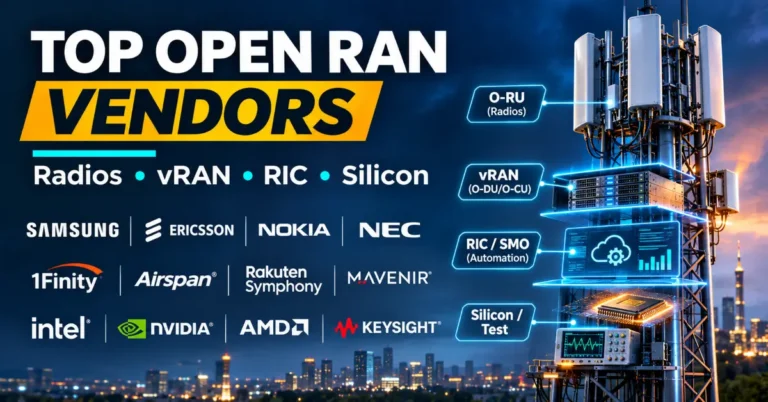
The leading Open RAN vendors in 2026 are Samsung, Ericsson, Nokia and NEC for end-to-end and macro RAN; 1Finity (Fujitsu), Airspan, NEC and Samsung for O-RAN radio units; Rakuten Symphony, Mavenir, Parallel Wireless and Radisys for RAN software; Intel, NVIDIA and AMD for silicon; Dell, HPE, Quanta and Supermicro for servers; Wind River and Red Hat for cloud platforms; and Keysight, VIAVI and Rohde & Schwarz for testing.

When TeckNexus first published this list in 2021, it was built around 28 vendors identified from Open RAN deployments and trials, many of them challengers hoping to break the hold of the traditional RAN suppliers. Five years later, the picture looks different. The largest incumbent vendors now offer O-RAN-compliant products and lead the biggest Open RAN programmes, several challengers have narrowed their focus, and new categories, led by AI-RAN computing, have become central to the market.

How the Open RAN Vendor Landscape Has Changed Since 2021
Several shifts explain why a 2026 list of Open RAN vendors looks so different from the original.
- Incumbents have embraced open interfaces. Ericsson expects 160 of its radio models to be Open-RAN-proven by the end of 2026, and Nokia‘s AI-RAN platform, announced in July 2026, can run with Nokia or O-RAN-compliant radios.
- Samsung has become the main challenger in large brownfield programmes, with Vodafone, Verizon, TELUS, KDDI, Orange and Rakuten Mobile among its Open RAN customers.
- Several early challengers have changed shape. Altiostar became part of Rakuten Symphony, Fujitsu moved its Open RAN radios into a new subsidiary, 1Finity, and Mavenir completed a recapitalisation in 2025 and exited radio hardware manufacturing to focus on software.
- The independent RIC market has consolidated. Nokia licensed HPE‘s Juniper RIC technology and took on its development team in October 2025, after VMware had already wound down its RIC products under Broadcom.
- AI-RAN has added a new category. NVIDIA invested $1 billion in Nokia in October 2025 to develop GPU-based AI-RAN, while Intel and AMD are positioning CPUs with built-in AI acceleration for the same workloads.
For the operator side of the market, including which networks run Open RAN at scale, see our companion article on the current state of Open RAN by country and operator.
Why the Open RAN Vendor Landscape Matters
Open RAN revenue has returned to growth. Dell’Oro Group’s March 2026 Open RAN update reported that worldwide Open RAN revenue grew at a double-digit rate in 2025, after falling by around 40% between 2022 and 2024. At the same time, Dell’Oro’s base case expects multi-vendor RAN, where operators mix suppliers at the same site, to account for less than 5% of total RAN deployments by 2030.

The two figures together describe today’s market. Open interfaces are now standard in RAN tenders, but most operators choose one lead supplier that supports them, rather than assembling many vendors at once. The overall RAN market also remains highly concentrated: Dell’Oro reports that Huawei, Ericsson, Nokia, ZTE and Samsung accounted for 96% of worldwide RAN revenue in the first half of 2026. The Open RAN challengers that are growing tend to specialise in one layer, such as radios, software, automation or compute, rather than competing across the full stack.
Open RAN Vendor Categories Explained
Open RAN splits the radio access network into components with standard interfaces between them. Vendors usually specialise in one or more of the following categories.
| Category | What it covers |
| End-to-end and macro RAN | Vendors supplying radios, baseband and software for full operator networks |
| O-RAN radio units (O-RU) | Radios that connect to any compliant baseband over the Open Fronthaul interface |
| RAN software (O-DU and O-CU) | Distributed and centralised unit software, usually running on standard servers as vRAN |
| RIC and SMO | RAN Intelligent Controllers that host third-party xApps and rApps, plus service management and orchestration |
| Silicon and accelerators | CPUs, GPUs and accelerators that process RAN and AI workloads |
| Servers and cloud platforms | Telco-grade servers and the container platforms (O-Cloud) that run RAN software |
| Test and certification | Tools and labs that validate conformance, interoperability and performance |
Top Open RAN Vendors by Category: 2026 Summary
The table below summarises the vendors profiled in this edition, with recent evidence of their Open RAN activity. Each entry was checked against company or operator announcements in November 2026.
| Vendor | Category | Recent Open RAN evidence | Date of evidence |
| Samsung | End-to-end, O-RU, vRAN | Vodafone first call on Xeon 6 SoC; Orange expansion; Rakuten Mobile radio supply | Feb to Mar 2026 |
| Ericsson | End-to-end, O-RU | 160 radio models Open-RAN-proven by end-2026; AT&T programme | 2026 |
| Nokia | End-to-end, RIC and SMO, AI-RAN | AI-RAN platform compliant with Open RAN; Juniper RIC assets added | Oct 2025 to Jul 2026 |
| NEC | End-to-end, O-RU, vRAN | New massive MIMO radio for vRAN, launch in fiscal 2026 | Jan 2026 |
| 1Finity (Fujitsu) | O-RU, vRAN | Rakuten Mobile radio rollout complete; Vodafone selection; enterprise AI-native vRAN | Oct 2025 to Nov 2026 |
| Airspan | O-RU, small cells | Selected as radio unit supplier for Rakuten Mobile | Dec 2025 |
| Rakuten Symphony | RAN software, integration | Platform behind Rakuten Mobile and 1&1 networks | 2026 |
| Mavenir | RAN software | Recapitalisation complete; software-only Open RAN strategy | Jun to Jul 2025 |
| Parallel Wireless | RAN software, RIC | UNITY.AI launch; MTEL and Telecall Colombia collaborations | Feb to Apr 2026 |
| Radisys | RAN software | 3GPP Release 19 5G-Advanced RAN software | Feb 2026 |
| Intel | Silicon | Xeon 6 SoC used for Samsung and Ericsson vRAN at Vodafone and AT&T | Mar 2026 |
| NVIDIA | Silicon, AI-RAN | ARC-Pro platform; $1bn Nokia investment; T-Mobile AI-RAN call | Oct 2025 to 2026 |
| Wind River | Cloud platform | Unified O-RAN and AI-RAN platform with AMD; Vodafone AI-RAN operations | Feb to Mar 2026 |
| Keysight, VIAVI, Rohde & Schwarz | Test and certification | Tools used by O-RAN ALLIANCE test and integration centres | 2025 to 2026 |
End-to-End and Macro Open RAN Vendors
These vendors supply complete RAN solutions with O-RAN-compliant interfaces, and lead most of the large brownfield Open RAN programmes.
Samsung
Samsung is the leading challenger vendor in brownfield Open RAN. Vodafone selected it as a key partner for Open RAN at scale across Europe, starting in Germany, and in March 2026 the two companies completed their first call using Samsung’s vRAN on Intel’s Xeon 6 SoC, with Dell servers and the Wind River cloud platform, ahead of commercial deployment during 2026. In February 2026, Samsung and Orange agreed to expand their vRAN and Open RAN sites after pilots that began in 2023, and in March 2026 Rakuten Mobile selected Samsung to supply O-RAN-compliant 5G radios for its nationwide network.
Ericsson
Ericsson’s Open RAN strategy centres on making its portfolio Open RAN-ready while keeping its integrated systems. It leads AT&T’s open RAN programme, where third-party radios from 1Finity have been connected to Ericsson basebands on the commercial network, and Ericsson expects 160 of its radio models to be Open-RAN-proven by the end of 2026. Its Intelligent Automation Platform also supports third-party rApps, extending openness to the management layer.
Nokia
Nokia combines its anyRAN software, which runs on purpose-built or cloud infrastructure, with an expanding automation and AI portfolio. In October 2025 it licensed HPE’s Juniper RIC technology and took on its development team to strengthen its MantaRay SMO platform, and NVIDIA invested $1 billion in the company to accelerate AI-RAN. In July 2026 Nokia announced its AI-RAN platform, which it describes as fully compliant with Open RAN standards and able to run with existing Nokia or O-RAN-compliant radios, with pilots from the end of 2026 and commercial availability in 2027.
NEC
NEC, a long-standing supplier to NTT Docomo, has focused its RAN strategy on vRAN and massive MIMO. It has shipped more than 50,000 massive MIMO units since 2020, and in January 2026 announced a new massive MIMO radio for its vRAN, with launch planned in fiscal 2026 and a fronthaul reach of 40 km. Through OREX SAI, its joint venture with NTT Docomo, NEC also offers pre-integrated Open RAN packages to other operators.
Open RAN Radio Unit (O-RU) Vendors
Radio units are where Open RAN has the most to prove, because they account for a large share of RAN cost and energy use. Several vendors now have O-RAN radios in large commercial networks.
- 1Finity (Fujitsu): Fujitsu’s photonics and mobile networks business, spun out as 1Finity in 2025, has become one of the most widely deployed independent O-RAN radio suppliers. Rakuten Mobile completed a nationwide rollout of its 44R21 radios in May 2026 and plans to deploy its massive MIMO radios, Vodafone selected 1Finity radios in October 2025, and its radios run with Ericsson basebands at AT&T. Dell’Oro reports that 1Finity moved up one place in its 2025 Open RAN ranking.
- Airspan: now privately held as Airspan Networks Holdings, Airspan acquired Jabil’s radio portfolio and Corning’s wireless business in 2025, and in December 2025 was selected by Rakuten Mobile to supply O-RAN radios across Japan, in a deployment supported by NTIA grant funding.
- NEC and Samsung: both supply O-RAN-compliant massive MIMO and macro radios alongside their vRAN, giving operators a single supplier option that still uses open fronthaul.
- Ericsson and Nokia: both now support Open Fronthaul on a growing share of their radio portfolios, which allows their radios to work with other vendors’ baseband.
Open RAN Software Vendors: vRAN, CU and DU
RAN software vendors supply the distributed and centralised unit software that turns standard servers into base stations.
Rakuten Symphony
Rakuten Symphony, which absorbed Altiostar in 2021, provides the cloud-native RAN platform behind Rakuten Mobile’s network of more than 345,000 cells and served as general contractor for 1&1’s network in Germany. It says it works with around 70 active customers and has been selected by Japan‘s Ministry of Economy, Trade and Industry for an overseas Open RAN and RIC demonstration project.
Mavenir
Mavenir completed a recapitalisation in 2025 that removed more than $1.3 billion of debt and made Siris its controlling shareholder. It has exited the manufacture of Open RAN radio units, licensing its radio designs to manufacturers instead, and refocused its Open RAN investment on 4G and 5G software while continuing to support existing customers. Dell’Oro notes that Mavenir is now putting more emphasis on small cells and non-terrestrial networks.
Parallel Wireless
Parallel Wireless offers hardware-agnostic 2G to 5G software through its GreenRAN platform, with a focus on energy efficiency. It made its Trusted RIC generally available in November 2025, launched its UNITY.AI capability in February 2026, and in 2026 expanded collaborations with MTEL Banja Luka in Bosnia and Herzegovina and Telecall in Colombia.
Radisys
Radisys, owned by Jio Platforms, supplies disaggregated RAN software and integration services. In February 2026 it introduced what it describes as the industry’s first 3GPP Release 19 5G-Advanced RAN software, combining terrestrial and non-terrestrial networks with AI-RAN capabilities, and it is active in defence and mission-critical private 5G.
RIC and SMO Vendors for Open RAN
The RAN Intelligent Controller (RIC) and service management and orchestration (SMO) layer is where Open RAN’s promise of third-party applications is now most visible. AT&T, Verizon and TELUS all run RIC-based applications in their live networks. The supplier field, however, has consolidated. With VMware winding down its RIC products and HPE passing Juniper’s RIC technology to Nokia, most production RIC and SMO platforms now come from the main RAN vendors, Nokia, Ericsson and Samsung, often hosting rApps and xApps from smaller specialists. Parallel Wireless’s Trusted RIC is one of the remaining independent options.
Open RAN Silicon, Server and Cloud Platform Vendors
Compute and cloud vendors provide the foundation that allows RAN software to run on standard hardware, and they are central to the move towards AI-RAN.
| Vendor | Role | 2026 position |
| Intel | CPUs with built-in vRAN and AI acceleration | Says most commercial vRAN deployments run on Xeon; Xeon 6 SoC adopted for Samsung and Ericsson vRAN at Vodafone and AT&T |
| NVIDIA | GPU-accelerated AI-RAN computing | ARC-Pro platform; nearly 20 operators have announced AI-RAN collaborations using Nokia software on NVIDIA ARC |
| AMD | CPUs and adaptive silicon (including former Xilinx) | EPYC CPUs paired with Wind River for a unified O-RAN and AI-RAN platform |
| Qualcomm | RAN silicon and automation | Supplies RAN automation applications used in Verizon’s multi-vendor RIC |
| Dell, HPE, Quanta (QCT), Supermicro | Telco-grade servers | Single-server Xeon 6 SoC vRAN systems and AI-RAN servers for NVIDIA platforms |
| Wind River, Red Hat | O-Cloud container platforms | Wind River underpins Samsung’s vRAN at Vodafone and Verizon; Red Hat supports KDDI‘s Samsung vRAN |
The main debate in this layer is how AI workloads should run in the RAN. NVIDIA and Nokia argue for GPU acceleration that can host AI applications alongside RAN processing, while Intel and AMD position CPUs with built-in acceleration as the more economical option for most sites. Both approaches keep RAN software on standard, open hardware, which is a central principle of Open RAN.
Open RAN Test, Certification and Integration Vendors
Multi-vendor networks only work if components are tested together, which has made test and integration an essential Open RAN category. Keysight, VIAVI Solutions and Rohde & Schwarz supply the conformance and interoperability test tools used by O-RAN ALLIANCE Open Testing and Integration Centres (OTICs), which award O-RAN certificates and badges to products. The i14y Lab in Berlin, led by Deutsche Telekom, is one of Europe‘s main OTICs. Systems integrators such as Rakuten Symphony, NTT Data and Tech Mahindra, along with the integration arms of the main RAN vendors, then take responsibility for bringing tested components together in operator networks.
Open RAN Vendors From Our 2021 List: Where They Are Now
Our original edition listed 28 vendors identified from Open RAN deployments and trials up to May 2021. The table below shows how each is positioned in this edition.
| Vendor (2021 list) | Status in this edition |
| Airspan | Profiled: O-RU and small cell supplier, now privately held |
| Altiostar | Part of Rakuten Symphony since 2021 |
| AWS | Not profiled in this edition |
| Baicells | Not profiled in this edition |
| Ciena Blue Planet | Not profiled in this edition |
| Cisco | Not profiled in this edition |
| Dell | Profiled: servers for vRAN and AI-RAN |
| Fujitsu | Open RAN radios now supplied by its subsidiary 1Finity |
| Gigatera | Not profiled in this edition |
| IBM Red Hat | Profiled: cloud platform |
| Intel | Profiled: silicon |
| Lime Microsystems | Not profiled in this edition |
| Mavenir | Profiled: RAN software, after 2025 recapitalisation |
| NEC | Profiled: end-to-end, radios and vRAN |
| Nokia | Profiled: end-to-end, RIC and SMO, AI-RAN |
| NTT Data | Mentioned as a systems integrator |
| NuRAN Wireless | Not profiled in this edition |
| Parallel Wireless | Profiled: RAN software and RIC |
| Quanta | Profiled: servers (QCT) |
| Qualcomm | Profiled: silicon and RAN automation |
| Radisys | Profiled: RAN software |
| Rakuten | Profiled as Rakuten Symphony |
| Samsung | Profiled: end-to-end, radios and vRAN |
| Sercomm | Not profiled in this edition |
| SuperMicro | Profiled: servers |
| Tech Mahindra | Mentioned as a systems integrator |
| VANU | Not profiled in this edition |
| Xilinx | Part of AMD since 2022; AMD profiled under silicon |
New to this edition are Ericsson, 1Finity, NVIDIA, AMD, Wind River, HPE and the test vendors Keysight, VIAVI and Rohde & Schwarz, reflecting how the market has shifted towards incumbents, specialist radio suppliers and compute platforms.
What Comes Next for Open RAN Vendors
Several developments over the next 12 to 18 months will shape which vendors gain ground.
- Large brownfield tenders, including Deutsche Telekom‘s component-based European RAN tender and Vodafone’s five-year RAN programme, which will decide how much room there is for independent radio and software suppliers.
- Commercial AI-RAN, with Nokia’s platform moving from pilots at the end of 2026 to commercial availability in 2027, and the outcome of the GPU versus CPU debate.
- Further consolidation among software and RIC suppliers, as smaller vendors specialise or partner with larger RAN providers.
- Growth of independent radio suppliers such as 1Finity and Airspan at operators including Rakuten Mobile, Vodafone and AT&T.
- Open RAN in private, defence and non-terrestrial networks, where vendors such as Radisys, Mavenir and Airspan are concentrating new development.
- O-RAN ALLIANCE work on 6G, which aims to build openness into the next generation from the start.
The broad picture is that the Open RAN vendor market has matured rather than disappeared. The incumbents have absorbed the open interfaces, a smaller group of specialists has found defensible positions in radios, software and automation, and compute vendors have become central to the next phase. TeckNexus will continue to track these vendors in our Open RAN coverage.
For more analysis like this, subscribe to the TeckNexus Newsletter, explore our 2027 programs, or partner with us to share your perspective and generate leads.