




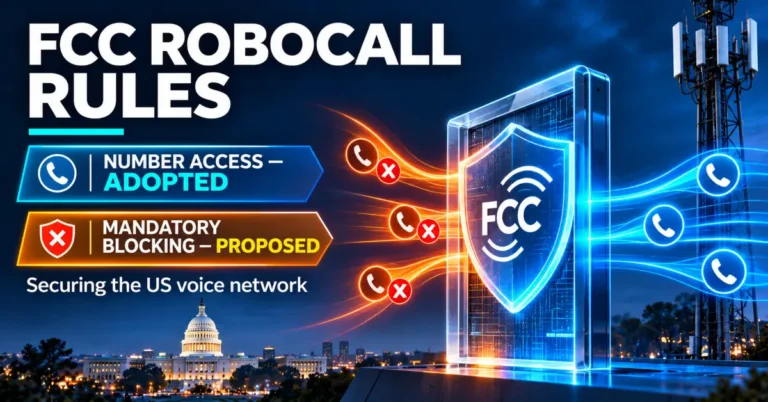
What are the FCC’s new robocall rules for telecom providers?
In the week of 19 November 2026, the US Federal Communications Commission (FCC) took two linked steps against illegal robocalls. It adopted rules requiring VoIP providers that obtain phone numbers directly to pass national security certifications, which shuts out companies on its Covered List, including China Mobile, China Telecom and China Unicom. Chairman Brendan Carr then proposed requiring some terminating providers to block calls that are highly likely to be illegal.

The first step is a final rule. At its November Open Meeting, the Commission adopted a Fourth Report and Order and Fourth Further Notice of Proposed Rulemaking on securing phone numbers against national security threats. The second is a proposal. In a 23 November blog post previewing the December agenda, Carr said the Commission will vote on strengthening its call blocking rules: requiring some terminating voice providers to block calls highly likely to be illegal, and giving consumers more call-screening and blocking tools. That item is a proposal for public comment, not an adopted rule.
Why the FCC robocall rules matter now
Robocall policy has shifted from a consumer nuisance issue to a question of network trust and national security. An illegal robocall campaign needs three things: telephone numbers, a path through the network, and a way to reach the handset. Over the past year the FCC has been tightening each of those points in turn. The November actions address the first and the last: who may obtain numbers, and whether illegal calls are stopped before the phone rings.
The national security element is significant for the wider telecom ecosystem. Direct access to numbers lets VoIP providers obtain numbers from the North American Numbering Plan Administrator without going through an intermediary carrier, which lowers costs and supports advanced calling features. Making that access conditional on supply chain and ownership certifications applies the same logic the FCC already uses for network equipment to the numbering system.
It also continues a broader federal focus on the integrity of US telecom networks, which TeckNexus has followed since the FCC’s earlier decision on the telecom cybersecurity mandate. Numbers, signalling and call routing are all part of that infrastructure.
What the FCC robocall rules adopted on 19 November require
The adopted order focuses on interconnected VoIP providers that hold, or want, direct access to telephone numbers. Its main effects are:
- National security certifications: providers must certify that they are not on the FCC’s Covered List of entities deemed to pose national security risks, and that their networks do not use covered equipment or services.
- Chinese carriers shut out: the certification requirement bars China Mobile, China Telecom and China Unicom, which are already prohibited from providing international telecom services to the US, from direct number access.
- Equipment reach: providers relying on equipment from Covered List vendors, which include Huawei and ZTE, are also excluded from direct access.
- Further proposals: the accompanying Further Notice seeks comment on additional measures to strengthen the direct access rules.
The order builds on an earlier step. In December 2025, the FCC applied its robocall, public safety and national security certification and disclosure requirements to all interconnected VoIP providers with direct access. The new order adds a specific supply chain test to that framework.
What the FCC robocall rules proposed for December would change
Today, US rules generally permit rather than require analytics-based blocking. Since 2020, terminating voice providers have been allowed to block calls at the network level, without customer opt-in or opt-out, where reasonable analytics that incorporate caller ID authentication identify calls as highly likely to be illegal, provided they maintain human oversight and network monitoring. All providers are already required to block calls from numbers on a reasonable do-not-originate list, such as invalid or unallocated numbers.
The December proposal would move part of that permission to an obligation. Based on the Chairman’s description, it would:
- Require blocking: some terminating voice providers would have to block calls that are highly likely to be illegal, instead of simply being allowed to.
- Expand consumer tools: consumers would gain more call-screening and blocking options.
Important details, including which terminating providers would be covered, how analytics would be judged, and any cost or timing requirements, will only be clear once the draft text is published and the Commission votes. As with all proposed rules, the final version may change after public comment.
How the FCC robocall rules fit Carr’s call-path strategy
The November actions are the latest in a sequence that targets each stage of a call, from number assignment to delivery. The timeline below shows the main steps from FCC records.
| Date | FCC action | Stage of the call path | Status |
| Dec 2020 | Safe harbour for network-level blocking based on reasonable analytics | Delivery | Adopted |
| Oct 2025 | Proposals for verified caller name and foreign-origin flags in analytics | Caller identity | Proposed |
| Dec 2025 | Certification and disclosure duties for all VoIP providers with direct number access | Numbering | Adopted |
| Mar 2026 | Proposals on numbering policy, number resale and offshore call centres | Numbering and origination | Proposed |
| Mar 2026 | Deadline for SIP code 603+ notification of analytics-based blocking | Delivery | In force |
| May 2026 | Know-your-upstream-provider and STIR/SHAKEN oversight proposals | Network transit | Proposed |
| Sep 2026 | Consent revocation reforms; Robocall Scorecard proposed | Consumer control | Adopted / proposed |
| 19 Nov 2026 | National security certifications for direct number access | Numbering | Adopted |
| Dec 2026 | Required blocking of calls highly likely to be illegal; more consumer tools | Delivery | Proposed, vote pending |
In a September 2026 statement, Carr also said the FCC had recently cut off more than a dozen voice service providers from US networks for failing to comply with robocall rules. Taken together, the record shows a regulator using both access controls and enforcement, with mandatory blocking as the next lever.
What the FCC robocall rules mean for operators, VoIP providers and enterprises
Operators and terminating providers
A blocking mandate would make call analytics a compliance function rather than a product feature. Providers that already run analytics-based blocking will want to show that their models are reasonable, monitored and accurate. Those that do not will need to build or buy the capability. Accuracy matters on both sides: blocking too little leaves a provider exposed under the new rule, while blocking too much stops wanted calls. The existing redress tools, including the 603+ SIP notification code and dispute processes for wrongly blocked calls, will become more important.
VoIP, CPaaS and wholesale voice providers
For any provider with direct number access, the adopted certifications turn supply chain transparency into a condition of doing business. Providers should be able to show what equipment and services sit in their networks and who owns and controls them. Wholesale and resale relationships deserve the same review, since the FCC has also been examining how numbers are resold.
Enterprises and critical service operators
Utilities, hospitals, banks, transport operators and public agencies place large volumes of legitimate automated calls, such as outage notices, appointment reminders, fraud alerts and emergency notifications. Stronger blocking raises the importance of making those calls easy to verify. Practical steps include:
- Confirming that outbound calling providers sign calls with full STIR/SHAKEN attestation.
- Keeping calling numbers, caller name and branded calling registrations consistent and current.
- Monitoring blocking notifications and knowing how to use providers’ dispute channels quickly.
- Reviewing communications vendors for supply chain exposure in light of the new certifications.
What comes next for the FCC robocall rules
Separating the adopted rule from the proposal keeps the picture clear.
| Item | Status |
| National security certifications for VoIP direct number access | Adopted at the November 2026 Open Meeting |
| Exclusion of Covered List entities, including China Mobile, China Telecom and China Unicom | Adopted |
| Additional direct access proposals in the Further Notice | Open for comment |
| Required blocking of calls highly likely to be illegal by some terminating providers | Proposed; vote scheduled for the December 2026 Open Meeting |
| More call-screening and blocking tools for consumers | Proposed alongside the blocking requirement |
If the Commission votes to advance the blocking proposal, the next stage is a comment period in which carriers, analytics providers, consumer groups and legitimate high-volume callers will argue over scope, accuracy standards and redress. Three questions are likely to shape the final rule:
- Scope. Which terminating providers are covered, and whether smaller carriers receive different obligations or timelines.
- Analytics standards. How the FCC defines reasonable analytics, and whether factors such as caller ID attestation or foreign origin become required inputs.
- Protection for wanted calls. How quickly erroneously blocked calls must be resolved, particularly for emergency and critical service notifications.
For the telecom industry, the direction is clear. Access to numbers is now tied to national security checks, and blocking illegal traffic is moving from good practice towards a legal duty. Providers that treat call analytics, authentication and supply chain transparency as core network functions will be best placed for both.
For more analysis like this, subscribe to the TeckNexus Newsletter, explore our 2027 programs, or partner with us to share your perspective and generate leads.