




Who Are the Top Satellite Connectivity Companies in 2026?
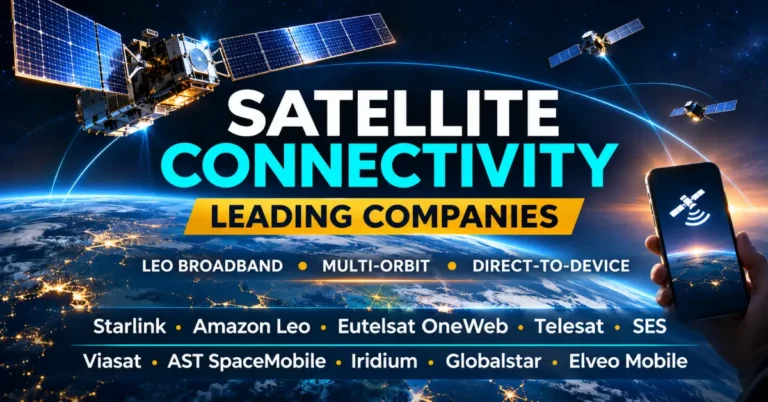
The top satellite connectivity companies in 2026 are SpaceX (Starlink), Amazon Leo, Eutelsat OneWeb and Telesat in LEO broadband; SES and Viasat in multi-orbit services; and AST SpaceMobile, Iridium, Globalstar and Elveo Mobile in direct-to-device and mobile satellite services. Starlink leads on scale, while spectrum deals are reshaping the direct-to-device field.

The satellite connectivity market is consolidating fast: several major operators have merged, been acquired or changed focus, and direct-to-device has become its own category. For the technology behind satellite-to-phone service, see our explainer on satellites as cell towers.
Why Satellite Connectivity Companies Matter for Telecom
Satellite connectivity has moved from a niche backhaul and maritime service into mainstream telecom planning. Three developments explain why operators, enterprises and regulators now treat satellite players as part of the mobile and broadband market.
- LEO broadband at scale: low Earth orbit constellations now deliver fibre-like latency to homes, aircraft, ships and enterprise sites in areas terrestrial networks do not reach.
- Satellite-to-phone services go live: direct-to-device (D2D) services connect standard smartphones to satellites, and mobile operators are signing partnerships to fill coverage gaps.
- Standards and spectrum converge: 3GPP non-terrestrial network (NTN) standards and large spectrum transactions are pulling satellite and mobile ecosystems together.
How We Selected the Top Satellite Connectivity Companies
We assessed operators that provide connectivity services, not satellite manufacturers or launch providers, using three criteria based on public information available in November 2026.
- Operational scale: satellites in service, customers or contracted capacity reported by the company.
- Relevance to telecom: wholesale, backhaul, enterprise, mobility or direct-to-device services that interact with mobile and broadband networks.
- 2026 momentum: launches, service entries, financing or transactions during the year.
Companies are grouped by category. Figures are company-reported unless another source is named.
LEO Broadband Satellite Connectivity Companies
Low Earth orbit constellations compete with fixed and mobile broadband in rural areas and serve aviation, maritime and government customers worldwide.
1. SpaceX (Starlink)
Starlink is the largest satellite connectivity provider by subscribers and satellites. SpaceX reported about 12 million Starlink customers across more than 160 countries and territories by mid-2026, served by a constellation of more than 10,000 satellites. Its Direct to Cell service, now marketed as Starlink Mobile, works with operator partners worldwide.
In 2026 SpaceX also strengthened its spectrum position for satellite-to-phone service. It acquired EchoStar‘s AWS-4 and H-block licences and agreed to buy Grain Management’s 800MHz portfolio, both tracked in our Telecom and Tech M&A Tracker.
2. Amazon Leo
Amazon’s constellation, renamed from Project Kuiper to Amazon Leo in November 2025, entered enterprise beta in April 2026. A July launch brought the fleet to 396 operational satellites, which Amazon said was enough to begin commercial service in initial latitudes in 2026. In April, Amazon also agreed to acquire Globalstar to add direct-to-device capability.
3. Eutelsat OneWeb
Eutelsat combines GEO satellites with the OneWeb LEO constellation, focused on enterprise, government, aviation and maritime customers. LEO revenues grew 69.5% in the 2025-26 financial year to about a quarter of group revenue. Backed by a €1.5 billion capital increase led by the French state, Eutelsat signed nearly €1 billion of export credit financing in February 2026 to procure next-generation OneWeb satellites, and holds a lead role in the EU’s IRIS² programme.
4. Telesat
Canada’s Telesat is building Lightspeed, a 198-satellite LEO network designed for enterprise, telecom backhaul and government users, including 500MHz of military Ka-band spectrum. The company plans to launch the first two Lightspeed production satellites in December 2026, followed by a high-cadence launch campaign through 2027.
Multi-Orbit Satellite Connectivity Companies
Multi-orbit operators combine geostationary, medium Earth orbit and partner LEO capacity, selling managed services to airlines, shipping lines, governments and telecom operators.
5. SES (including Intelsat)
SES completed its acquisition of Intelsat on 17 July 2025, creating a GEO and MEO operator with O3b mPOWER as its MEO flagship. In its 2025 results, SES reported €1.8 billion of new business and renewals and a combined backlog of over €6.6 billion. By Q1 2026, nearly 600 aircraft were flying with its multi-orbit inflight connectivity system, and three more O3b mPOWER satellites were scheduled for launch in the second half of 2026.
6. Viasat (including Inmarsat)
Viasat combines its Ka-band broadband fleet with Inmarsat’s L-band network. In 2026 it completed deployments on ViaSat-3 F2 and launched ViaSat-3 F3, which the company says will expand broadband capacity substantially, according to its FY2026 annual report. With Space42, Viasat is developing Equatys, a shared spectrum venture for direct-to-device services that could be supported by up to 2,800 satellites.
Direct-to-Device and Mobile Satellite Companies
Direct-to-device providers connect ordinary phones and IoT devices to satellites, usually in partnership with mobile operators, while mobile satellite service (MSS) operators hold the L-band and S-band spectrum that many of these services need.
7. AST SpaceMobile
AST SpaceMobile is building a space-based cellular broadband network designed to connect directly to unmodified smartphones. Its Block 2 BlueBird satellites carry communications arrays of nearly 2,400 square feet, the largest commercial arrays deployed in low Earth orbit. By August 2026 the company had launched 13 BlueBirds and was preparing beta service with AT&T and Verizon in the US.
8. Iridium
Iridium operates a global L-band LEO network used for voice, data, IoT and safety services. It announced that its 3GPP standards-based NTN service would go live in the second half of 2026, S&P Global reported. In June 2026, Rocket Lab agreed to acquire Iridium for about $8 billion, subject to approvals.
9. Globalstar
Globalstar provides mobile satellite services and the network behind satellite messaging features on Apple‘s iPhone. In April 2026, Amazon agreed to acquire Globalstar for about $11.6 billion, with Amazon Leo set to power satellite features on iPhone and Apple Watch once the deal completes.
10. Elveo Mobile (Lynk Global and Omnispace)
Elveo Mobile was formed when Lynk Global and Omnispace completed their merger on 14 August 2026. It combines Lynk’s direct-to-device satellites with Omnispace’s 60MHz of globally coordinated S-band spectrum, and reports commercial agreements with more than 50 mobile operators across more than 60 countries.
Satellite Connectivity Companies Compared
The table summarises each company’s orbit, key spectrum, main markets and 2026 status.
| Company | Orbit / type | Key spectrum | Main markets | 2026 status |
| SpaceX (Starlink) | LEO broadband and D2D | Ku, Ka; AWS-4 and PCS for D2D | Consumer, enterprise, mobility, government, operators | About 12 million customers; D2D in service |
| Amazon Leo | LEO broadband | Ka | Consumer, enterprise, government | 396 satellites; commercial service starting |
| Eutelsat OneWeb | LEO and GEO | Ku, Ka | Enterprise, government, mobility | LEO revenue up 69.5%; fleet refresh financed |
| Telesat | LEO (Lightspeed) and GEO | Ka, including military Ka | Enterprise, backhaul, government | First Lightspeed launches December 2026 |
| SES | GEO and MEO | C, Ku, Ka | Aviation, maritime, government, media | Intelsat integrated; O3b mPOWER expanding |
| Viasat | GEO | Ka, L (Inmarsat) | Aviation, maritime, government, broadband | ViaSat-3 F2 and F3 deployed |
| AST SpaceMobile | LEO D2D | Partner operators’ cellular spectrum | Mobile operators | 13 BlueBirds launched; US beta planned |
| Iridium | LEO | L | IoT, safety, government, NTN | NTN service due H2 2026; Rocket Lab deal pending |
| Globalstar | LEO MSS | L, S | Smartphone satellite features, IoT | Amazon acquisition pending |
| Elveo Mobile | LEO D2D | S | Mobile operators | Merger completed August 2026 |
Other Satellite Connectivity Companies to Watch
Several other companies play important roles in satellite connectivity, either as service providers in specific segments or as enablers for operators and device makers.
- Hughes (EchoStar): operates the JUPITER high-throughput GEO fleet and the HughesNet service, and provides managed LEO, private wireless and network services to enterprises and governments.
- Skylo: runs a 3GPP standards-based narrowband NTN service on existing operators’ satellites, used for satellite messaging and SOS on Google Pixel and Samsung Galaxy phones, Pixel Watch 4 and Verizon devices.
- Space42: the UAE satellite operator is Viasat’s partner in Equatys, the planned shared spectrum venture for direct-to-device services.
Satellite Connectivity Companies: Frequently Asked Questions
Who is the biggest satellite connectivity provider?
SpaceX’s Starlink is the largest by both satellites and customers, with more than 10,000 satellites in orbit and about 12 million customers by mid-2026. Among geostationary and medium Earth orbit operators, SES, combined with Intelsat since 2025, runs one of the largest multi-orbit fleets.
Who is Starlink’s biggest competitor?
In LEO broadband, Amazon Leo is Starlink’s most direct competitor, with commercial service starting in 2026, followed by Eutelsat OneWeb in enterprise and government markets. In satellite-to-phone services, AST SpaceMobile is the main alternative, working with AT&T, Verizon and other operators.
What is the difference between satellite broadband and direct-to-device?
Satellite broadband uses a dedicated terminal or dish to deliver internet service to homes, vehicles, ships, aircraft and enterprise sites. Direct-to-device connects ordinary smartphones and IoT devices to satellites without extra hardware, usually through a mobile operator partnership, and today focuses on messaging, emergency services and basic data.
Satellite Connectivity in 2026 by the Numbers
These figures show how quickly satellite connectivity has scaled and how deeply it now connects with mobile operators.
| Indicator | Figure | Source |
| Mobile operators with satellite service partnerships | 118 operators, with 33 services live, as of December 2025 | GSMA Intelligence, via S&P Global |
| Operators investing in D2D satellite technology | 97 | GSA State of the Market, April 2026 |
| Starlink Direct to Cell reach | First-generation constellation of 650+ satellites completed; more than 12 million people connected at least once | Starlink Progress Report |
| Satellite industry in 3GPP | The Mobile Satellite Services Association became a 3GPP Market Representation Partner in October 2026 | 3GPP |
Five Shifts Reshaping Satellite Connectivity
Five shifts are reshaping which companies lead satellite connectivity and how operators work with them.
- Consolidation: SES now includes Intelsat, and Iridium and Globalstar have agreed to be acquired by Rocket Lab and Amazon respectively.
- Project Kuiper became Amazon Leo and moved from prototypes to commercial service.
- EchoStar changed course: EchoStar changed course: it sold its terrestrial and satellite spectrum to AT&T and SpaceX, gaining a SpaceX equity stake, so its spectrum now sits with SpaceX’s direct-to-device plans.
- Manufacturers moved out of scope: Manufacturers and service providers have separated: Boeing builds satellites for operators such as SES and Viasat but does not sell connectivity services, which is why this guide focuses on service providers.
- Direct-to-device became a category: AST SpaceMobile, Globalstar and Elveo Mobile join the list as satellite-to-phone services move into commercial operation.
For more analysis like this, subscribe to the TeckNexus Newsletter, explore our 2027 programs, or partner with us to share your perspective and generate leads.