


Who Are the Top Telco Cloud and IT Cloud Computing Vendors in 2026?
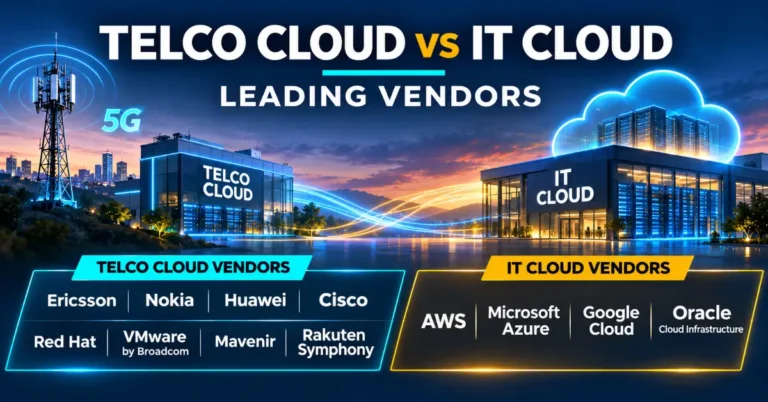
The top telco cloud vendors in 2026 are Ericsson, Nokia and Huawei in cloud-native 5G core, with Cisco, Red Hat, VMware by Broadcom, Mavenir and Rakuten Symphony providing networking, platforms and core software. AWS, Microsoft Azure, Google Cloud and Oracle Cloud Infrastructure lead the IT cloud vendors that operators use for edge, IT, AI and sovereign cloud.

Each of these vendors plays a distinct role, and those roles are shifting: 5G standalone has driven cloud-native core spending, hyperscalers have narrowed their network-function ambitions and moved towards AI and sovereign cloud, and several platform vendors have changed ownership or strategy.
Why Telco Cloud Vendors Matter in 2026
Three forces are reshaping how operators choose telco cloud and IT cloud vendors.
- 5G standalone drives cloud-native core: 5G SA requires a cloud-native core, and operators are consolidating virtual machines and containers onto common, horizontal platforms.
- AI moves into operations: vendors and hyperscalers now compete on AI agents for autonomous network operations, not just on infrastructure.
- Sovereignty shapes cloud choices: regulators and enterprise customers want data kept in-country, which favours private telco clouds and operator-run sovereign cloud services.
How We Selected the Top Telco Cloud Vendors
We grouped vendors by the role they play in operator cloud strategies and assessed them using public information available in November 2026.
- Breadth of telco cloud portfolio: core network functions, cloud platforms, networking, automation or public cloud services used by operators.
- Market evidence: analyst rankings, market share data or named operator deployments.
- 2026 activity: product launches, operator agreements or strategic changes during the year.
The list is not ranked by revenue. Figures are company-reported unless an analyst source is named.
Telco Cloud Platform and Network Vendors
These vendors supply the cloud-native network functions, platforms and networking that operators run in their own data centres and at the edge.
1. Ericsson
Role: Cloud-native 5G core, Cloud RAN and orchestration
Ericsson supplies dual-mode 5G core, Cloud RAN and automation software, and supports deployments on private and public clouds. The company reported more than 70 live cloud-native core deployments when it was named a Leader in the 2025 Gartner Magic Quadrant for CSP 5G core for the second consecutive year. With Google Cloud, it launched Ericsson On-Demand, which delivers core network services as software-as-a-service.
2026 focus: SaaS-delivered core, Cloud RAN and AI-driven network automation.
2. Nokia
Role: Cloud-native core, IP and data centre networking, network as code
Nokia’s core portfolio is fully cloud-native, covering packet core, voice core, subscriber data management and network exposure. It was named a Leader in the 2025 Gartner Magic Quadrant for CSP 5G core for the fifth consecutive year. Nokia also supplies data centre fabric and IP networking, and works with AWS and Google Cloud on agentic AI and network-as-code services.
2026 focus: Cloud-native core on multiple cloud platforms, AI-RAN with NVIDIA and AI-driven slicing.
3. Huawei
Role: Converged 5G core, cloud infrastructure and Huawei Cloud
Huawei offers a converged 2G to 5G core that supports evolution from virtualised to cloud-native network functions, alongside its Huawei Cloud public cloud. It was also named a Leader in the 2025 Gartner Magic Quadrant for 5G core network infrastructure, and Dell’Oro reports that Huawei, Ericsson and Nokia have gained mobile core share as 5G SA spending has grown.
2026 focus: AI-enabled core network and cloud services in markets where it operates.
4. Cisco
Role: IP networking, mobility services platform, security and observability
Cisco provides the IP transport, data centre networking, security and observability that underpin telco clouds, plus mobile core and IoT platforms. At MWC 2026, it highlighted its Mobility Services Platform for IoT-as-a-service and programmable core, and Cisco AI Grid with NVIDIA, which AT&T is using for edge AI inferencing on its IoT core.
2026 focus: Networks for distributed AI, AgenticOps automation and secure service provider infrastructure.
5. Red Hat
Role: Open source hybrid cloud platform for network and IT workloads
Red Hat, part of IBM, supplies OpenShift, OpenStack, OpenShift Virtualization and Ansible automation to operators building a common telco cloud for virtual machines and containers. In March 2026, Telefónica Spain standardised on Red Hat OpenShift as the common platform for its IT workloads and cloud-native network functions, and Telenor selected Red Hat platforms for its sovereign AI Factory.
2026 focus: Common telco cloud, OpenShift AI and sovereign AI platforms.
6. VMware by Broadcom
Role: Private telco cloud platform for VMs and containers
Broadcom acquired VMware in 2023 and continues to develop VMware Telco Cloud Platform for operator data centres. At MWC 2026 it announced VMware Telco Cloud Platform 9, built on VMware Cloud Foundation 9, which unifies VMs and containers and adds capabilities for sovereign cloud and AI services. Broadcom estimates a 40% five-year TCO saving compared with siloed architectures.
2026 focus: Sovereign, AI-ready private cloud for telco data centres.
7. Mavenir
Role: Cloud-native mobile core, IMS and Open RAN software
Mavenir is a software vendor focused on cloud-native packet core, IMS, messaging and Open RAN software, serving more than 300 operators. Following its June 2025 recapitalisation, it sharpened its focus on mobile core and AI-enabled automation and moved its Open RAN investment to 4G and 5G software rather than radio hardware.
2026 focus: Cloud-native IMS and packet core migrations, and AI-native network software.
8. Rakuten Symphony (including Robin.io)
Role: Kubernetes-based telco cloud, orchestration and storage
Rakuten Symphony, which absorbed Robin.io, sells Rakuten Cloud: a cloud-native platform, orchestrator and storage proven in Rakuten Mobile’s network. In March 2026, Nokia’s cloud-native IMS and core functions went live on Rakuten Cloud in Rakuten Mobile’s network, Samsung‘s vRAN and vCore completed interoperability testing on the platform, and Rakuten Cloud-Native Storage was built into Google Distributed Cloud connected servers.
2026 focus: Horizontal multi-vendor telco cloud and sovereign network-as-a-service.
For the Open RAN software and platform vendors that run on these clouds, see our Open RAN vendors by category guide.
IT Cloud Computing Vendors for Telcos
Hyperscalers provide the public cloud, edge zones, data and AI platforms that operators use for IT modernisation, enterprise services and, in some cases, network functions.
9. Amazon Web Services (AWS)
Role: Largest public cloud; edge zones, telco workloads and AI
AWS held 26% of the global cloud infrastructure market in Q3 2026, according to Synergy Research Group. For operators, AWS offers Outposts, Local Zones and Wavelength edge zones inside networks run by Verizon, Vodafone, KDDI, SK Telecom, Bell and BT. With Nokia, AWS is also trialling agentic AI for 5G network slicing with operators.
2026 focus: Generative and agentic AI for operations, edge computing and telco workload migration.
10. Microsoft Azure
Role: Public cloud, hybrid Operator Nexus platform and AI
Microsoft held 19% of the cloud infrastructure market in Q3 2026. Its main telco platform is Azure Operator Nexus, a hybrid carrier-grade cloud on which AT&T runs 5G near-edge network functions. Microsoft has wound down the Affirmed Networks core portfolio it acquired in 2020 and now concentrates on cloud infrastructure, AI and productivity services for operators.
2026 focus: Hybrid carrier-grade cloud and AI copilots and agents for operator workforces.
11. Google Cloud
Role: Public cloud, distributed cloud, data and AI for autonomous networks
Google Cloud held 16% of the market in Q3 2026 and grew faster than AWS. At MWC 2026 it showed its Autonomous Network Operations framework, which uses Gemini models, BigQuery and Spanner Graph to give AI agents a live digital twin of the network. Deutsche Telekom, Vodafone and One New Zealand are among the operators using or trialling it, and Google Distributed Cloud supports network workloads at the edge.
2026 focus: Agentic AI for network operations and customer experience. For why telecom agents need this grounding, see what makes telecom AI agents different.
12. Oracle Cloud Infrastructure (OCI)
Role: Public, dedicated and sovereign cloud; communications software
Oracle was among the fastest-growing tier-two cloud providers in Q3 2026, according to Synergy. Its telco offer combines OCI with Oracle Communications software for signalling, charging and BSS. Through Oracle Alloy, operators can run OCI as their own cloud: Ooredoo selected Oracle Alloy in February 2026 to deliver sovereign AI and cloud services from its data centres in Qatar.
2026 focus: Operator-run sovereign cloud and AI infrastructure.
Telco and IT Cloud Vendors Compared
The table summarises each vendor’s main role for operators in 2026.
| Vendor | Type | Main telco cloud role | 2026 highlight |
| Ericsson | Network vendor | Cloud-native core, Cloud RAN | Ericsson On-Demand with Google Cloud |
| Nokia | Network vendor | Cloud-native core, IP and data centre networking | Gartner core Leader, fifth year |
| Huawei | Network vendor and cloud | Converged core, Huawei Cloud | Gartner core Leader |
| Cisco | Networking vendor | IP, security, mobility platform | AI Grid with NVIDIA at AT&T |
| Red Hat | Platform vendor | OpenShift common telco cloud | Telefónica Spain standardises on OpenShift |
| VMware by Broadcom | Platform vendor | Private telco cloud | Telco Cloud Platform 9 |
| Mavenir | Software vendor | Cloud-native core and IMS | Refocus on core and AI |
| Rakuten Symphony | Platform vendor | Kubernetes cloud, orchestration, storage | Nokia core live on Rakuten Cloud |
| AWS | Hyperscaler | Public cloud, edge, AI | 26% cloud market share |
| Microsoft Azure | Hyperscaler | Operator Nexus, AI | 19% cloud market share |
| Google Cloud | Hyperscaler | Distributed cloud, data, agentic AI | Autonomous network agents |
| Oracle OCI | Hyperscaler | Sovereign and dedicated cloud | Ooredoo sovereign cloud on Oracle Alloy |
Other Cloud Vendors to Watch
Several other providers are relevant to operators, particularly in specific regions or for AI workloads.
- Alibaba Cloud: a major cloud provider in China and Asia-Pacific, offering infrastructure and AI services.
- IBM: Red Hat’s parent, providing hybrid cloud, AI and consulting services to operators.
- Neoclouds: GPU cloud providers such as CoreWeave, Nebius and Crusoe were among the fastest-growing cloud providers in 2026, and some operators are partnering with them or building similar AI infrastructure.
Telco Cloud Vendors: Frequently Asked Questions
What is telco cloud?
Telco cloud is the cloud infrastructure and software that operators use to run network functions such as the 5G core, RAN and voice services as software on shared, automated platforms, rather than on dedicated hardware. It can run in operator data centres, at the network edge or on public cloud.
What are the big three cloud providers?
Amazon Web Services, Microsoft Azure and Google Cloud are the three largest cloud providers. Together they held about 61% of global cloud infrastructure services spending in Q3 2026, according to Synergy Research Group.
Who are the leading 5G core vendors?
Huawei, Ericsson and Nokia are the leading 5G core vendors by market share and were each named a Leader in the 2025 Gartner Magic Quadrant for CSP 5G core. Mavenir, Cisco, Samsung and ZTE also supply core network software.
The Telco and IT Cloud Market in 2026 by the Numbers
These figures show the scale of the IT cloud market and the momentum behind cloud-native telco core.
| Indicator | Figure | Source |
| Global cloud infrastructure services spending, Q3 2026 | $167.7 billion, up 55% year on year; AI-specific services about a third of the market | Synergy Research Group |
| Cloud market share, Q3 2026 | Amazon 26%, Microsoft 19%, Google 16%; Oracle among the fastest-growing tier-two providers | Synergy Research Group |
| 5G mobile core network market outlook | Forecast revised up to 12% CAGR from 2025 to 2030 as 5G SA reaches an inflection point | Dell’Oro Group, January 2026 |
| 5G core vendor recognition | Ericsson, Nokia and Huawei each named a Leader in the 2025 Gartner Magic Quadrant for CSP 5G Core Network Infrastructure Solutions | Company announcements, 2025 |
Four Shifts Reshaping the Telco Cloud Vendor Landscape
Four shifts are changing how these twelve telco cloud vendors compete and what operators buy from them.
- Ownership changes: Broadcom acquired VMware, and Robin.io is now part of Rakuten Symphony’s Rakuten Cloud portfolio.
- Hyperscalers refocused: Microsoft wound down its Affirmed Networks core portfolio and concentrates on Operator Nexus and AI, while AWS and Google Cloud now lead with AI for network operations.
- Mavenir became a software-first company after its 2025 recapitalisation, focusing on mobile core and AI.
- AI and sovereignty became the main themes: platform launches in 2026 from Broadcom, Red Hat, Oracle and Rakuten Symphony all emphasise sovereign cloud and AI workloads.
For more analysis like this, subscribe to the TeckNexus Newsletter, explore our 2027 programs, or partner with us to share your perspective and generate leads.