





Where does AI-RAN really stand at the end of 2026?

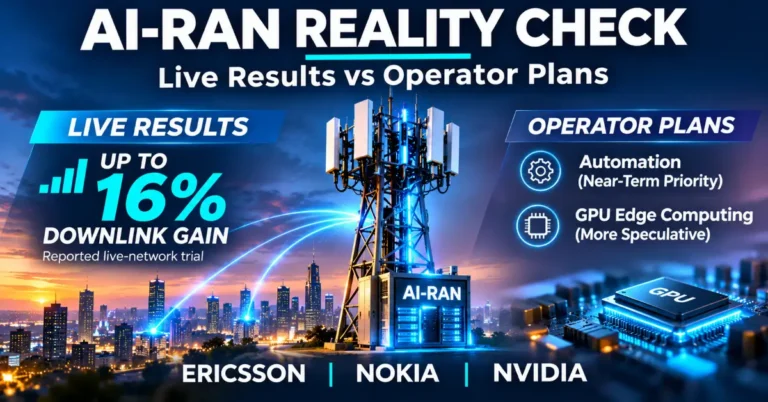
AI–RAN is delivering value today, mainly through network automation and AI software running on existing radio hardware. Live trials report spectral efficiency gains of around 10% and downlink improvements of up to 16%. Deeper AI in the baseband is in early field trials on both custom silicon and GPU platforms. Selling AI compute from the RAN remains a longer-term opportunity, held back by equipment depreciation cycles.
That picture comes from two sources. The first is the growing record of live-network results from operators working with Ericsson, Nokia and NVIDIA, which TeckNexus has tracked through 2026. The second is Omdia’s new AI RAN Operator Survey, sponsored by Amdocs, Ericsson, Qualcomm and Red Hat, which asked more than 100 people at mobile operators how they expect AI to change their radio networks. Read together, they show an industry that is moving faster on practical AI than the headlines about GPU base stations suggest, and more cautiously on AI compute monetisation.
Why AI-RAN adoption matters now
The radio access network is the largest and most expensive part of a mobile network, and for most operators it is a flat-revenue asset. AI-RAN offers three things operators badly need: more capacity from the same spectrum, lower operating costs through automation, and a possible new revenue line from hosting AI workloads at the network edge.
Timing makes the question urgent. Operators are already planning the hardware that will carry them from 5G-Advanced into 6G, and the choices made in this refresh cycle will shape their networks for close to a decade. At the same time, AI devices, agents and physical AI applications are starting to change traffic patterns, particularly in the uplink. Decisions about where AI runs in the RAN, and on what silicon, are being made now.
For vendors, the stakes are just as high. Ericsson and Nokia have taken different hardware paths to the same goal, and both are now producing results on live networks. TeckNexus examined the first wave of those results in its analysis of AI-RAN moving from the lab to the live network.
What live networks show about AI-RAN today
The most useful evidence comes from operators running AI features on commercial traffic. The table below summarises key results and milestones published during 2026. Figures are vendor- or operator-reported and refer to specific trial conditions.
| Operator and vendor | AI-RAN development | Reported result or status |
| T-Mobile US with Ericsson | AI-native Scheduler with Link Adaptation in large-scale commercial trials | Close to 10% higher spectral efficiency and up to 15% higher downlink throughput (May 2026) |
| T-Mobile US with Ericsson | AI-Managed Beamforming on live 5G-Advanced sites in New York City | 16% higher downlink throughput and 12% better spectral efficiency at peak demand (October 2026) |
| Ericsson installed base | AI-native link adaptation running as software on existing Ericsson silicon | Up to 10% average spectral efficiency improvement in real-world deployments, with no new hardware |
| T-Mobile US with Nokia and NVIDIA | First AI-RAN call at a commercial cell site in Bellevue, Washington | Completed October 2026; performance data not yet published |
| Elisa with Nokia | Voice, mobile data and video analytics on one AI-RAN platform in Helsinki | Completed in a live environment; commercial services expected in 2027 |
| Deutsche Telekom with Nokia | AI-based channel estimation | Typical uplink gains of 10% to 15% in lab measurements |
| DNB with Ericsson | AI-driven autonomous RAN fault management | TM Forum Level 4 validation for three of five fault categories (November 2026) |
| VodafoneThree with Nokia and NVIDIA | AI-RAN lab and selected-site field trials | Announced November 2026; trial work expected during 2027 |
Three patterns stand out. First, the largest body of measured results so far comes from AI features that run on existing hardware and improve specific radio functions, such as link adaptation and beamforming. Second, GPU-based AI-RAN has crossed the threshold into live networks, with first calls and multi-workload trials completed and broader field programmes lined up for 2027. Third, automation is producing formally validated outcomes, with DNB and Ericsson showing that Level 4 autonomy is achievable for defined operational processes.
The VodafoneThree programme illustrates where the market is heading: operators testing more than one approach at once. TeckNexus covered that dual-track strategy in its analysis of VodafoneThree’s AI-RAN trials with Nokia and NVIDIA.
Two AI-RAN hardware paths, both moving forward
The debate over AI-RAN silicon is often framed as a contest, but the evidence points to two credible paths serving different needs.
- Custom silicon with embedded AI acceleration: Ericsson runs AI-RAN features as software on its own baseband and radio silicon, and has launched AI-ready radios with neural network accelerators built in. The advantage is immediate: gains can reach the existing installed base without a hardware change.
- GPU-accelerated RAN: Nokia runs its anyRAN software on NVIDIA’s accelerated computing platform. The advantage is flexibility: the same hardware can run radio processing, AI models that improve the radio, and other AI workloads such as video analytics or sensing.
Operators appear to see value in both. Many expect AI accelerators to become essential, but they differ on whether those accelerators are needed mainly to run AI inside the radio stack or to host broader AI applications alongside it. A meaningful minority believe existing architectures can handle many AI-RAN tasks. For most operators, the practical answer will depend on the site: a dense urban hub with edge AI demand is a different proposition from a rural macro site serving light traffic.
By the numbers: what operators told the Omdia AI-RAN survey
The Omdia AI RAN Operator Survey 2026 gathered responses from 113 people at telecom operators with wireless networks in July and August 2026. The US accounted for about a third of respondents and Western Europe for about a fifth, and most worked at operators with more than $1 billion in annual revenue. The research was led by Omdia analyst Gabriel Brown and sponsored by Amdocs, Ericsson, Qualcomm and Red Hat, which developed the questionnaire jointly with Omdia. Its main findings include:
| Topic | What operators said |
| Impact of AI traffic | 88% expect AI traffic to materially affect their RAN within three years; 31% see a large impact needing an urgent response |
| AI models in the base station | 12% have deployed or plan to deploy them, 27% are in live network trials, 27% in lab trials and 30% at the research stage |
| Near-term business impact | AI for RAN management and automation ranked first, ahead of AI for radio performance and AI compute hosted in the RAN |
| Hardware | 64% believe AI accelerators will be critical for AI-RAN; 20% think traditional architectures remain sufficient for many tasks |
| Capex barrier | 45% named depreciation cycles of existing RAN equipment as the biggest obstacle to AI-RAN compute investment; 26% cited extended ROI timelines |
| Selling AI compute | 48% expect to partner with software vendors bringing prebuilt workloads; 34% plan a direct technical salesforce; 11% favour a self-service marketplace |
| Agentic RAN priorities | 81% placed network operations and assurance in their top three lifecycle stages for AI, followed by optimisation at 73% |
| Open RAN | 43% see open RAN as a cornerstone of AI-RAN and 6G; a further 49% are committed to it despite its current maturity |
Omdia’s own commentary adds useful context. It notes that operators may overestimate their progress on fast-moving technologies, and describes expectations of Level 4 autonomy across most RAN processes within a year as optimistic, while judging Level 4 for discrete processes over the next year or two as realistic. That reading matches the live-network record above.
TeckNexus perspective: what AI-RAN adoption means for the market
Combining the survey with deployment evidence, TeckNexus sees five conclusions for operators, vendors and enterprise buyers.
- Automation is the first AI-RAN business case. The quickest returns come from AI that reduces faults, energy use and manual work across the existing network. Operators that map their RAN processes and measure their cost and duration will be best placed to show results.
- AI-RAN will arrive through software and refresh cycles. With depreciation cycles the leading capex barrier, most AI-RAN capability will reach networks as software on installed equipment or as part of planned hardware renewals. Investment protection is a core requirement, not a constraint to work around.
- Both silicon strategies will coexist. Custom silicon is delivering measurable gains at scale today, while GPU platforms are opening the door to multi-workload sites. Operators will choose by site type, power budget and the services they plan to offer.
- AI compute at the edge is a partner business first. Most operators expect to sell RAN-hosted AI compute with software partners rather than compete with hyperscalers. Services where the network itself creates the value, such as sensing and drone detection, are the clearest cases for operators to lead directly.
- Utilisation decides the economics. AI hardware at a cell site pays back only if it is kept busy. That favours designs that share capacity between radio and AI workloads where demand justifies it, and lighter configurations elsewhere.
The sensing opportunity deserves particular attention. TeckNexus has examined how 5G networks are being turned into drone sensors, a service that depends on the radio network itself and that critical infrastructure operators are actively seeking. Operators building telco AI factories face the same utilisation discipline at data centre scale that AI-RAN will bring to cell sites.
For enterprises and private network operators, the same direction of travel applies. AI-RAN features that improve uplink capacity, positioning and reliability are directly relevant to industrial sites running video analytics, autonomous vehicles and connected workers. Light-touch designs that colocate radio and AI compute at a customer facility could also bring edge AI closer to factories, ports and utilities without a separate infrastructure build.
What comes next for AI-RAN
Several milestones over the next 12 to 18 months will show how quickly AI-RAN moves from trials to standard practice:
- Field trials at scale. BT‘s live-network trial in Birmingham, Elisa’s commercial AI-RAN services and VodafoneThree’s field trial are all expected during 2027.
- Published GPU-based performance data. Measured results from live GPU-accelerated sites will allow like-for-like comparison with AI features on custom silicon.
- Wider Level 4 validations. More operators securing Level 4 autonomy for defined processes such as energy management and fault handling.
- Power within site limits. Operators ranked the ability to deploy within existing site power and footprint as the top criterion for AI-RAN and 6G architectures, so efficiency results will carry particular weight.
- Early AI compute services. The first commercial offers that host partner AI workloads or sensing services at the RAN edge will test whether operators can turn network compute into revenue.
AI-RAN is no longer a question of whether. The evidence now shows AI improving radio performance and operations on commercial networks, with two strong hardware paths and a clear set of near-term priorities. The bigger prize, an AI-native network that hosts new services at the edge, will be built step by step on those foundations.
For more analysis like this, subscribe to the TeckNexus Newsletter, explore our 2027 programs, or partner with us to share your perspective and generate leads.