



Who Are the Leading 5G Core Vendors in 2026?
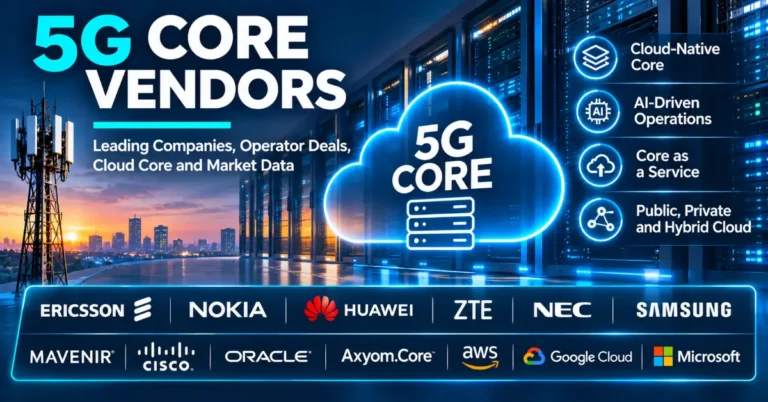
Ericsson, Nokia and Huawei are the leading 5G core vendors in 2026. Ericsson and Nokia lead outside China, where they have won many of the largest 5G standalone core contracts of 2026, while Huawei is the largest supplier by core revenue, driven by China and emerging markets. ZTE, NEC and Samsung complete the top tier, and Mavenir, Cisco, Oracle and Axyom.Core lead the software specialists.

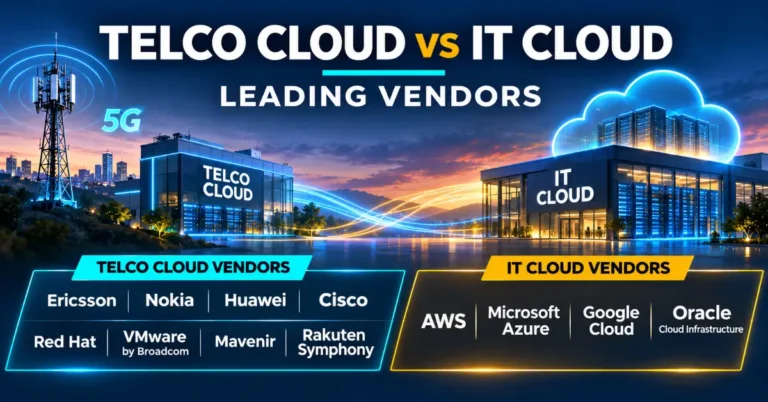
The 5G core is the control centre of a mobile network. It handles subscriber identity, sessions, mobility, policy and charging, and it is the part of the network that makes 5G standalone features such as network slicing and RedCap possible. This guide covers the companies that supply it today and how their roles are changing. For the wider 5G supplier landscape, see our 5G companies infographic and our guide to top telco and IT cloud vendors.
Why 5G Core Vendors Matter in 2026
Five forces have moved the 5G core to the top of operator investment plans.
- 5G standalone has reached scale. Operators that launched 5G on a 4G core are now replacing or upgrading it, because slicing, RedCap, 5G-Advanced and many enterprise services need a standalone core.
- The market is consolidating. Large vendors have taken share from smaller players as operators favour suppliers that can cover 4G, 5G and voice in one cloud-native core.
- Core is moving to cloud and as-a-service models. 2026 brought the first commercial 5G core delivered as software-as-a-service and the first commercial 5G core on public cloud in Asia Pacific.
- Forced migrations are under way. Microsoft‘s decision to wind down the Affirmed Networks core portfolio means its operator customers, many of them regional carriers, must move to a new core supplier.
- AI is entering the core. Vendors now compete on AI agents that build, operate and optimise the core, alongside traditional performance and reliability.
These shifts also shape how operators use AI in operations; see what makes telecom AI agents different for why grounding in live network data matters.
How We Selected the 5G Core Vendors
We grouped 5G core vendors by the role they play for operators and assessed them on four criteria, using public information available in November 2026.
- Portfolio breadth: packet core, subscriber data management, policy, charging, signalling, voice (IMS) and network exposure.
- Operator evidence: named 5G standalone or core modernisation contracts and live deployments in 2025 and 2026.
- Market position: analyst market share data and evaluations from Gartner, Omdia and Dell’Oro Group.
- Direction: progress on cloud-native architecture, core as a service and AI automation.
The list is not a strict revenue ranking. Figures are company-reported unless an analyst source is named.
5G Core Vendors at a Glance
The table below summarises the main 5G core vendors and their 2026 highlights.
| Vendor | Type | Core focus | 2026 highlight |
| Ericsson | Network vendor | Dual-mode 5G core, cloud IMS, Ericsson On-Demand SaaS | MasOrange, Wind Tre, SoftBank and ICE core deals |
| Nokia | Network vendor | Cloud-native core on any cloud, Core SaaS | First commercial 5G Core SaaS service, with Citymesh on AWS |
| Huawei | Network vendor | Converged 2G to 5G core, AI core | AgenticCore launch at MWC 2026 |
| ZTE | Network vendor | 5G Common Core on its own distributed cloud | Third-largest core supplier by revenue |
| NEC | Network vendor | Cloud-native 5G core and UPF | DOCOMO commercial 5G core on AWS |
| Samsung | Network vendor | Cloud-native 5G and 4G core | Videotron core gateway deployment |
| Mavenir | Software specialist | Converged packet core, IMS, messaging | Deutsche Telekom energy savings; Rakuten Mobile packet core live |
| Cisco | Software and networking | Ultra Cloud Core, Programmable Core | AT&T 5G SA IoT platform |
| Oracle | Signalling specialist | Signalling, policy and charging | Transatel 5G SA signalling core |
| Axyom.Core | Software specialist | Converged 4G/5G core | Telenor distributed core; Affirmed migrations |
Tier-One 5G Core Vendors
Six network equipment vendors supply most of the world’s mobile core networks, usually alongside their radio and voice portfolios.
1. Ericsson
Role: Dual-mode 5G core, cloud IMS, subscriber data management and core as a service
Ericsson’s dual-mode 5G core serves 4G and 5G subscribers on one cloud-native platform, running on its own Cloud Native Infrastructure Solution or on private and public clouds. It was named a Leader in the 2025 Gartner Magic Quadrant for CSP 5G core for the second year running, and with Google Cloud it offers Ericsson On-Demand, which delivers core network functions as software-as-a-service.
2026 has been a strong year for Ericsson core contracts. MasOrange chose Ericsson to unify its 5G standalone core across all its brands, Wind Tre signed a seven-year core modernisation agreement running to 2032, SoftBank signed a multi-year framework agreement to accelerate 5G standalone in Japan, and Costa Rica’s ICE picked Ericsson for radio and a full 5G core for its new standalone network.
2026 focus: Core modernisation and 5G standalone migrations, SaaS-delivered core and AI-driven automation.
2. Nokia
Role: Cloud-native core for any cloud, voice core, network exposure and Core SaaS
Nokia’s core portfolio is fully cloud-native across 2G to 5G and IMS voice, and its strategy is to run that core on any infrastructure, including AWS, Google Cloud and Microsoft Azure. Nokia was named a Leader in the 2025 Gartner Magic Quadrant for CSP 5G core for the fifth year running, positioned furthest for completeness of vision, and Omdia’s 2026 core vendor review ranked it first for portfolio competitiveness.
In February 2026, Belgium’s Citymesh became the first operator to launch a commercial mobile service on 5G Core SaaS, using Nokia’s Core SaaS for Business on AWS to serve enterprises, first responders and small businesses without owning core infrastructure.
2026 focus: Core as a service, multi-cloud deployment and network exposure through APIs.
3. Huawei
Role: Converged 2G to 5G core, Huawei Cloud and AI core
Huawei is the largest mobile core supplier by revenue, according to Omdia, helped by China and gains in emerging markets. It offers a fully converged 2G to 5G core that can evolve from virtualised to cloud-native functions, runs it on its own telco cloud and chipsets, and was named a Leader in the 2025 Gartner Magic Quadrant for 5G core. At MWC 2026 it launched AgenticCore, which adds AI agents to voice, mobile internet and home broadband services. Its business is concentrated in China, the Middle East, Africa and Asia Pacific.
2026 focus: AI-centric core and 5G-Advanced service monetisation.
4. ZTE
Role: 5G Common Core on ZTE’s distributed cloud
ZTE’s Common Core consolidates 2G to 5G and fixed access on a single containerised platform, using its own distributed cloud and stateless database. ZTE is the third-largest core vendor by revenue in Omdia’s ranking and a major supplier to China Mobile’s 5G standalone core, with growing activity in Asia, the Middle East and Africa.
2026 focus: AI-native core and converged fixed and mobile core.
5. NEC
Role: Cloud-native 5G core and user plane
NEC is one of the five vendors that together hold most of the core market, with a strong base in Japan. In February 2026, NTT DOCOMO and NEC launched Japan’s first commercial 5G core on AWS, in a hybrid design with DOCOMO’s own cloud. AI agents built the deployment, cutting construction time by about 80%. NEC’s user plane function now also runs on second-generation AWS Outposts racks inside operator sites.
2026 focus: Hybrid cloud core and AI-automated core operations.
6. Samsung
Role: Cloud-native 5G and 4G core
Samsung is building a core business alongside its radio portfolio. In February 2026, Canada’s Videotron selected Samsung to deploy its 5G non-standalone and 4G core gateway on Dell servers with AMD processors and Red Hat OpenShift, extending a radio partnership that began in 2019. Samsung also optimises its core for AWS, Google Cloud and Microsoft Azure for enterprise edge use.
2026 focus: Cloud-native AI core and growth beyond its radio customers.
Cloud-Native 5G Core Software Specialists
Software specialists compete on cloud-native design, cost and flexibility, often supplying specific core functions alongside a larger vendor.
7. Mavenir
Role: Converged packet core, IMS voice and messaging
Mavenir is a software company serving more than 300 operators. Deutsche Telekom reported up to 65% energy savings in its 5G core in projects supported by Mavenir in February 2026, and in April Mavenir’s converged packet core went live in Rakuten Mobile’s nationwide network, supporting Japan’s new emergency roaming service. Recent customers also include RINA Wireless, Tune Talk and TextNow.
2026 focus: Cloud-native packet core and voice migrations, and AI-enabled automation.
8. Cisco
Role: Ultra Cloud Core, converged core and core as a service
Cisco supplies cloud-native packet core software and the data centre and IP networking it runs on, and is a long-standing core supplier to T-Mobile in the US. In February 2026, AT&T and Cisco activated a 5G standalone IoT platform that links AT&T’s standalone core with Cisco’s Mobility Services Platform and converged core. Cisco’s Programmable Core offers mobile core as a service for wholesale, MVNO and IoT traffic.
2026 focus: IoT as a service, core as a service and networks for distributed AI.
9. Oracle
Role: 5G signalling, policy and charging
Oracle Communications supplies the signalling and control functions that tie a 5G core together, including the service communication proxy, security edge protection proxy and network repository function, plus policy and converged charging. Transatel, an NTT company, chose Oracle’s cloud-native 5G signalling core for its 5G standalone IoT services in November 2025.
2026 focus: Cloud-native signalling, policy and charging for 5G standalone.
10. Axyom.Core
Role: Converged 4G and 5G core, femto core and security gateways
Axyom.Core offers a single stateless core for 4G, 5G and Wi-Fi access and has become an upgrade path for operators leaving the Affirmed Networks platform. Telenor runs a distributed 5G core from Axyom.Core on Red Hat OpenShift so that edge sites keep working if links to the central core fail. Omdia added Axyom.Core to its group of upcoming core vendors in 2026.
2026 focus: Affirmed migrations, fixed wireless access and distributed edge core.
5G Core Vendors for Private and Enterprise Networks
Private networks need compact cores that run on a single server or in the cloud and are simple for enterprise teams to manage. HPE‘s Athonet core, Druid Software’s Raemis, Cumucore, Ataya, Highway 9 Networks, Pente Networks, Blue Arcus and Tecore Networks all specialise here, alongside the private offers of Ericsson, Nokia and Samsung. Our guide to private network ecosystem players covers these companies in detail.
Hyperscalers and the 5G Core
Cloud providers now host 5G core software from network vendors rather than selling their own core.
- AWS hosts NEC’s core for NTT DOCOMO and Nokia’s Core SaaS for Citymesh, and its Outposts racks bring cloud infrastructure into operator sites.
- Google Cloud partners with Ericsson on Ericsson On-Demand and supports Nokia’s multi-cloud core.
- Microsoft is winding down the Affirmed Networks core portfolio it bought in 2020 and retired Azure Private 5G Core in 2025, focusing instead on Azure Operator Nexus, the hybrid cloud on which AT&T runs 5G network functions, and on AI.
For the cloud platforms operators use to run core software, see our telco and IT cloud vendors guide. For the radio side of the network, see Open RAN vendors by category.
Other 5G Core Vendors to Watch
Beyond the vendors profiled above, many companies supply specific core functions or platforms.
| Segment | Companies |
| Core network software | Enea, Alepo, Expeto, A5G Networks, Pente Networks, Blue Arcus, Tecore Networks, Druid Software, Cumucore, Ataya, Highway 9 Networks, Rakuten Symphony |
| Open source core | Open5GS, free5GC, OpenAirInterface, Magma |
| Signalling, policy and charging | Oracle, Amdocs, Matrixx Software, Optiva, Enea |
| Assurance and analytics | RADCOM, NETSCOUT, VIAVI Solutions |
| Core security | A10 Networks, Palo Alto Networks, Fortinet, SecurityGen |
| Cloud platforms for the core | Red Hat, VMware by Broadcom, Wind River, AWS, Google Cloud, Microsoft Azure |
Five Shifts Reshaping the 5G Core Market
Taken together, the 2026 activity above points to five shifts in the 5G core market.
| Shift | What it looks like in 2026 |
| Standalone migrations drive spending | Operators such as MasOrange, Wind Tre and SoftBank are replacing or unifying cores to move subscribers to 5G standalone |
| Share consolidates with the largest vendors | Ericsson, Nokia and Huawei gain share as smaller suppliers lose ground |
| Core becomes a cloud service | Nokia Core SaaS on AWS, Ericsson On-Demand on Google Cloud and NEC’s core on AWS for DOCOMO |
| Affirmed customers move | Microsoft’s wind-down opens deals for Ericsson, Nokia, Mavenir, Cisco and Axyom.Core |
| AI agents run the core | AI-automated deployment at DOCOMO, Huawei AgenticCore and agentic operations from all major vendors |
The 5G Core Market in 2026 by the Numbers
These analyst figures show how fast the 5G core market is moving and how concentrated it remains.
| Indicator | Figure | Source |
| 5G mobile core revenue growth, North America and EMEA, 1Q 2026 | About 20% year on year, while China declined | Dell’Oro Group |
| Share movement, 1Q 2026 | Huawei, Ericsson and Nokia took share from smaller vendors; Nokia gained most outside China | Dell’Oro Group |
| Core market concentration, 2025 | Top five vendors held 86.1% of 4G and 5G core revenue | Omdia, Market Landscape: Core Vendors 2026 |
| Portfolio competitiveness, 2026 | Nokia first, Ericsson second | Omdia, Market Landscape: Core Vendors 2026 |
| Gartner Leaders, 5G core, 2025 | Ericsson, Nokia and Huawei | Gartner Magic Quadrant for CSP 5G Core |
| Operators with launched 5G standalone service | 95, up 42% since 1Q 2025; 29% of 5G services were standalone | GSA, April 2026 |
Omdia’s market share figures exclude spending on cloud infrastructure, servers and management software, so they measure core application revenue only.
5G Core Vendors: Frequently Asked Questions
What is a 5G core network?
The 5G core is the central part of a mobile network that authenticates users, manages sessions and mobility, applies policy and charging, and connects devices to the internet and services. Unlike the 4G core, it uses a cloud-native, service-based architecture, which makes features such as network slicing possible.
Who are the top 5G core vendors?
Ericsson, Nokia and Huawei are the top 5G core vendors, each named a Leader in Gartner’s 2025 Magic Quadrant. Ericsson and Nokia lead outside China, and Huawei is the largest by revenue. ZTE, NEC and Samsung are the other major suppliers, followed by software specialists such as Mavenir, Cisco, Oracle and Axyom.Core.
What is the difference between a 5G non-standalone and a 5G standalone core?
Non-standalone 5G uses 5G radios with an existing 4G core, which speeds up launch but limits features. Standalone 5G uses a new 5G core, which enables network slicing, lower latency, RedCap devices and 5G-Advanced capabilities.
Can the 5G core run on public cloud?
Yes. In 2026, NTT DOCOMO launched a commercial 5G core on AWS with NEC, and Citymesh launched the first commercial mobile service on Nokia’s Core SaaS, also on AWS. Most large operators still run their main core on private telco clouds, often with public cloud for specific functions or new services.
What happened to Affirmed Networks?
Microsoft bought Affirmed Networks in 2020 and is now winding down its core portfolio. Operators that used it are moving to other core suppliers, including Ericsson, Nokia, Mavenir, Cisco and Axyom.Core.
For the other categories of 5G suppliers and operators, see our overview of the leading 5G companies.
For more analysis like this, subscribe to the TeckNexus Newsletter, explore our 2027 programs, or partner with us to share your perspective and generate leads.