Nokia

Nokia Defense and NestAI have published their first operational capabilities: AI-enabled command and control on deployable 5G, connectivity-aware mission planning, and Integrated Sensing and Communications for threat detection. The assumption they’re engineering against — that connectivity will be available and adequate — is the same assumption that limits industrial AI deployments in underground mines, complex facilities and remote critical infrastructure sites.
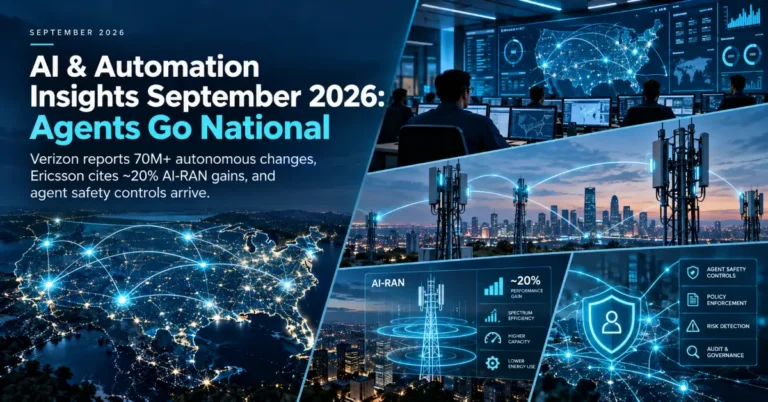
Telecom just crossed a line it spent years approaching carefully. AI agents are no longer confined to recommending fixes to network engineers — in a growing number of deployments, they're diagnosing faults and proposing remediations that a human simply signs off on, rather than performs. Nokia's work with Google Cloud is a clear marker of how far this has come: agents built on Gemini now sit inside Nokia's Assurance Center, and early results point to fault-resolution times cut by more than half, sometimes by as much as 80 percent. That's the part of the story getting the headlines. It's also, in a sense, the easy part... The harder question — the one the industry has mostly deferred — is what happens structurally once agents stop merely proposing and start acting, especially across more than one system at a time.
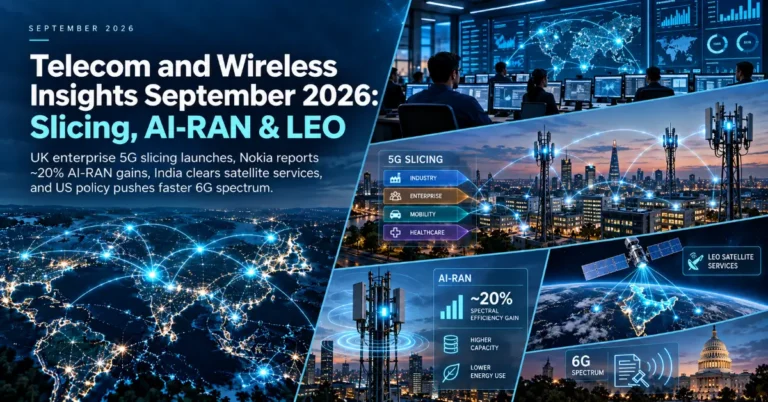
June 2026 showed agentic AI scaling from pilot to platform: industry-wide standards momentum, AI-RAN field trials from Nokia, Amdocs and KDDI, and fresh capital across data centers on three continents. This full roundup covers every deployment, partnership, funding round and governance move from the month, with tools to prioritise AI use cases and plan the network around them.
Telecom AI agents share the same anatomy as any AI agent - but grounding, systems, stakes, goals, and multi-vendor interoperability set them apart. Here are the five differences that matter, plus how to evaluate an agent before you trust it on a live network.
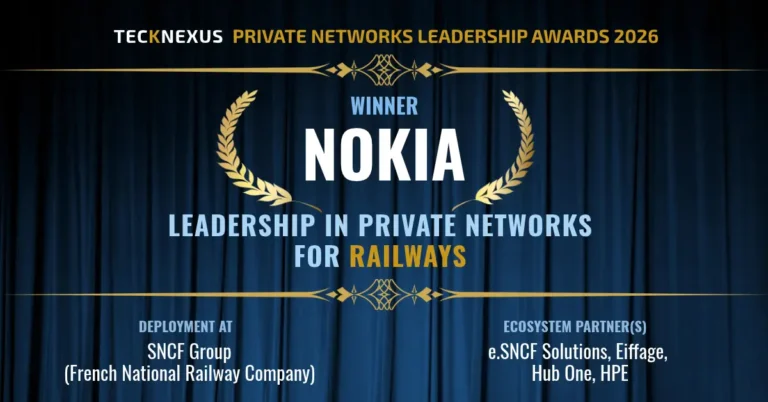
Private 5G became an industrial default in May 2026, with CBRS now the U.S. factory spectrum of record. This month's roundup spans deployments across manufacturing, ports, utilities, rail and defence — plus a deep utilities thread on grid AI and security — and what the shift means for buyers scoping spectrum, architecture and security.
T-Mobile's Dynamic CX applies AI to its Self-Organizing Network architecture, scanning public data sources - event schedules, ticketing platforms, social activity — to anticipate high-density demand before it strains the network. Launching ahead of the 2026 FIFA World Cup across eleven U.S. host cities, the capability shifts network management from reactive triage to proactive resource allocation. Opensignal data from February through May 2026 already shows T-Mobile leading mobile experience metrics in all eleven markets, a baseline Dynamic CX is engineered to sustain under peak load conditions.
Interactive business case tool for port terminal operators evaluating private wireless investment. Models ROI across crane automation, yard management, and worker connectivity use cases.
Estimate the sustainability impact of deploying private wireless — including energy efficiency gains, carbon reduction, and ESG reporting metrics - across industrial and enterprise environments.
Sponsored by Palo Alto Networks
⚡ Utilities ⏱ 8 min ✓ Free
This tool is built and hosted by TeckNexus.
Launch Tool →
Whitepaper
Airports are deploying AI surveillance, biometrics, and autonomous vehicles faster than most networks can secure them. See what 100 real-world airport deployments reveal about the airside/landside security gap — and the 4-layer framework built to close it....
Palo Alto Networks
Scroll to Top