Cisco

Runaway AI training demand is pushing data center fabrics past their limits, making optical networking the bottleneck to unlock GPU-scale performance and efficiency. Scale-up connects more GPUs within a box or across tightly coupled racks to form supernodes with ultra-low-latency fabrics. A new forecast from Goldman Sachs positions optical networking as the next mega-trend in AI infrastructure, with spend growing an order of magnitude as clusters densify. CPO—integrating optical engines with switch ASICs or accelerators—features prominently in the growth outlook. Expect a technology mix that also includes pluggable 800G/1.6T optics and emerging Linear Pluggable Optics (LPO) to reduce DSP power at short reaches.
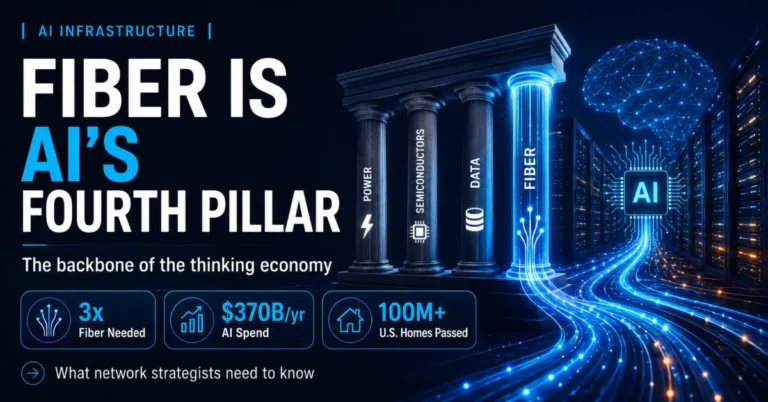
The Fiber Broadband Association's Fiber Connect 2026 conference repositioned fiber as a foundational prerequisite for AI infrastructure — not merely a consumer broadband conduit. With hyperscalers investing $370 billion annually in AI, the FBA projects demand for twice as many fiber route miles and three times total fiber deployed today. Over 100 million U.S. homes have now been passed with fiber, yet workforce shortages exceeding 200,000 workers and power constraints threaten deployment velocity precisely when AI-driven demand is accelerating fastest.
Enterprises need indoor mobile coverage that works like the macro, integrates with private wireless, and sets a path to 5G and AI without ripping-and-replacing infrastructure. InfiniG’s Neutral Host as a Service turns a CBRS shared-spectrum deployment into an extension of public mobile networks using a 3GPP MOCN architecture. Employees, contractors, and visitors get native service from AT&T, T-Mobile, and Verizon on their existing SIMs—no apps, no plan changes. The Nokia RAN is 5G-ready out of the box, protecting investments as operators certify 5G Standalone and VoNR on neutral host. Radios and gateways are software-upgradable, so enterprises can deploy today for LTE and move to 5G without swapping hardware.
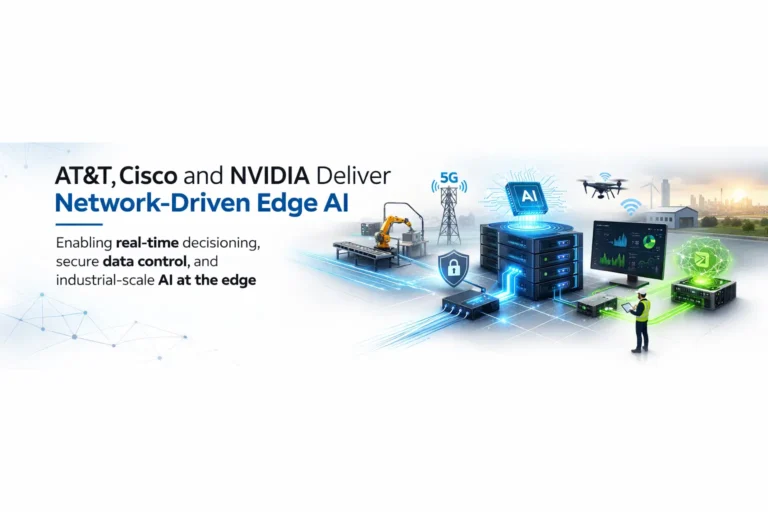
AT&T’s new collaboration with Cisco and NVIDIA signals a decisive shift from cloud-centric AI to network-driven edge intelligence for enterprise operations. Enterprises want real-time decisioning without shipping sensitive data to distant clouds, and operators need a scalable way to deliver it. By combining AT&T’s dedicated IoT core with Cisco’s mobility services platform and NVIDIA-powered AI infrastructure, the trio is packaging deterministic connectivity, near-device inference, and policy enforcement into a single, operator-grade platform. The promise: lower latency, tighter data control, and a path to production for AI at industrial scale.
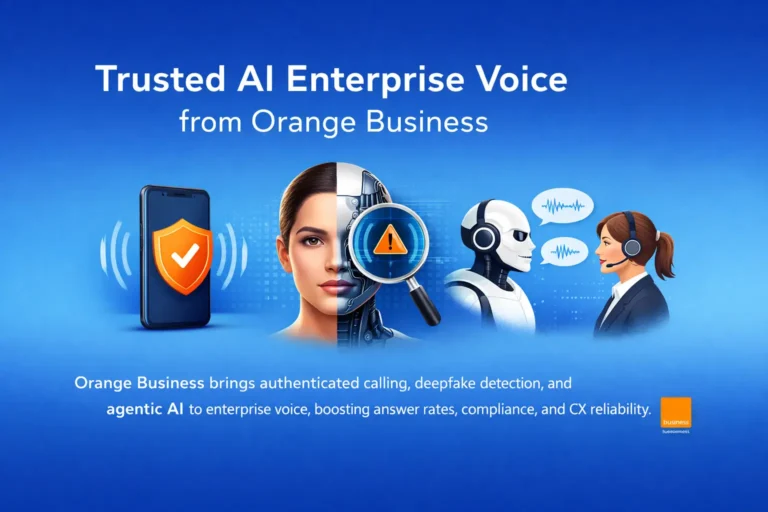
Orange Business is putting authenticated, AI-augmented voice back in the critical path of CX and employee workflows as enterprises confront fraud, fatigue, and falling answer rates. As digital touchpoints proliferate, the phone channel faces a crisis of confidence: spoofed identities, impersonation scams, and AI-generated content have eroded user trust and pushed customers to ignore legitimate calls. Despite surging chat and self-service volumes, voice remains the preferred medium for resolving complex or high-stakes problems, and the most-used channel for many service agents. The new capabilities combine authenticated caller identity, deepfake detection, generative AI in the contact center, and agentic telephony that can autonomously manage call flows.
Private LTE, 5G, and CBRS networks are becoming the backbone of industrial operations. This article maps private network security vendors to a Four Pillars framework—Core Controls, Device Visibility, Detection & Response, and Orchestration—revealing where structural gaps emerge in real-world industrial deployments. From slice isolation and SIM lifecycle governance to OT micro-segmentation and SOC integration, it explains why layered enforcement—not vendor breadth—determines private 5G security resilience.
Enterprises are moving fast to private 5G to digitize operations, but the payoff only materializes if security scales with the new connectivity footprint. Private 5G brings deterministic wireless to factories, hospitals, ports, and energy sites, connecting robots, AGVs, cameras, and critical control systems. Security must follow identities and workloads, not subnets. Adopt a Zero‑Trust approach aligned to NIST SP 800‑207 with a single source of truth for identity and policy. Shift from perimeter controls to context-driven segmentation. Build on open standards and APIs to avoid lock‑in and simplify operations. Security must be foundational, measurable, and auditable from day one.
A high-stakes policy fight has emerged in India over the 6 GHz band, pitting global device and cloud ecosystems against mobile operators over whether the band should power unlicensed Wi‑Fi or licensed mobile (IMT) networks. Apple, Amazon, Cisco, Meta, HP, and Intel have jointly urged India’s regulator, TRAI, to reserve the full 6 GHz range for Wi‑Fi, arguing the band is not technically or commercially ready for IMT and that unlicensed use will deliver immediate, widespread capacity benefits. Reliance Jio, Bharti Airtel, and Vodafone Idea have countered that delicensing upper 6 GHz would permanently foreclose India’s option to deploy wide‑area licensed broadband in prime mid‑band spectrum.
Palo Alto Networks is buying Chronosphere to fuse cost-efficient, large-scale observability with AI-driven automation for modern cloud and AI data centers. Palo Alto Networks agreed to acquire Chronosphere for approximately $3.35 billion in a mix of cash and replacement equity, with closing expected in the second half of PANW’s fiscal 2026 (ending July 31). Chronosphere brings a next-generation observability architecture and telemetry pipeline built for scale and cost control. Together, they aim to turn observability from passive dashboards into autonomous, governed remediation that blends performance and security insights.
Cisco’s intent to acquire Seattle-based NeuralFabric signals a decisive shift toward practical, domain-specific AI that meets real-world constraints around data, compliance, and infrastructure. Cisco plans to acquire NeuralFabric, an enterprise AI platform focused on building small language models (SLMs) from proprietary data with deployment across SaaS and on-premises environments. By focusing on SLMs trained on enterprise data and deployable in hybrid environments, Cisco aims to shorten time-to-value while keeping control where it belongs—inside the business. They reduce inference cost, improve latency, and can be deployed on-premises or at the edge—critical for sectors like telecom, financial services, and healthcare.
Amazon has moved its low Earth orbit broadband effort out of code-name mode and into a market-facing brand with strategic implications for telecom and enterprise buyers. Project Kuiper is now Amazon Leo, a direct reference to the low Earth orbit constellation underpinning the service. The rebrand signals a transition from R&D to commercial execution. Amazon reports more than 150 satellites in orbit today—roughly 153 by recent counts—following a string of successful launches and a completed prototype mission. The company says it will light up service as it adds coverage and capacity.
Enterprises adopting private 5G, LTE, or CBRS networks need more than encryption to stay secure. This article explains the 4 pillars of private network security: core controls, device visibility, real-time threat detection, and orchestration. Learn how to protect SIM and device identities, isolate traffic, secure OT and IoT, and choose the right vendors for a robust private network security strategy.

Your Brand. Our Intelligence Tools.

Capture leads at the point of evaluation. Talk to Us →

Sponsored by Palo Alto Networks
⚡ Utilities ⏱ 8 min ✓ Free
This tool is built and hosted by TeckNexus.
Launch Tool →
Whitepaper
This whitepaper explains how utilities can use secure AI-enabled private mobile networks to modernize operations, support distributed intelligence, improve resilience, and strengthen cybersecurity across critical infrastructure. It covers AI applications, private network advantages, zero trust principles, multilayered security architecture, and governance considerations for AI-ready utility environments....
Whitepaper
Non-terrestrial networks are rapidly evolving from experimental satellite systems into an increasingly important part of the global 5G connectivity landscape. This eBook, developed by Radisys in collaboration with TeckNexus, explores how 3GPP standardization, satellite architecture innovation, and software-driven network design are reshaping NTN deployment models. It examines the transition from...
Whitepaper
Private cellular networks are transforming industrial operations, but securing private 5G, LTE, and CBRS infrastructure requires more than legacy IT/OT tools. This whitepaper by TeckNexus and sponsored by OneLayer outlines a 4-pillar framework to protect critical systems, offering clear guidance for evaluating security vendors, deploying zero trust, and integrating IT,...
Scroll to Top

Map your security gaps to real threat scenarios – including Salt Typhoon, Volt Typhoon, AI data poisoning, rogue devices, and unencrypted OT traffic.

Take the free 8-minute assessment built for utility operators evaluating AI-enabled private mobile networks. Get a readiness score across five critical domains, see where your gaps are, and receive a prioritized action plan for what to fix first.

Free • 8 minutes • Built for private network security