Data Privacy

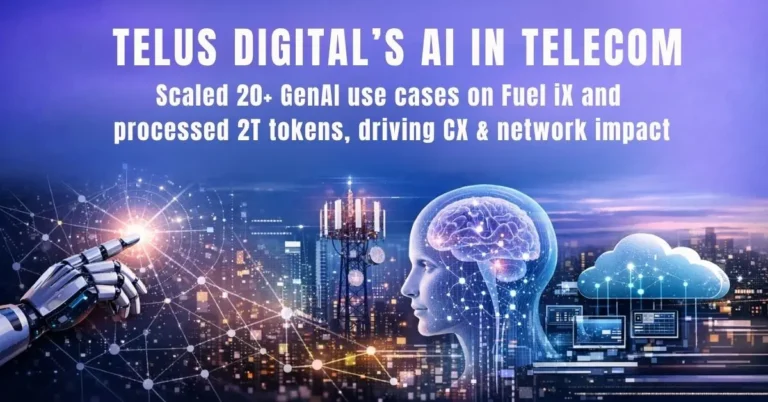
TELUS Digital is using Mobile World Congress 2026 to move the AI-in-telecom conversation from pilots to proven production at scale. TELUS Digital reports processing more than two trillion tokens in 2025 through its Fuel iX generative AI platform for TELUS operations and customers. The portfolio spans AI for customer experience, application safety, and network modernization—built and battle-tested within TELUS before client rollout. The Network Design Services practice applies AI to planning and optimization while charting a path from legacy network stacks to cloud-native, automated environments.
Reliance Jio’s six-plan lineup for November 2025 blends low entry pricing with AI, cloud, and OTT hooks, signaling how prepaid is evolving from pure connectivity to service-led bundles. Starting at Rs 189, Jio is segmenting prepaid users by usage intensity (voice-first, balanced data, and long-validity) while nudging them into its digital stack: JioTV for content, JioAICloud for storage, and on select offers, Google Gemini Pro for AI. As 5G coverage and usage expand, Jio’s add-ons are designed to create reasons to stay on-network and upgrade. AI benefits in prepaid are rare globally; anchoring them to eligibility criteria and higher-tier 5G plans suggests an upsell path that can improve monetization without headline tariff hikes.
Google Cloud’s 2025 ROI of AI study signals a step-change: AI agents are now in production at scale and delivering measurable business outcomes. The study, fielded with National Research Group across 24 countries, finds 52% of executives report their organizations already use AI agents—specialized models that can plan, reason, and take actions. Momentum is material: 39% say their company has launched more than ten agents. Executives also report faster delivery cycles, with over half moving use cases from idea to production within three to six months, up from last year. Generative AI investment continues to climb as technology costs fall.
Telefónica reports €77 billion invested over ten years to expand sustainable, resilient connectivity, with SDG 9 (industry, innovation and infrastructure) as the strategic anchor. The operator now serves nearly 350 million accesses, has passed 81.4 million premises with FTTH, and runs one of the largest ultra-broadband footprints globally, second in scale only to China. Spain is Telefónica’s showcase for fiber-led modernization. Dense FTTH has enabled a managed copper switch-off, which simplifies operations, cuts energy use, and improves service quality. The operator targets net zero by 2040 - ten years ahead of many international timelines—and reports a 52% reduction in CO2 emissions across the value chain from 2015 to 2024.
HUMAIN, a Saudi PIF-backed AI company, introduced Horizon Pro, an “agentic AI” PC built on Qualcomm’s Snapdragon X Elite, positioning it as a new class of Windows laptop where on-device AI drives workflows, decisions, and user interaction. At Qualcomm’s Snapdragon Summit in Maui, HUMAIN CEO Tareq Amin unveiled the Horizon Pro PC and the company’s agentic software layer, Humain One, which runs on top of Windows 11 and is slated for formal launch at the Future Investment Initiative in Riyadh.
Jack Dorsey’s BitChat is a decentralized messaging app using BLE mesh networks to deliver encrypted messages without the internet. With no central servers, user accounts, or cloud storage, BitChat promises privacy but raises questions about security, user experience, and practical use in real-world settings like protests, emergencies, and areas with no connectivity.
Gartner’s latest outlook points to global AI spend hitting roughly $1.5 trillion in 2025 and exceeding $2 trillion in 2026, signaling a multi-year investment cycle that will reshape infrastructure, devices, and networks. This is not a short-lived hype curve; it is a capital plan. Hyperscalers are pouring money into data centers built around AI-optimized servers and accelerators, while device makers push on-device AI into smartphones and PCs at scale. For telecom and enterprise IT leaders, the message is clear: capacity, latency, and data gravity will dictate where value lands. Spending is broad-based. AI services and software are growing fast, but the heavy lift is in hardware and cloud infrastructure.
COAI has endorsed MeitY's move to address spam and scam communication from OTT apps. While telecom operators follow strict UCC rules, OTT platforms remain loosely regulated. COAI is advocating for uniform cybersecurity standards and clear regulatory roles to ensure user safety, particularly with emerging threats like steganography.
ETSI has published its first ISAC report for 6G—ETSI GR ISC 001—highlighting 18 use cases across healthcare, public safety, automation, and mobility. The report dives into deployment scenarios, sensing modalities, and KPIs like fine motion accuracy and sensing latency. It also outlines security, privacy, and sustainability guidelines for real-world ISAC integration into 6G networks.
Confidencial.io will unveil its unified AI data governance platform at RSAC 2025. Designed to secure unstructured data in AI workflows, the system applies object-level Zero Trust encryption and seamless compliance with NIST/ISO frameworks. It protects AI pipelines and agentic systems from sensitive data leakage while supporting safe, large-scale innovation.
NVIDIA and Google Cloud are collaborating to bring secure, on-premises agentic AI to enterprises by integrating Google’s Gemini models with NVIDIA’s Blackwell platforms. Leveraging confidential computing and enhanced infrastructure like the GKE Inference Gateway and Triton Inference Server, the partnership ensures scalable AI deployment without compromising regulatory compliance or data sovereignty.
India’s telecom sector is rapidly evolving with AI and automation enhancing network operations, customer service, and 5G deployment. With over 125 million 5G users and major investments from companies like Reliance Jio and Bharti Airtel, AI technologies are proving essential for scalability and efficiency. Despite challenges like infrastructure integration and talent gaps, India’s growing AI ecosystem and government support are driving the future of smart telecom solutions.

Your Brand. Our Intelligence Tools.

Capture leads at the point of evaluation. Talk to Us →

Sponsored by Palo Alto Networks
⚡ Utilities ⏱ 8 min ✓ Free
This tool is built and hosted by TeckNexus.
Launch Tool →
Whitepaper
This whitepaper explains how utilities can use secure AI-enabled private mobile networks to modernize operations, support distributed intelligence, improve resilience, and strengthen cybersecurity across critical infrastructure. It covers AI applications, private network advantages, zero trust principles, multilayered security architecture, and governance considerations for AI-ready utility environments....
Whitepaper
Non-terrestrial networks are rapidly evolving from experimental satellite systems into an increasingly important part of the global 5G connectivity landscape. This eBook, developed by Radisys in collaboration with TeckNexus, explores how 3GPP standardization, satellite architecture innovation, and software-driven network design are reshaping NTN deployment models. It examines the transition from...
Whitepaper
Private cellular networks are transforming industrial operations, but securing private 5G, LTE, and CBRS infrastructure requires more than legacy IT/OT tools. This whitepaper by TeckNexus and sponsored by OneLayer outlines a 4-pillar framework to protect critical systems, offering clear guidance for evaluating security vendors, deploying zero trust, and integrating IT,...
Scroll to Top

Map your security gaps to real threat scenarios – including Salt Typhoon, Volt Typhoon, AI data poisoning, rogue devices, and unencrypted OT traffic.

Take the free 8-minute assessment built for utility operators evaluating AI-enabled private mobile networks. Get a readiness score across five critical domains, see where your gaps are, and receive a prioritized action plan for what to fix first.

Free • 8 minutes • Built for private network security