
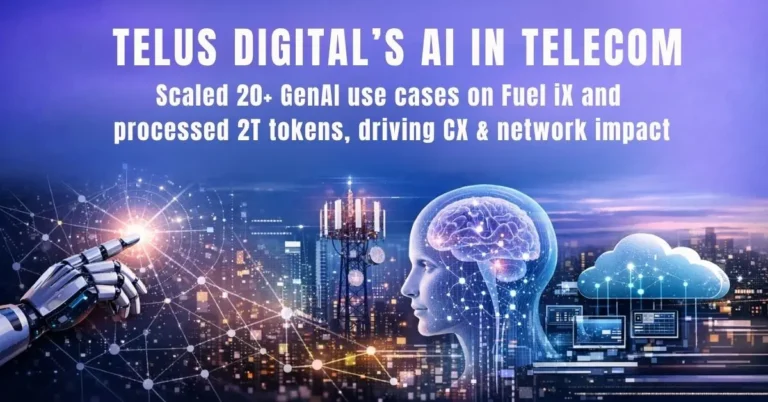
Why TELUS Digital’s AI in Telecom at MWC 2026 Matters
TELUS Digital is using Mobile World Congress 2026 to move the AI-in-telecom conversation from pilots to proven production at scale.

Why CSP AI Programs Stall After Pilots
Across telecom, most AI budgets flow to customer experience and to network planning and operations, yet many programs stall after promising proofs of concept because platforms, data pipelines, safety, and cost controls are not engineered for scale. NVIDIA’s latest industry research underscores that prioritization, but the gap between experimentation and enterprise deployment remains wide due to fragmentation across OSS/BSS, legacy processes, and unclear value tracking.
Tokens at Scale as Proof of Enterprise-Ready AI
TELUS Digital reports processing more than two trillion tokens in 2025 through its Fuel iX generative AI platform for TELUS operations and customers. That volume—spanning multiple models and use cases—signals hardened infrastructure, governance, observability, and cost management, not just lab experiments. At MWC, the company plans a 90-minute session with NVIDIA and F3 Networks to unpack the operating blueprint behind scaling 20-plus production use cases.
What TELUS Digital Is Showcasing at MWC 2026
The portfolio spans AI for customer experience, application safety, and network modernization—built and battle-tested within TELUS before client rollout.
CX Automation to Reduce Cost-to-Serve
AI-led care and sales require accurate intent detection, fast retrieval of trusted knowledge, and agent assist that improves handle time and first-contact resolution. TELUS Digital’s Fuel iX Agent Trainer uses simulated voice and chat to accelerate onboarding and proficiency, while Fuel iX Agent Assist supports live interactions with context-aware prompts and next-best actions. The focus is on measurable outcomes: faster agent ramp, lower average handle time, higher containment in digital channels, and improved CSAT.
Built-In AI Safety, Security, and Governance
Fuel iX Fortify brings automated safety and security testing into the AI lifecycle, enabling continuous guardrail validation, red-teaming, and monitoring across prompts, models, and integrations. By making these controls accessible to product managers, engineers, risk, responsible AI, and security teams, it operationalizes compliance and auditability, which are prerequisites for scaling regulated, customer-facing AI in telecom.
AI-Powered Network Design for Cloud-Native Ops
The Network Design Services practice applies AI to planning and optimization while charting a path from legacy network stacks to cloud-native, automated environments. Expect emphasis on intent-driven workflows, integration with existing OSS/BSS, and design choices that align with TM Forum Open Digital Architecture and leverage telco cloud patterns—all critical to reduce time-to-market, improve uptime, and support edge and 5G monetization.
Inside the Fuel iX GenAI Platform
The platform underpins production-grade GenAI with model choice, observability, safety, and cost controls designed for telco scale.
Multi-Model MLOps, Observability, and Token Economics
Running diverse language and multimodal models in production requires consistent logging, latency SLOs, failover, and granular cost tracking per token and per use case. Fuel iX’s control plane approach centralizes model access, data privacy policies, retrieval augmentation, and performance monitoring so product teams can iterate quickly without sacrificing governance. The two-trillion-token milestone implies hard-won capabilities in load management, caching, and unit economics optimization.
Ecosystem with NVIDIA and F3 Networks
The joint MWC session with NVIDIA and F3 Networks highlights the importance of an ecosystem spanning accelerated infrastructure, inference optimization, and network engineering. Expect discussion on reference architectures, GPU utilization strategies, and automation patterns that reduce inference cost, improve throughput, and ensure resilience across on-prem and cloud footprints.
Strategic Implications for CSPs
The message is clear: prioritize a production playbook that turns AI into durable P&L impact across CX and network operations.
Prioritize High-Value, Production-Ready Use Cases
Start where value is closest to the surface—care automation, agent assist and training, guided sales, field operations, and network planning—then expand to cross-sell, proactive care, and network anomaly detection. Define outcomes up front (AHT, FCR, CSAT, truck rolls avoided, opex savings) and insist on stage-gated paths from sandbox to production.
Manage Token Economics as a Core KPI
Token volume drives cost and experience; manage it like any critical commodity. Implement policies for model selection by task, prompt efficiency, caching, and data retrieval to reduce token usage without degrading quality. Build dashboards that tie token consumption to business KPIs so product owners see cost-to-serve and value per interaction.
Make Safety, Compliance, and Audit Non-Negotiable
Automate testing for toxicity, PII leakage, and hallucinations; enforce role-based access and encryption; and maintain lineage for prompts, datasets, and model versions. Continuous validation and rollback plans are essential when AI touches regulated customer interactions or network change workflows.
90-Day Plan for Production-Grade AI
Translate strategy into execution with a platform-first approach and a small, outcome-focused portfolio.
Establish an AI Control Plane
Establish a central platform team to manage models, data connections, policies, and observability across business units. Standardize SDKs, APIs, safety checks, and deployment pipelines so new AI features ship faster with consistent governance—whether you adopt a solution like Fuel iX or integrate best-of-breed components.
Choose 3–5 Use Cases with Hard KPIs
Instrument baselines, set target deltas, and link to commercial metrics (churn, ARPU, NPS, opex) with executive sponsorship. Tie funding to milestones, not demos, and publish a production-readiness checklist covering security, reliability, and support.
Modernize Data and Network Foundations
Build trusted knowledge layers for retrieval-augmented generation, enforce data access policies, and upgrade observability across OSS/BSS. In parallel, progress toward cloud-native network functions and API exposure aligned with TM Forum and GSMA Open Gateway to unlock automation and partner-led revenue.
What to Watch at MWC 2026
Differentiate slideware from operating reality by pushing for proof points and open roadmaps.
Demand Real Operating Benchmarks
Look for throughput under load, latency distributions, token cost per interaction, safety testing coverage, and rollback procedures. Ask for before-and-after metrics from production environments, not labs.
Check Ecosystem Commitments and Standards Alignment
Probe how solutions integrate with NVIDIA-accelerated infrastructure, telco cloud stacks, and CI/CD; and whether they align with TM Forum ODA and GSMA frameworks for interoperability and lifecycle management.
Build a Credible Path to Nine-Figure Value
Value at scale comes from a portfolio view: repeatable patterns, shared services, common guardrails, and re-use across brands and markets—precisely the operating model TELUS Digital aims to showcase with its 20-plus production use cases.