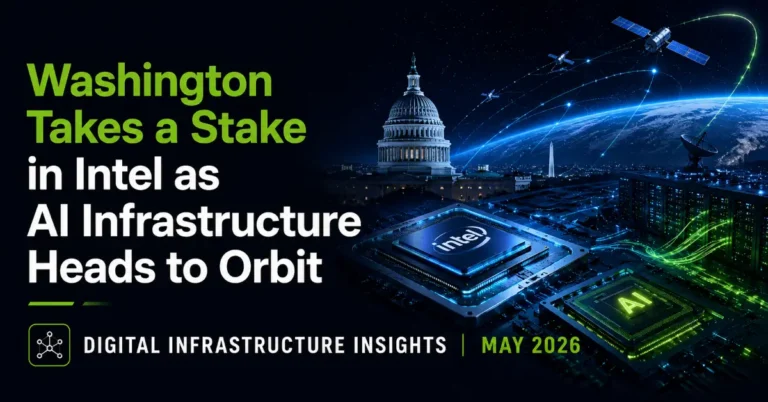
May 2026’s roundup: the US government’s 10% equity stake in Intel (now valued above $50B) underscores how strategic chip manufacturing has become, India and Vietnam both advance new chip fab and testing capacity, the AI chip supply chain keeps fragmenting beyond Nvidia, and Pixxel and Sarvam AI plan India‘s first orbital data center satellite.

At a glance – Digital Infrastructure Insights for May 2026
- The US government’s 10% equity stake in Intel — acquired roughly nine months ago alongside $10B in fab-expansion funding — is now reportedly valued at more than $50 billion, according to a Fortune interview.
- Anthropic secured access to more than 300MW of compute and over 220,000 Nvidia GPUs at SpaceX‘s Colossus 1 data centre in Memphis to scale Claude Pro and Claude Max.
- Tata Electronics partnered with ASML to deploy advanced lithography tools at India’s first planned chip fab in Dholera, Gujarat, while Samsung committed $1.5B to its first chip testing plant in Vietnam.
- The AI chip supply chain kept fragmenting beyond Nvidia: Apple and Intel reached a preliminary agreement to diversify Apple‘s chip manufacturing beyond TSMC, Amazon leaned further into in-house AI silicon, and Samsung began sampling 12-layer HBM4E memory.
- Nvidia and IREN signed a strategic partnership to deploy up to 5GW of DSX-aligned AI infrastructure, and Samsung SDS is leading the race for South Korea’s 2.08 trillion won AI GPU data center project.
- Pixxel and Sarvam AI announced plans for what would be India’s first orbital data centre satellite, running AI workloads in orbit.
1. Chip manufacturing expands into new geographies
India and Vietnam both moved from chip-manufacturing aspiration to committed capital this month:

- Tata Electronics & ASML: will deploy ASML’s suite of advanced lithography tools at Tata’s planned semiconductor fabrication facility in Dholera, Gujarat, under a partnership formalized during a meeting attended by India’s Prime Minister — strengthening India-Netherlands collaboration on critical technologies and underpinning India’s first planned chip fab.
- Samsung Electronics: will invest 39 trillion dong (roughly $1.5B) to build its first chip testing plant in Vietnam (Thai Nguyen province, ~60km north of Hanoi); construction has begun, with operations targeted for November 2027, focused on legacy DRAM and NAND with planned annual output of 153.3 billion Gb (DRAM) and 255.6 billion Gb (NAND) — Samsung may reinvest up to ~$2.5B in profits for a potential second factory.
- Sony Semiconductor Solutions & TSMC: signed a non-binding MoU for a strategic partnership to co-develop and manufacture next-generation image sensors and jointly explore physical AI applications in automotive and robotics; the MoU contemplates forming a joint venture in which Sony would be majority and controlling shareholder.
- Sivers Semiconductors & Tachyon Networks: entered a $1.5 million development partnership to co-develop a 60GHz mmWave transceiver targeting fixed wireless access (FWA).
- India — ISM 1.0: the central government approved 12 applications under the India Semiconductor Mission, representing approximately ₹1.64 lakh crore in proposed investment.
- Tata Electronics: reported scaling its revenue run rate to ₹1.3 lakh crore (from a ₹400 crore base) and targets $30B as semiconductor fabrication and OSAT packaging ramp, already among the Tata Group’s top five businesses by revenue and profitable.
Why it matters for buyers: India’s first planned fab (Dholera) now has a named lithography partner, and 12 ISM 1.0 applications worth ₹1.64 lakh crore were approved in a single batch. Buyers evaluating supply chain diversification should treat South and Southeast Asia as genuine near-term manufacturing geographies, not multi-year speculative bets. → Compare emerging chip manufacturing geographies with TeckNexus Technology Selector.
2. The AI chip supply chain fragments beyond Nvidia
National industrial policy is now directly intertwined with AI chip supply:
- Samsung Electronics: began sampling a 12-layer HBM4E device to selected customers, following mass production and shipment of HBM4 earlier this year — described as an industry first for a 12-layer stack, delivering up to 16 Gb/s transfer speeds with improved energy efficiency.
- Apple & Intel: reportedly reached a preliminary agreement for Intel to manufacture a portion of the chips used in iPhones, iPads, and other devices, following more than a year of negotiations — a move that would reduce Apple’s reliance on TSMC, its primary custom silicon manufacturer.
- Amazon: hyperscalers and AI labs are increasing reliance on custom in-house silicon to train and run large models, shifting the data centre AI chip market from Nvidia’s near-monopoly toward a more fragmented supplier landscape.
- Arm: indicated that the rise of agentic AI workloads will substantially increase CPU demand inside AI data centers, emphasizing a larger role for general-purpose compute alongside accelerators.
- Intel: according to a Fortune interview, the US government acquired a 10% equity stake in Intel roughly nine months ago and provided $10B in funding to support expansion of US fabrication facilities; the government’s stake is reportedly now valued at more than $50B.
Why it matters for buyers: the US government’s Intel stake being valued at more than 5x its original funding is a striking data point on its own, but it also signals how directly national industrial policy is now intertwined with AI chip supply — buyers should factor geopolitical and government-ownership dynamics into long-term chip supply relationships, not just technical roadmaps. → Compare chip supply diversification strategies with TeckNexus Technology Selector.
3. Hyperscale AI data center capacity races across Asia-Pacific and the Americas
AI data center capacity is being built at every scale simultaneously this month, from 40MW to 5GW:
- AirTrunk & Princeton Digital Group: AirTrunk disclosed plans for a new hyperscale data center facility in Malaysia; Princeton Digital Group separately announced a new hyperscale build in Indonesia.
- Samsung SDS: is leading the race for South Korea’s 2.08 trillion won AI GPU data center project, with the Ministry of Science and ICT and NIPA negotiating with Samsung SDS, Naver Cloud, and Elice after completing on-site inspections; evaluation emphasized GPU procurement, large-scale cluster operations, and power/cooling design, with initial deployments expected on Nvidia Blackwell GPUs and Vera Rubin phased in later subject to supply and cost — service launch could slip beyond this year.
- Anthropic & SpaceX: Anthropic secured access to more than 300MW of compute at SpaceX’s Colossus 1 data centre in Memphis, Tennessee, including over 220,000 Nvidia GPUs, to scale its Claude Pro and Claude Max services; access is expected within a month, with financial terms undisclosed.
- Nvidia & IREN: signed a strategic partnership to build up to 5GW of DSX-aligned AI infrastructure, expanding large-scale AI compute capacity across multiple locations.
- Digi Power X & Cerebras: executed a Master Services Agreement to colocate a purpose-built 40MW Tier III AI data center campus in Columbiana, Alabama, valued at roughly $1.1B over a 10-year initial term (up to $2.5B including renewals); deployment occurs in two phases (15MW then 25MW), with Phase 1 targeted for December 15, 2026 and full deployment by end of Q1 2027 — power interconnection and an on-site substation are already complete with Alabama Power.
- Tigo (Millicom): will maintain roughly $100M/year in capex in Panama, expand fiber coverage by 60,000–100,000 homes passed per year, and build a fourth data center intended to serve regional and international customers.
Why it matters for buyers: the sheer scale disparity across this month’s deals — from Nvidia/IREN’s 5GW partnership down to Digi Power X’s 40MW Alabama campus — shows AI data center capacity is being built at every scale simultaneously, from hyperscale multi-gigawatt campuses to purpose-built regional colocation facilities. → Model data center buildout economics at your target scale with TeckNexus ROI/TCO tools.
4. Sovereign and managed AI cloud services expand
Sovereignty models varied sharply in structural depth this month:
- Thales & Google Cloud: partnered to deliver a fully sovereign cloud in Germany, with Thales managing and operating dedicated German infrastructure via a new, legally independent German entity staffed entirely with local personnel, designed to meet German digital sovereignty and regulatory requirements.
- Orange & Google Cloud: Orange is partnering with Google Cloud, with Anthropic referenced, to advance Orange’s transformation using cloud-hosted AI capabilities.
- Rackspace: is offering end-to-end managed enterprise AI operations with an operator-led, single-accountability model covering multiple layers of enterprise AI systems, configured for data sovereignty and performance.
- Google Cloud: at Google Cloud Next ’26, showcased new agentic AI solutions and enhancements to its AI architecture, positioned for cloud-based workloads in telecom cloud infrastructure and wireless contexts.
- AWS & Red Hat: detailed a production-ready AWS Neuron Operator for OpenShift (v1.1.4) with Neuron SDK 2.28 support, rolling driver upgrades, node telemetry, and GitOps-ready deployment — enabling LLM inference (e.g., Llama 3.1 8B) on AWS Inferentia (Inf2) and Trainium (Trn1) using Red Hat AI Inference with vLLM and KServe on ROSA/OpenShift.
Why it matters for buyers: Thales/Google Cloud’s approach — a legally independent, locally-staffed German entity — is a notably stricter sovereignty model than most “sovereign cloud” offerings, which often just mean regional data residency. Buyers with genuine data-sovereignty requirements should distinguish between this kind of structural independence and lighter-weight regional hosting claims. → Compare sovereign and managed AI cloud models with TeckNexus Vertical Intelligence.
5. Data center capital markets and M&A accelerate
Data center capital markets matured across multiple instrument types simultaneously this month:
- Cogent Communications: entered a definitive agreement to sell 10 US data center facilities — including sites in Phoenix, Anaheim, Burbank, and Stockton — to a newly formed entity sponsored by I Squared Capital for $225 million in cash.
- IREN: announced plans to acquire Mirantis, an infrastructure management software provider, to integrate software-driven orchestration and operations into its AI data center business.
- Cerebras: is preparing an IPO targeting up to $4B, according to Bloomberg, amid heightened demand for AI compute and data center capacity.
- Digital Edge: arranged holding company-level financing that includes an option to convert the facility into a sustainability-linked loan once sustainability performance targets are formally agreed.
- Sterlite Technologies: announced a manufacturing investment to expand capacity serving AI data centre and telecom customers, expected to create 400–500 jobs and increase output.
- Render Networks: secured $14M in funding and acquired mPower to extend its network construction and work-management software beyond telecom into adjacent infrastructure sectors.
Why it matters for buyers: the mix this month — an asset sale (Cogent), a software acquisition (IREN/Mirantis), an IPO (Cerebras), and sustainability-linked financing (Digital Edge) — shows data center capital markets maturing across multiple instrument types simultaneously, not just raw construction capital. → Track data center capital market activity with TeckNexus ROI/TCO tools.
6. AI infrastructure reaches new frontiers: orbit and the network edge
The same pressure — getting AI compute closer to where it’s needed, or where constraints are lowest — is playing out at opposite extremes this month:
- Pixxel & Sarvam AI: announced a partnership to develop an orbital data centre satellite, described as India’s first, to run AI workloads in orbit; technical specifications, launch timeline, and compute details were not disclosed.
- EXA Infrastructure: announced network connectivity tailored for AI compute environments and highlighted a partnership with Argentum AI and Boosteroid to enable low-latency, high-throughput links between GPU clusters and data centers.
- Qualcomm Technologies: introduced the Dragonwing Mobile Broadband Multimedia (MBM) family of broadband chipsets built on a 4nm process, featuring on-device AI, advanced connectivity, and multimedia capabilities; the premium MBM7 Series, led by the MBM715, supports sub-6GHz 5G NR and Wi-Fi 7 with up to 5.8 Gb/s, 320MHz channels, and 4K QAM for low-latency, high-throughput performance.
Why it matters for buyers: Pixxel and Sarvam AI’s orbital data center satellite is a genuine frontier story — it’s the same logical extension of “AI infrastructure needs to go where the constraints are lowest” that’s driving hyperscale buildouts on Earth, just applied to orbit. Meanwhile EXA’s AI-optimized network links and Qualcomm‘s on-device AI chipsets show the same underlying pressure playing out at the opposite extreme, on-device. → Plan distributed and edge AI infrastructure with TeckNexus Network Planning tools.
Every May item, with full source detail, is on the curated Digital Infrastructure Monthly Insights page →
A note on scope: this roundup covers data center infrastructure, power/cooling, chip manufacturing and supply chain, and physical AI infrastructure specifically. AI models, agents, and applications are covered in the companion AI & Automation Insights series; wireless/spectrum/satellite infrastructure is covered in Advanced Connectivity Insights. Two archive items were excluded from this draft: “Yotta Infrastructure” was tagged “Ignore” in the source archive, and a vague “Schneider Electric” entry described only general media coverage with no specific company action, product, or deployment.
What this means if you’re planning digital infrastructure
May’s throughline is that AI infrastructure investment is now genuinely global and multi-scale — from a $50B-valued government equity stake in a single chip manufacturer, to India’s first planned chip fab and first orbital data center satellite, to hyperscale campuses ranging from 40MW to 5GW. Five moves follow directly from the month:
- Factor government ownership and industrial-policy dynamics into long-term chip supply relationships — Intel’s US government stake shows this isn’t a peripheral consideration anymore.
- Treat South and Southeast Asian chip manufacturing (India’s Dholera fab, Vietnam’s Samsung testing plant) as near-term supply chain options, not multi-year speculative bets.
- Distinguish structurally independent sovereign cloud offerings (like Thales/Google Cloud’s Germany entity) from lighter regional-hosting claims when evaluating data-sovereignty requirements.
- Match your AI data center scale ambitions to the right capital instrument — this month’s mix of asset sales, software acquisitions, IPOs, and sustainability-linked financing shows multiple paths now exist.
- Watch orbital and on-device AI infrastructure as genuine (if early) options for workloads where terrestrial data center constraints — power, land, latency — are the binding factor.
Catching up? Last month’s edition is here: Chip Fabs Race to Scale as Networks Become AI Compute Platforms: Digital Infrastructure Insights, April 2026 →
→ Start with the TeckNexus Intelligence Platform — independent, buyer-neutral tools for spectrum, TCO, architecture, and RFP decisions.
This analysis is drawn from TeckNexus’s full curated Digital Infrastructure Monthly Insights for May 2026. See every deployment, product, and partnership update.