Which 5G Stocks to invest in? Who are the leading 5G companies?

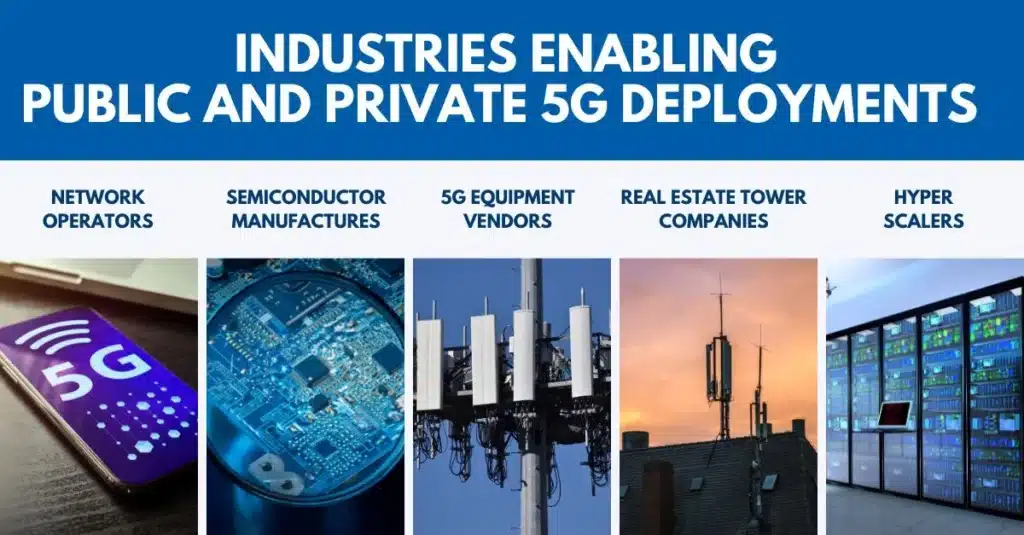
Investors seeking to maximize their profits from the potential of 5G should consider a multi-pronged approach and invest in companies that provide 5G network equipment, tower infrastructure, semiconductors, and hyperscalers as well as 5G mobile network operators. Here are the top companies across the sectors that are leading global public/private network rollouts.
Which 5G Stocks to invest in? Who are the leading 5G companies?

5G is the fifth generation of cellular network technology, offering faster speeds and more reliable connections than previous generations. 5G networks use higher frequency radio waves than earlier networks, enabling them to carry more data over greater distances and at faster speeds. With 5G, users can expect download speeds 100 times faster than 4G.

As of December 2023, there have been over 290+ 5G network deployments globally, and the number is growing. To fuel this ongoing growth, several countries have scheduled mid-band and high-band spectrum auctions for the years 2023 to 2024. This demonstrates that the momentum behind 5G networks will stay strong throughout the coming years.

Statista and Ericsson predict the global 5G subscriptions to skyrocket and break the 1 billion mark. Statista predicts subscriptions for 5G networks are projected to skyrocket over the next several years, reaching an estimated 4 billion people by 2027. According to Ericsson Mobility Report, the number of 5G mobile subscriptions is forecast to reach 5 billion in 2028.

5G can potentially bring up to $5-7tn worth of economic value by 2030, as reported in InterDigital & ABI Research Report.  For consumers and businesses (especially those deploying private 5G networks) alike, upgrading to 5G-capable cell phones and other industrial devices is a must to enable innovative applications and use cases. This transition will continue to remain a top investment opportunity far into 2023 and beyond.

5G Stocks: 5G Exchange-Traded Funds (ETFs)

Investors seeking to maximize their profits from the potential of 5G should consider a multi-pronged approach and invest in companies that provide 5G network equipment, tower infrastructure, semiconductors, and hyperscalers as well as 5G mobile network operators. Several 5G exchange-traded funds (ETFs) also offer an exciting opportunity for keen investors. Here are the eight best 5G ETFs to buy: (Source: USNews)

Top 10 stocks 5G and edge companies best positioned for 2021- TeckNexus

  • Vanguard Communication Services ETF (VOX)
  • Defiance Next Gen Connectivity ETF (FIVG)
  • First Trust IndXX NextG ETF (NXTG)
  • Fidelity MSCI Communication Services Index ETF (FCOM)
  • iShares U.S. Telecommunications ETF (IYZ)
  • iShares Global Telecom ETF (IXP)
  • Global X Internet of Things ETF (SNSR)
  • Pacer Benchmark Data & Infrastructure Real Estate SCTR ETF (SRVR)


5G Stocks: Top 5G Network Operators in the United States

5G Cell Tower Types - TeckNexus

T-Mobile US (NASDAQ:TMUS), Verizon Communications (NASDAQ:VZ), and AT&T (NASDAQ:T) are rapidly increasing their 5G wireless broadband services to residences. To encourage customers to opt into the service, they have discounted packages that include both cell phones and 5G broadband services. Additionally, Dish Networks (NASDAQ:DISH) continues to roll out its 5G wireless network, solidifying itself as a leader in the satellite-TV service provider industry.

Aside from increasing their 5G network coverage, Fixed Wireless Access (FWA) and private networks constitute other key sectors in which 5G mobile network operators are either investing on their own or in partnerships with technology suppliers and hyper-scalers.


5G Stocks: Top 5G Technology and Network Equipment Companies


Ericsson | Top 5G Network Equipment and Technology Company

 

Ericsson - Private Network Strategy of Operators | TeckNexus

Ericsson is a multinational technology company based in Sweden that provides telecommunications and networking solutions, with a strong presence in Europe, North America, and Asia. Ericsson’s portfolio of solutions includes mobile networks, fixed networks, cloud and data centers, and Internet of Things (IoT) offerings – powered by 5G and IoT platforms.

Ericsson’s 5G Market Traction | Ericsson has 143 Live 5G networks across 62 countries as of Feb 2023. Sample 5G wireless operators with live 5G deployment on Ericsson’s network equipment and solutions include AT&T, China Telecom, Deutsche Telekom, Orange, Telefonica, Verizon, and Vodafone.

Ericsson’s Stock Information | As a publicly traded company, Ericsson is listed on the NASDAQ in New York (ERIC) with a market capitalization of $18.62B billion. 

Read More


Nokia | 5G Network Equipment & Technology Company


Nokia New Logo Nokia is a Finnish multinational telecommunications, information technology, and consumer electronics company that provides a wide range of equipment, services, and software for telecom operators and enterprises. With their comprehensive offering, from hardware components for communication service providers to cutting-edge software options, customers in select verticals are able to plan, optimize, implement, run, and upgrade networks. Broadly their portfolio consists of core networks, datacenter, fixed networks, the internet of things (IoT), IP networks, mobile networks, optical networks, private networks, security, operational support systems (OSS), business support systems (BSS) and Network solutions for industry, enterprises, and the public sector.

Nokia’s 5G Market Traction

Nokia has 269 commercial 5G deals with 98 live 5G operator networks as of Feb 2023. Sample 5G mobile network operators with live 5G networks on Nokia’s network equipment and solutions include AT&T, Bell Canada, T-Mobile, Verizon, BT, O2, Orange, China Unicom, China Telecom, NTT Docomo, and Vodafone.

Nokia’s Stock Information

As a publicly traded company, Nokia is listed on the NYSE in New York (NOK) with a market capitalization of $26.16B billion.

Read More


Samsung | Top 5G Devices, 5G Network Equipment, and Semi-Conductor Company

Samsung | 5G Stocks - Top 10 5G and Edge Companies best positioned for 2021 - TeckNexus

Samsung is a multinational conglomerate based in South Korea that operates in a wide range of industries, including electronics, semiconductors, appliances, and more. In recent years, Samsung has been heavily focused on 5G technology, both as a supplier of equipment and as a provider of end-user devices. Samsung’s 5G technology portfolio includes:

5G network equipment: Samsung is a leading provider of 5G network infrastructure, including base stations and other equipment, to mobile network operators worldwide. The company’s 5G technology is designed to provide high-speed data transmission, low latency, and massive connectivity, enabling a wide range of new use cases and applications.

5G smartphones: Samsung has released several 5G-enabled smartphones in recent years, including the Galaxy S21 5G, Galaxy S20 5G, and Galaxy Note20 5G. These devices are designed to take advantage of the high-speed data transmission and low latency provided by 5G networks, enabling faster downloads, smoother streaming, and more responsive gaming experiences.

5G chipsets: Samsung has developed its own 5G chipsets, including the Exynos 5G modem, which is used in some of the company’s 5G-enabled devices. These chipsets are designed to provide high-speed data transmission and low latency, while also being energy-efficient.

5G home routers: Samsung has also developed 5G-enabled home routers, which can provide high-speed internet access to homes and businesses without the need for traditional fixed-line broadband connections.

Samsung Devices

Samsung 5G devices include 5G phones (e.g., Galaxy Z Flip4, Galaxy Z Fold4, Galaxy S22 Ultra, , Galaxy Z Flip3 5G, Galaxy S21 Ultra 5G), 5G tablets (e.g., Galaxy Tab S8+, Galaxy Tab S8, and Galaxy Tab S7+), 5G Home Router, and 5G Chipsets (28 GHz Chipset and 5G Mode). In the US, US, all major 5G network operators offer Samsung galaxy devices, including Verizon, AT&T, T-Mobile, and US Cellular.

5G Stock Market Information

Samsung is listed on the Korea stock exchange (KSE) with a market capitalization of 407.05T KRW.

Read More


5G Stocks: Top 5G Semiconductor and Chipset Companies


Broadcom | Top 5G Chipset & Technology Company


Broadcom Logo

Broadcom is a global technology company that designs, develops, and supplies a wide range of semiconductor and infrastructure software solutions. The company was founded in 1991 in Irvine, California, and has since grown through mergers and acquisitions to become one of the largest semiconductor companies in the world.

Broadcom’s products and technologies are used in a wide range of industries, including data center networking, enterprise storage, broadband communication, and industrial and automotive markets. The company’s semiconductor solutions include system-on-chips (SoCs), network processors, Ethernet switches, and wireless connectivity solutions for smartphones, laptops, tablets, and other devices. Broadcom’s infrastructure software solutions include storage management, network monitoring, and security software.

In recent years, Broadcom has focused on expanding its portfolio through strategic acquisitions. Notable acquisitions include Brocade Communications Systems, CA Technologies, Symantec’s enterprise security business, and LSI Corporation’s networking business.

With its extensive product portfolio and expertise in key areas such as networking and wireless communication, Broadcom is well-positioned to continue driving innovation and growth in the semiconductor industry.

Broadcom 5G Tech Stock Market Information

As a publicly traded company, Broadcom is listed on the NASDAQ in New York (AVGO) with a market capitalization of $248B billion.


MediaTek | Top Semiconductor/Chip Manufacturing Company

Mediatek | 5G Stocks - Top 10 5G and Edge Companies best positioned for 2021 - TeckNexus

MediaTek is a Taiwanese semiconductor company that designs and manufactures system-on-chip (SoC) processors and other electronic components. The company was founded in 1997 and has since grown to become a leading provider of chipsets for smartphones, tablets, smart TVs, and other connected devices.

MediaTek’s processors are known for their affordability and versatility, making them popular with device manufacturers in emerging markets. MediaTek’s chips also often feature advanced features such as built-in AI processing capabilities and support for advanced camera technologies. In addition to its hardware offerings, MediaTek also provides software development tools and services to help developers create and optimize applications for its chipsets.

In recent years, MediaTek has been increasing its market share and competitiveness in the smartphone chip market, with its Helio series of processors being used in devices from brands like Xiaomi, Oppo, and Vivo. The company also recently announced a partnership with Intel to bring 5G connectivity to laptops using MediaTek’s modem technology.

Overall, MediaTek is an important player in the semiconductor industry and plays a significant role in powering the devices that we use every day. With its strong focus on innovation and collaboration with industry partners, MediaTek is well-positioned to continue driving growth in the semiconductor industry and supporting the development of new technologies and products for the connected world.

MediaTek 5G Tech Stock Market Information

MediaTek is listed on the Taiwan Stock Exchange under the ticker symbol “2454” with a market capitalization of 1.24T TWD. It is also listed on the over-the-counter market in the United States under the ticker symbol “MDTKF”.


Qualcomm | Top 5G Chipset & Technology Company

Qualcomm | 5G Stocks - Top 10 5G and Edge Companies best positioned for 2021 - TeckNexus

Qualcomm is a multinational semiconductor and telecommunications equipment company based in the United States. Qualcomm’s portfolio of solutions includes mobile processors, modems, and wireless communication technologies such as 5G and Wi-Fi. The company’s solutions are designed to enable devices to connect to wireless networks and communicate with each other. Their technology portfolio includes:

5G technology: Qualcomm’s Snapdragon X-series 5G modems and Snapdragon 5G mobile platforms are designed to enable fast and reliable 5G connectivity. These chipsets support a range of 5G frequencies, including sub-6GHz and mmWave, and can deliver multi-gigabit speeds and low latency.

Mobile processors: Qualcomm’s Snapdragon mobile processors are used in many popular smartphones, tablets, and other mobile devices. These chipsets integrate features such as CPUs, GPUs, AI accelerators, modems, and imaging processors.

Artificial Intelligence: Qualcomm has been heavily investing in AI processing capabilities, with its Snapdragon AI Engine that incorporates multiple AI hardware and software components for machine learning and advanced analytics.

Wi-Fi and Bluetooth connectivity: Qualcomm produces chipsets that support the latest Wi-Fi and Bluetooth standards, enabling high-speed data transfer and reliable connectivity.

Automotive solutions: Qualcomm provides chipsets for automotive applications, including in-vehicle infotainment systems, telematics, and advanced driver assistance systems (ADAS).

Audio and visual processing: Qualcomm’s chipsets incorporate advanced audio and visual processing technologies, enabling high-quality multimedia experiences on devices such as smartphones, TVs, and smart speakers.

Internet of Things (IoT): Qualcomm produces chipsets designed specifically for IoT applications, with features such as low power consumption and support for a range of connectivity options.

Overall, Qualcomm’s technology portfolio is focused on enabling advanced features and reliable performance across a range of connected devices, with a strong emphasis on 5G technology and AI processing. The company’s customers include original equipment manufacturers, telecommunications service providers, and other technology companies. Overall, Qualcomm is a major player in the global technology market, driving innovation in wireless communication and computing.

Qualcomm 5G Market Traction

Sample 5G smartphones using Snapdragon 5G mobile platform include Samsung (Galaxy S20 Ultra 5G phone, Galaxy S20 5G phone, Galaxy S20+ 5G phone, Galaxy Note10+ 5G phone, Galaxy A90 5G phone, Galaxy S10 5G phone), LG V50 ThinQ 5G, Xiaomi Mi MIX 3 5G, ZTE Axon 10 Pro 5G, OPPO Reno 5G and OnePlus 7 Pro 5G smartphone. Additionally, the Apple 5G iPhone 12 currently uses a Snapdragon X55 5G modem.

Qualcomm 5G Tech Stock Market Information

As a publicly traded company, Qualcomm is listed on the NASDAQ in New York (QCOM) with a market capitalization of $137.90B billion.


5G Stocks: Top Real Estate Infrastructure (Tower, DAS, Small Cell) Companies


American Tower | Top Real Estate Infrastructure (Tower, DAS, Small Cell) Company

American Tower | 5G Stocks - Top 10 5G and Edge Companies best positioned for 2021 - TeckNexus

American Tower Corporation is an American real estate investment trust (REIT) that specializes in owning and operating wireless and broadcast communications infrastructure. The company was founded in 1995 and is headquartered in Boston, Massachusetts.

American Tower owns and operates over 180,000 communication sites, including towers, rooftops, and other structures, across the United States and in several international markets. The company provides space on its infrastructure to wireless service providers, radio and television broadcasters, and other communication companies.

American Tower’s business model is based on leasing space on its communication sites to its customers, which generates a steady stream of rental income for the company. The company’s services help its customers to expand their wireless and broadcast coverage, improve network quality, and offer new services to their users.

The range of services offered by American Tower comprises the following:

Build-to-Suit: Offers a comprehensive site analysis and selection service with a detailed site data package that includes owner information, utility providers, zoning and permitting information, and preliminary site evaluations. Additionally, the service includes complete tower construction management services.

Backup Power: Provides a turnkey and fully managed backup solution that ensures continuous power to 5G applications, keeping the network up and running at all times.

Connected Buildings: Offers enhanced wireless coverage through building and venue small cell solutions, distributed antenna systems (DAS), and carrier-grade WiFi.

American Tower’s Stock Information

As a publicly traded company, AWS is listed on the NASDAQ in New York (AMT) with a market capitalization of 93.76B USD.


Cellnex | Top Real Estate Infrastructure (Tower, DAS, Small Cell) Company

Cellnex | 5G Stocks - Top 10 5G and Edge Companies best positioned for 2021 - TeckNexus

Cellnex is a European telecommunications infrastructure company that specializes in the design, deployment, and management of wireless telecommunications infrastructure. The company operates in multiple European countries, including Spain, Italy, France, the Netherlands, and the UK, and is focused on supporting the growth of 5G technology across the continent. Cellnex’s 5G technology portfolio includes:

5G network infrastructure: Cellnex provides infrastructure services to mobile network operators to support the deployment of 5G networks. The company’s infrastructure includes towers, rooftops, and other facilities that are designed to support the high-speed data transmission and low latency required by 5G networks.

Small cells: Cellnex has also developed small cells, which are compact base stations that can be deployed in densely populated urban areas to improve coverage and capacity. Small cells are a key component of 5G networks, as they can provide high-speed connectivity to users in areas where traditional macrocells may not be practical.

Distributed antenna systems (DAS): Cellnex also offers DAS solutions, which are systems that distribute wireless signals across large indoor or outdoor spaces. DAS systems are a key component of 5G networks, as they can help ensure consistent coverage and capacity in large public spaces such as airports, stadiums, and shopping centers.

Overall, Cellnex’s focus on 5G technology reflects its commitment to supporting the growth of next-generation wireless networks across Europe. As the demand for high-speed connectivity continues to grow, Cellnex is well-positioned to play a key role in enabling the deployment of 5G networks and supporting the development of new applications and use cases.

Cellnex’s Stock Information

Cellnex is listed on the Spanish Stock Exchange (Mercado Continuo Espana – CLNX.MC), selective IBEX35 and EuroStoxx 600, and the MSCI Europe index with a market capitalization of 24.459B EUR.


5G Stocks: Top Edge Computing and Technology Companies (Hyper-Scalers)


Amazon (AWS) | Top Edge Computing Company


AWS | 5G Stocks - Top 10 5G and Edge Companies best positioned for 2021 - TeckNexus

Amazon Web Services (AWS) is a prominent global cloud infrastructure platform that provides services to customers in more than 245 countries. AWS offers a comprehensive range of 5G and Edge technology services for Communication Service Providers.

One of its flagship offerings, AWS Wavelength, combines the high bandwidth and ultra-low latency of 5G networks with AWS compute and storage services to enable developers to build high-performance mobile edge computing applications. These can include game streaming, interactive live video, and event streaming, AR/VR applications, in-car telematics, and industrial automation. AWS Wavelength zones, available in 10 cities in the US with Verizon, Tokyo, Japan with KDDI, and Daejeon, South Korea with SKT, are AWS infrastructure deployments that embed AWS compute and storage services within an operator’s data centers at the edge of the 5G network. This allows application traffic from 5G devices to reach servers in the wavelength zone without leaving the operator’s network.

Another offering from AWS is AWS Local Zones, which enables AWS to compute, storage, database, and other services to be placed near end-users in a specific geographic area, allowing them to run applications with single-digit millisecond latency. AWS Outposts allows customers to perform computing and storage on-premises to meet latency requirements. The AWS Snow Family, consisting of AWS Snowcone, AWS Snowball, and AWS Snowmobile, offers various physical devices, capacity points, and built-in computing capabilities to support applications that require increased capabilities and performance at the edge. Some examples of use cases that can benefit from the Snow Family include IoT for manufacturing and healthcare and private LTE/5G network deployments.

AWS’s Stock Market Information

As a publicly traded company, AWS is listed on the NASDAQ in New York (AMZN) with a market capitalization of 1.01T USD.


Azure (Microsoft) | Top Edge Computing and Technology Company

 

Microsoft Azure | Private Networks Strategys

Microsoft Azure is a prominent cloud infrastructure platform that comprises over 160 interconnected physical data centers distributed across 60 regions and more than 170 POPs. It features an extensive network of fiber optic and undersea cable systems, providing connectivity at 100 Gbps via Azure ExpressRoute, from data center to cloud.

Microsoft’s 5G and Edge Technology Portfolio includes the following offerings for Communication Service Providers:

Azure Edge Zones: connects Azure services directly to 5G networks in the operator’s data center, enabling developers to create applications requiring ultra-low latency such as online gaming, remote meetings, and events. Examples of operators that have expanded their collaboration with Microsoft Azure include AT&T, Etisalat, NTT Communications, Proximus, Rogers, SK Telecom, Telefonica, Telstra, and Vodafone Business.

Azure Private Edge Zones: combines a private 5G/LTE network with Azure Stack Edge on-premise to deliver high-bandwidth, ultra-low latency, and secure solutions. Applications that can benefit from Azure Private Edge Zones include smart factory/IoT use cases, logistics and operations for retail customers, and smart grids at hospitals for remote diagnostics.

vEPC (Virtual Evolved Packet Core): enables 5G NSA (Non-Standalone), CUPS (Control and User Plane Separation), network slicing, integrated virtual probe, virtualized DPI, GiLAN, analytics and security services, virtualized Wi-Fi, automation, and orchestration capabilities via the Affirmed Networks acquisition.

Fusion Core: an enterprise 5G/4G network solution that utilizes CBRS, LTE-U, and NR-U, consisting of 5G user plane function, control plane functions, network orchestration, and automation capabilities through the Metaswitch acquisition.

Microsoft’s Stock Market Information

Microsoft is a publicly traded company listed on the NASDAQ in New York (MSFT) with a market capitalization of 2.08T USD.

Picture of Hema Kadia

Hema Kadia

Founder and CEO, TeckNexus

Recent Content

Tech News & Insight
American Tower’s latest outlook puts a hard number on a trend most operators feel on the ground: the network needs to double by the end of the decade to absorb 5G, fixed wireless access, and AI-driven traffic. Mobile data growth remains the primary engine for new network investment. As 5G adoption scales and fixed wireless access expands, capacity pressure is shifting from coverage to throughput. The next leg comes from AI. New applications—from on-device inference to computer vision at the edge—demand more bandwidth, tighter latency, and stronger uplink. That profile is different from today’s downlink-heavy usage and will stress radios, backhaul, and site power.

Tech News & Insight
American Tower’s latest outlook puts a hard number on a trend most operators feel on the ground: the network needs to double by the end of the decade to absorb 5G, fixed wireless access, and AI-driven traffic. Mobile data growth remains the primary engine for new network investment. As 5G adoption scales and fixed wireless access expands, capacity pressure is shifting from coverage to throughput. The next leg comes from AI. New applications—from on-device inference to computer vision at the edge—demand more bandwidth, tighter latency, and stronger uplink. That profile is different from today’s downlink-heavy usage and will stress radios, backhaul, and site power.
Tech News & Insight
NTT DATA’s private 5G rollout across 50 Cargill facilities signals that industrial connectivity is moving from pilot projects to standardized, multi-site execution. NTT DATA has deployed private 5G at Cargill manufacturing and processing locations worldwide—mostly in the United States with live sites in Europe—enabling a connected workforce, robotics, and edge AI across plants that are often too large and complex for conventional Wi‑Fi or wired networks to cover reliably. Manufacturers are consolidating on common digital platforms and need predictable, low-latency wireless for operational data, mobile human–machine interfaces, and autonomous systems; private 5G—built on 3GPP standards with SIM-based security and policy-based QoS—offers deterministic performance at scale where legacy networks struggle.
Tech News & Insight
NTT DATA’s private 5G rollout across 50 Cargill facilities signals that industrial connectivity is moving from pilot projects to standardized, multi-site execution. NTT DATA has deployed private 5G at Cargill manufacturing and processing locations worldwide—mostly in the United States with live sites in Europe—enabling a connected workforce, robotics, and edge AI across plants that are often too large and complex for conventional Wi‑Fi or wired networks to cover reliably. Manufacturers are consolidating on common digital platforms and need predictable, low-latency wireless for operational data, mobile human–machine interfaces, and autonomous systems; private 5G—built on 3GPP standards with SIM-based security and policy-based QoS—offers deterministic performance at scale where legacy networks struggle.
Tech News & Insight
TELUS Digital is using Mobile World Congress 2026 to move the AI-in-telecom conversation from pilots to proven production at scale. TELUS Digital reports processing more than two trillion tokens in 2025 through its Fuel iX generative AI platform for TELUS operations and customers. The portfolio spans AI for customer experience, application safety, and network modernization—built and battle-tested within TELUS before client rollout. The Network Design Services practice applies AI to planning and optimization while charting a path from legacy network stacks to cloud-native, automated environments.
Tech News & Insight
TELUS Digital is using Mobile World Congress 2026 to move the AI-in-telecom conversation from pilots to proven production at scale. TELUS Digital reports processing more than two trillion tokens in 2025 through its Fuel iX generative AI platform for TELUS operations and customers. The portfolio spans AI for customer experience, application safety, and network modernization—built and battle-tested within TELUS before client rollout. The Network Design Services practice applies AI to planning and optimization while charting a path from legacy network stacks to cloud-native, automated environments.
Tech News & Insight
A new collaboration between GSMA Foundry and Singapore’s National University Health System (NUHS) aims to operationalize connected health at scale, with Ericsson and Singtel anchoring the 5G foundation. Healthcare digitization has moved from pilots to production, but most sites still struggle with deterministic connectivity, secure data exchange and workflow integration. The program combines private 5G with digital twin, XR, IoT and ambient AI to improve outcomes and operational resilience across care pathways. Early focus areas include 5G-enabled remote surgical assistance with ultra-reliable, low-latency links; immersive XR training and simulation that compress learning curves; autonomous and semi-autonomous robotics for logistics and point-of-care tasks; and AI-guided imaging such as vein visualization.
Tech News & Insight
A new collaboration between GSMA Foundry and Singapore’s National University Health System (NUHS) aims to operationalize connected health at scale, with Ericsson and Singtel anchoring the 5G foundation. Healthcare digitization has moved from pilots to production, but most sites still struggle with deterministic connectivity, secure data exchange and workflow integration. The program combines private 5G with digital twin, XR, IoT and ambient AI to improve outcomes and operational resilience across care pathways. Early focus areas include 5G-enabled remote surgical assistance with ultra-reliable, low-latency links; immersive XR training and simulation that compress learning curves; autonomous and semi-autonomous robotics for logistics and point-of-care tasks; and AI-guided imaging such as vein visualization.
Tech News & Insight
SK Telecom introduced ATHENA—an architecture grounded in AI-native operations, Zero Trust security, hyper-connectivity, openness, and cloud-native design—to guide mid- to long-term evolution across RAN, core, transport, and network data platforms. The operator positions “AI for network” and “network for AI” as dual tracks: the former embeds AI into decision loops for autonomous optimization, while the latter tunes the network fabric to serve AI workloads efficiently. SK Telecom will showcase related technologies at MWC Barcelona 2026, including AI agents for networks, AI-RAN for combined connectivity and compute, device-side AI for antenna tuning, and integrated sensing-and-communications.
Tech News & Insight
SK Telecom introduced ATHENA—an architecture grounded in AI-native operations, Zero Trust security, hyper-connectivity, openness, and cloud-native design—to guide mid- to long-term evolution across RAN, core, transport, and network data platforms. The operator positions “AI for network” and “network for AI” as dual tracks: the former embeds AI into decision loops for autonomous optimization, while the latter tunes the network fabric to serve AI workloads efficiently. SK Telecom will showcase related technologies at MWC Barcelona 2026, including AI agents for networks, AI-RAN for combined connectivity and compute, device-side AI for antenna tuning, and integrated sensing-and-communications.
Tech News & Insight
Deutsche Telekom, Orange, Telefónica, TIM, and Vodafone unveiled a live, pan‑European edge federation at MWC 2026, marking a practical step toward an interoperable edge cloud that spans national borders. The five largest European operators demonstrated the European Edge Continuum, a federated edge capability now running in lab and pre‑production environments. The initiative provides a single entry point to deploy and manage applications across multiple operators’ edge nodes, with automated placement, security controls, and mobility‑aware continuity. The platform draws on components developed under the IPCEI‑CIS program backed by the EU’s NextGenerationEU funds, and is positioned for industrialization and commercial rollout next.
Tech News & Insight
Deutsche Telekom, Orange, Telefónica, TIM, and Vodafone unveiled a live, pan‑European edge federation at MWC 2026, marking a practical step toward an interoperable edge cloud that spans national borders. The five largest European operators demonstrated the European Edge Continuum, a federated edge capability now running in lab and pre‑production environments. The initiative provides a single entry point to deploy and manage applications across multiple operators’ edge nodes, with automated placement, security controls, and mobility‑aware continuity. The platform draws on components developed under the IPCEI‑CIS program backed by the EU’s NextGenerationEU funds, and is positioned for industrialization and commercial rollout next.
Tech News & Insight
Deutsche Telekom’s early live results showing up to 65% energy savings in its 5G core spotlight a pragmatic path to cut opex and carbon as traffic surges and standalone 5G scales. Operators have wrung out much of the easy efficiency from hardware refreshes; the next gains come from software-driven, demand-aware control. DT is applying that logic to the core, shifting components to run only when needed rather than idling at full power. The results are enabled by DT’s “Horizontal Telco Cloud,” a unified, standards-based platform that replaces fragmented stacks with one common layer for core services. Initial live-network tests have been completed, with broader rollout planned and further detail expected at MWC Barcelona 2026.
Tech News & Insight
Deutsche Telekom’s early live results showing up to 65% energy savings in its 5G core spotlight a pragmatic path to cut opex and carbon as traffic surges and standalone 5G scales. Operators have wrung out much of the easy efficiency from hardware refreshes; the next gains come from software-driven, demand-aware control. DT is applying that logic to the core, shifting components to run only when needed rather than idling at full power. The results are enabled by DT’s “Horizontal Telco Cloud,” a unified, standards-based platform that replaces fragmented stacks with one common layer for core services. Initial live-network tests have been completed, with broader rollout planned and further detail expected at MWC Barcelona 2026.
Tech News & Insight
Nokia and Amazon Web Services (AWS) are bringing agentic AI to 5G-Advanced network slicing, moving closed‑loop, intent-based services from PowerPoint to live pilots with du and Orange. The partners unveiled an agentic AI-powered slicing solution that fuses Nokia’s RAN-to-core slicing, AirScale radio, and MantaRay SMO with AWS’s Bedrock AI platform and EKS Hybrid Nodes to turn external context—events, traffic, maps, weather—and live network KPIs into real-time policy decisions. The result is adaptive, premium slices provisioned when and where they’re needed, without manual reconfiguration.
Tech News & Insight
Nokia and Amazon Web Services (AWS) are bringing agentic AI to 5G-Advanced network slicing, moving closed‑loop, intent-based services from PowerPoint to live pilots with du and Orange. The partners unveiled an agentic AI-powered slicing solution that fuses Nokia’s RAN-to-core slicing, AirScale radio, and MantaRay SMO with AWS’s Bedrock AI platform and EKS Hybrid Nodes to turn external context—events, traffic, maps, weather—and live network KPIs into real-time policy decisions. The result is adaptive, premium slices provisioned when and where they’re needed, without manual reconfiguration.
Tech News & Insight
India’s AI agenda increasingly spans silicon, data platforms, models, and applications, with an intent to catalyze domestic innovation and contribute to global ecosystems. For telecom leaders, the message is clear: AI is not a bolt-on capability but a system-level transformation that touches RAN, core, transport, cloud, and the enterprise edge. The AI economy runs on connectivity—low-latency access to data, assured bandwidth, location-aware processing, and programmable control. The operators that can fuse connectivity, compute, and data into a cohesive platform will set the pace for India’s next wave of digital growth.
Tech News & Insight
India’s AI agenda increasingly spans silicon, data platforms, models, and applications, with an intent to catalyze domestic innovation and contribute to global ecosystems. For telecom leaders, the message is clear: AI is not a bolt-on capability but a system-level transformation that touches RAN, core, transport, cloud, and the enterprise edge. The AI economy runs on connectivity—low-latency access to data, assured bandwidth, location-aware processing, and programmable control. The operators that can fuse connectivity, compute, and data into a cohesive platform will set the pace for India’s next wave of digital growth.
Tech News & Insight
A new partnership between Infosys and Anthropic brings agentic AI into regulated, process-heavy industries, with telecom squarely in scope. Infosys will integrate Anthropic’s Claude models and Claude Code with its Topaz portfolio to build and operate enterprise-grade AI solutions across telecom, financial services, manufacturing, and software engineering. The collaboration emphasizes agentic AI—systems that can plan, call tools, and execute multi-step workflows with oversight—delivered with the controls, auditability, and policy enforcement that regulated sectors demand. Pairing Infosys’s domain depth with Claude’s reasoning and long-context capabilities gives operators a path to pragmatic automation that respects regulatory, safety, and transparency requirements.
Tech News & Insight
A new partnership between Infosys and Anthropic brings agentic AI into regulated, process-heavy industries, with telecom squarely in scope. Infosys will integrate Anthropic’s Claude models and Claude Code with its Topaz portfolio to build and operate enterprise-grade AI solutions across telecom, financial services, manufacturing, and software engineering. The collaboration emphasizes agentic AI—systems that can plan, call tools, and execute multi-step workflows with oversight—delivered with the controls, auditability, and policy enforcement that regulated sectors demand. Pairing Infosys’s domain depth with Claude’s reasoning and long-context capabilities gives operators a path to pragmatic automation that respects regulatory, safety, and transparency requirements.

Your Brand. Our Intelligence Tools.

Capture leads at the point of evaluation. Talk to Us →

Sponsored by Palo Alto Networks
⚡ Utilities ⏱ 8 min ✓ Free
This tool is built and hosted by TeckNexus.
Launch Tool →
Whitepaper
This whitepaper explains how utilities can use secure AI-enabled private mobile networks to modernize operations, support distributed intelligence, improve resilience, and strengthen cybersecurity across critical infrastructure. It covers AI applications, private network advantages, zero trust principles, multilayered security architecture, and governance considerations for AI-ready utility environments....
Palo Alto Networks
Whitepaper
Non-terrestrial networks are rapidly evolving from experimental satellite systems into an increasingly important part of the global 5G connectivity landscape. This eBook, developed by Radisys in collaboration with TeckNexus, explores how 3GPP standardization, satellite architecture innovation, and software-driven network design are reshaping NTN deployment models. It examines the transition from...
Whitepaper
Private cellular networks are transforming industrial operations, but securing private 5G, LTE, and CBRS infrastructure requires more than legacy IT/OT tools. This whitepaper by TeckNexus and sponsored by OneLayer outlines a 4-pillar framework to protect critical systems, offering clear guidance for evaluating security vendors, deploying zero trust, and integrating IT,...

It seems we can't find what you're looking for.

Featured Content

Article & Insights
Article & Insights
Article & Insights
Scroll to Top