Boldyn

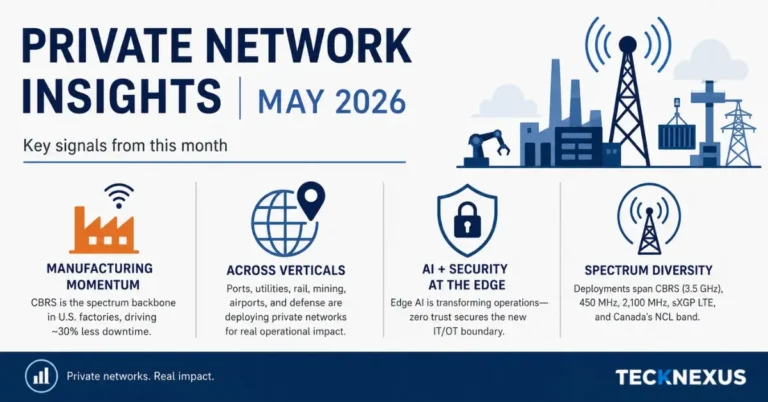
Private 5G became an industrial default in May 2026, with CBRS now the U.S. factory spectrum of record. This month's roundup spans deployments across manufacturing, ports, utilities, rail and defence — plus a deep utilities thread on grid AI and security — and what the shift means for buyers scoping spectrum, architecture and security.
Boldyn Networks is rolling out a neutral host 5G upgrade at Silverstone that shifts the circuit from seasonal stopgaps to a year-round, high-capacity mobile platform for fans, teams, and broadcasters. The architecture spans 25 locations, with 57 sectors engineered across 87 DAS zones to handle concentrated traffic and maintain performance under crowd pressure. The design anticipates surges in uplink and signaling, supports concurrent sessions at scale, and smooths throughput across hotspots. A permanent, multi-operator 5G foundation unlocks new revenue, better service metrics, and more efficient event delivery. When connectivity works, dwell time, spend, and satisfaction rise.
From Singapore to Schiphol, airports are embracing private networks for airports alongside AI and digital twins to drive operational efficiency, predictive maintenance, sustainability, and smarter passenger flows. This article explores 12 real-world deployments showcasing how private network deployments for aviation are shaping the future of Airport 4.0 globally.
Defense, public safety, transport, and critical infrastructure need deterministic connectivity that moves with the mission. Traditional rollouts struggle with time-to-service, power, and backhaul constraints. Portable, “all-in-one” 5G modules help bridge that gap by putting the radio, core, and management closer to the edge, enabling local breakout, resilience, and consistent QoS. With 3GPP Release 16/17 features maturing and SA-first private networks becoming standard, demand is shifting from pilots to field-ready systems that can be mounted in vehicles, worn as backpacks, or staged in temporary zones.
AT&T has gone live on Boldyn Networks’ neutral-host infrastructure in New York’s Joralemon Street tunnel, with G line tunnel segments next in the rollout. AT&T customers can now access 5G mobile service through the 1.1-mile (1.8 km) Joralemon Street tunnel, the oldest underwater subway tunnel in New York City, which links the 4/5 lines between Borough Hall in Brooklyn and Bowling Green in Manhattan. Subway connectivity has shifted from convenience to critical infrastructure for safety, accessibility, and productivity. AT&T’s first-mover status sets a competitive benchmark; other national carriers (Verizon and T‑Mobile) are expected to follow as on-boarding progresses across the system.
Boldyn Networks and O2 have upgraded AO Arena Manchester with a cutting-edge neutral host 5G DAS. Designed to support over a million annual attendees, the shared infrastructure enhances livestreaming, digital ticketing, and real-time services. The rollout delivers seamless mobile performance for fans, vendors, and staff, setting a new standard for large venue connectivity in the UK.
Nokia and Boldyn Networks have launched a private 5G network at Callio FutureMINE in Finland, addressing underground mining’s toughest connectivity issues. The network supports autonomous vehicles, real-time visualization, and tele-remote operations, transforming safety, efficiency, and sustainability in mining. This deployment sets a global benchmark for industrial 5G use in extreme environments.
The Small Cell Forum’s 2025 Market Forecast points to a market shifting from experimentation to scaled deployment, with enterprise demand and new business models driving a faster cadence. SCF forecasts cumulative small-cell shipments to reach 61 million units by 2030, supporting an installed base of roughly 54.4–54.5 million radio units and annual vendor/integrator revenues of about USD 4.23 billion. Indoor enterprise deployments continue to dominate, representing about 60% of rollouts in 2023–2024. SCF expects 5G SA small cells to grow at a 56% CAGR through 2030, with two-thirds of enterprise small cells co-located with edge compute by 2030.
Boldyn Networks and Virgin Media O2 have launched the UK’s first full RAN managed 5G service at Sunderland’s Stadium of Light. Powered by JMA XRAN® and a neutral host architecture, the deployment transforms fan experience, reduces energy use by 60%, and boosts operational safety and efficiency—setting a new benchmark for smart stadiums across the UK.
Chesapeake, Virginia, in partnership with Boldyn Networks, has launched Chesapeake Connects, a city-owned private LTE and IoT network aimed at transforming public services, improving digital equity, and reducing reliance on commercial carriers. The hybrid system leverages CBRS for Fixed Wireless Access and LoRaWAN for citywide IoT, supporting smart city infrastructure like flood sensors, smart traffic lights, and more.
Oulu University Hospital has deployed Europe’s first Private 5G Standalone (SA) network, revolutionizing healthcare with real-time patient monitoring, AI-assisted imaging, and augmented reality (AR) for surgery. Built by Boldyn Networks using Nokia Modular Private Wireless (MPW) technology, this high-speed, ultra-reliable network ensures seamless data flow, improved diagnostics, and enhanced patient safety. Learn how 5G is shaping the future of smart hospitals.

Partner Hubs

Download content, access intelligence tools, and hear from executives.

Partner Events

  • M360 ASEAN
  • FutureNet Asia 2026
Scroll to Top