

SoftBank record revenue and guidance boost with 5G, AI, and edge strategy
SoftBank Corp. delivered its strongest nine-month performance on record and lifted full-year guidance, underscoring a strategic shift from connectivity-only services to network-enabled platforms in AI, cloud, and edge.
Financial highlights: revenue, profit, and guidance upgrades
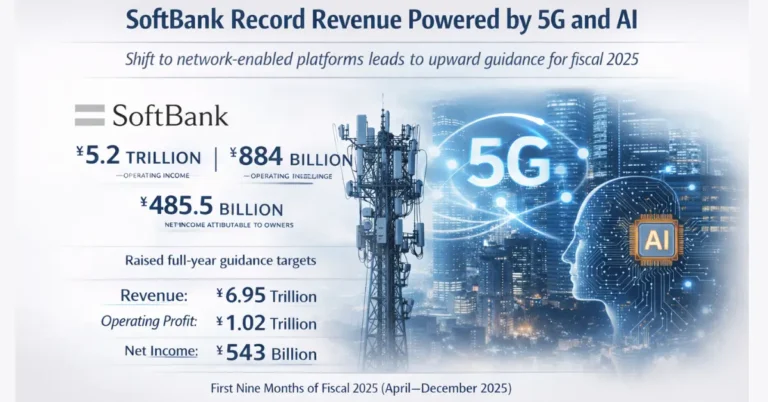
Through the first nine months of fiscal 2025 (April–December 2025), SoftBank reported revenue of ¥5.2 trillion, up 8% year over year, and operating income of ¥884 billion, also up 8%, with net income attributable to owners rising 11% to ¥485.5 billion. Management raised full-year targets to ¥6.95 trillion in revenue, ¥1.02 trillion in operating profit, and ¥543 billion in net income, signaling confidence heading into the March 31, 2026 year end. The quarter also absorbed a roughly ¥60 billion top-line impact tied to a ransomware incident at allied firm ASKUL, highlighting operational resilience despite security headwinds.
Segment performance: consumer mobility, enterprise IT, and fintech gains
Performance was broad-based. In consumer mobility, smartphone subscribers declined by about 100,000 in the quarter due to stricter acquisition policies, yet revenue rose about 3% and operating income increased roughly 6% as SoftBank prioritized higher-value, longer-tenure customers over volume. Enterprise revenues grew nearly 9% year on year, reflecting steady adoption of advanced connectivity and IT services. The financial services arm more than doubled operating profit, adding diversification beyond core mobile. Parent-level sentiment also benefited from Arm’s outsized results amid AI demand, even as SoftBank Corp.’s operational cadence stands on its own.
Executive changes underscore continuity and margin focus
CEO Junichi Miyakawa announced a rejuvenation of the executive bench, including the planned departure of CFO Kazuhiko Fujihara. With guidance raised and execution tracking ahead of plan, the timing signals continuity of strategy rather than a reset. Investors and partners will watch year-end disclosures for evidence that the quality-over-quantity customer mix can sustain margin gains.
Telco platform strategy: SA 5G, private 5G, AI-RAN, and edge compute
SoftBank is reframing telecom as a growth platform where network, compute, and data converge to unlock new B2B value in Japan’s next wave of digitalization.

SA 5G and local 5G for industrial SLAs and vertical solutions
SoftBank is investing in 3GPP Standalone 5G to deliver deterministic latency, network slicing, and uplink-optimized performance critical for industrial automation, video analytics, and private wireless. Local 5G—Japan’s spectrum framework for enterprise and municipal deployments—remains a vector for differentiated solutions in manufacturing, logistics, utilities, and smart cities. As Japan’s mobile market matures, these SA and private deployments provide new revenue pools beyond traditional ARPU, with opportunities to bundle managed services, SLAs, and vertical applications.
AI-RAN and O-RAN for energy efficiency and automated optimization
The company is moving toward AI-enhanced RAN operations, aligning with O-RAN Alliance trajectories that emphasize open interfaces and intelligent control. AI-RAN promises energy savings, better spectral efficiency, and automated optimization—essential in dense urban footprints. By co-designing radio sites with adjacent compute, SoftBank can host low-latency workloads closer to users and machines, creating a fabric for MEC-aligned services compliant with ETSI MEC principles.
Edge-aligned GPU data centers for AI training and inference
SoftBank is funding GPU infrastructure at facilities such as Sakai and Tomakomai to serve AI inference, training for domain-specific models, and real-time analytics tethered to the network edge. This distributed topology integrates transport, RAN, and compute, enabling packaged offers—connectivity plus compute, storage, and orchestration—rather than selling access alone. The approach supports scalable B2B engagements where performance, data residency, and compliance are part of the contract, not afterthoughts.
Sovereign cloud in Japan: performance, localization, and compliance
To compete with hyperscale clouds while meeting Japan’s data-sovereignty demands, SoftBank is preparing a sovereign cloud that binds network performance with regulated-class controls.
Infrinia sovereign cloud launch targeted for April 2026
SoftBank’s AI infrastructure unit, Infrinia, is targeting an April 2026 rollout of a sovereign cloud designed for public sector, financial services, healthcare, and manufacturers with strict data-governance needs. Expect architectural choices that emphasize data localization under Japan’s APPI requirements, zero-trust security, and alignment with global benchmarks like ISO/IEC 27001 and SOC reporting, plus auditability for sector standards. Integration with SoftBank’s fiber, 5G SA, and edge footprint aims to deliver predictable latency and assured data paths.
Market landscape, capex, power, and supply-chain risks
Japan’s sovereign cloud landscape is heating up as ministries and regulated enterprises weigh hyperscaler sovereign offerings against domestic options. SoftBank’s differentiation rests on network-embedded performance, local control, and the ability to bundle private 5G with secure cloud endpoints. Risks include capex intensity, power availability for GPU clusters, supply constraints on advanced accelerators, and the operational discipline required to run cloud-scale services alongside nationwide networks.
Why it matters and next steps for telcos and enterprises
SoftBank’s moves reflect a broader pivot across telecom: monetizing networks through AI, edge, and industry solutions, not just connectivity.
Operator playbook: SA 5G, AI-RAN KPIs, and edge investments
Prioritize SA 5G and private wireless with clear vertical plays, not generic connectivity. Build AI-RAN roadmaps tied to measurable KPIs—energy per bit, capacity gains, and trouble-ticket reductions. Co-invest in distributed GPU sites where enterprise demand is proven, with interconnects to public cloud gateways. Align product and finance teams to reward lifetime value and contract quality rather than gross adds.
Buyer guidance: private 5G RFPs, sovereignty, and edge AI
Use RFPs that weight deterministic latency, data residency, and integration with existing security posture as heavily as price. Pilot private 5G for use cases where Wi-Fi falls short (mobile robotics, high-definition inspection, uplink video). Evaluate sovereign cloud options on audit transparency, key management, lawful-access protections, and exit strategies—alongside performance on AI inference and analytics at the edge.
Key signals: slicing SLAs, AI-RAN rollout, and attach rates
Track the pace of SA 5G feature commercialization (slicing SLAs, URLLC-aligned services), AI-RAN deployments aligned with O-RAN near-real-time RIC adoption, and the attach rates between private 5G and edge compute. On financials, watch whether consumer ARPU and churn trends validate the premium-customer focus, and whether enterprise backlog converts as sovereign cloud comes online. Execution against power and supply-chain constraints for GPU rollouts will be a leading indicator of capacity to scale AI services.