5G and Public Safety – Top 10 Use Cases enabling First Responders to SAVE MORE LIVES

We all know how first responders — firefighters, law enforcement, and emergency medical service personnels risk their lives everyday, to save ours. They are the real heroes. And in times of global corona pandemic, we have come to appreciate their value even more.

Introduction: 5G and Public Safety – Transforming First Response Operations

In our rapidly evolving world, the role of first responders — firefighters, law enforcement officers, and emergency medical service personnel — has never been more critical. These brave individuals risk their lives daily to ensure our safety, a fact that has been highlighted during the global coronavirus pandemic. Their heroism is unquestionable, yet they face a significant challenge: accessing critical, real-time information in the field. This is where the transformative power of 5G technology comes into play.

5G Characteristics: Enhancing Real-Time Response Capabilities

5G, with its revolutionary characteristics, is set to redefine public safety and dramatically enhance the capabilities of first responders. Its high throughput capacity, capable of reaching up to 10 Gigabits per second, ensures the rapid transmission of large amounts of data. The ultra-low latency of as low as 1 millisecond, coupled with a high-reliability rate of 99.999% availability, enables real-time communication and decision-making. Furthermore, its ability to support massive connectivity, with 100 times more connected devices per unit area compared to 4G, and better user mobility at speeds up to 500 km/hour, greatly expands the operational scope of emergency services.
Top 10 Use Cases of 5G in Public Safety


1. Finding Missing Persons in Emergencies via 5G Enabled Drones

5G technology significantly enhances the capabilities of drones in search and rescue operations. These advanced drones, equipped with high-resolution cameras and real-time data processing, can cover vast areas quickly, identifying missing persons in emergencies with greater efficiency. The low latency and high-speed data transfer of 5G enable real-time image and video analysis, making it possible for rescue teams to receive instant updates and precise locations. This technology is particularly useful in challenging terrains or during adverse weather conditions, where traditional search methods are less effective.

2. Active Shooter Alert with Location & Weapon Info to First Responders

In critical situations like active shooter incidents, 5G can play a pivotal role in enhancing public safety. By integrating 5G with existing camera systems and artificial intelligence, it’s possible to quickly identify the location of the shooter, the type of weapon used, and the dynamics of the situation. This real-time information can be relayed to first responders, enabling them to respond more effectively and safely. Such systems can also help in crowd management and evacuation procedures, minimizing the risk to civilians and law enforcement personnel.

3. Delivering Medical Equipment to Remote Areas via 5G Enabled Drones

5G’s high bandwidth and low latency capabilities are revolutionizing medical aid delivery, especially in remote or inaccessible areas. Drones enabled with 5G can transport essential medical supplies, such as medications, vaccines, or even small medical equipment, to areas where traditional delivery methods are slow or impractical. This not only speeds up the delivery process but also ensures that communities in remote locations have access to critical healthcare supplies when needed.

4. Traffic Management for Emergency Vehicle Routing

5G technology can transform traffic management, especially for routing emergency vehicles during critical situations. With its ability to handle large volumes of data from various sources (like traffic cameras, sensors, and GPS systems), 5G can provide real-time traffic analysis, enabling the precise prediction of traffic patterns and the most efficient routes for emergency vehicles. This ensures quicker response times for ambulances, fire trucks, and police vehicles, potentially saving more lives.

5. Virtual Reality-Based Training for First Responders

Virtual reality (VR), powered by 5G, offers an innovative way to train first responders. By simulating real-world scenarios in a controlled, virtual environment, first responders can gain valuable experience without the risks associated with traditional training methods. The high-speed and low-latency of 5G ensure a seamless and realistic VR experience, enabling simultaneous training of multiple users

and fostering collaborative learning. This approach is cost-effective, reducing the need for physical resources and locations while preparing responders for a wide range of emergency scenarios.

6. Bomb or Abandoned Items Disposal via 5G Enabled Drones or Robots

The disposal of bombs or suspicious items is a high-risk task where 5G technology can offer significant safety benefits. Drones or remotely controlled robots equipped with 5G can approach and assess potentially dangerous objects from a safe distance. These devices can transmit high-definition images and data in real-time, allowing bomb disposal experts to make informed decisions without being in harm’s way. This remote approach minimizes the risk to human lives and can be instrumental in diffusing dangerous situations more safely and efficiently.

7. 5G Connected Ambulances with Remote Support from Doctors

5G connected ambulances are a leap forward in emergency medical services. These ambulances can transmit vital patient data, such as ECGs, imaging results, and real-time vital signs, to hospitals while en route. This allows doctors to remotely assess the patient’s condition, provide critical guidance to paramedics, and prepare for immediate treatment upon the patient’s arrival. The fast and reliable communication enabled by 5G ensures that the patient receives the best possible care from the moment of first response.

8. Providing Location Information in Building Collapses

In the aftermath of an earthquake or similar disaster, locating survivors trapped in collapsed buildings is a time-critical task. 5G technology can be utilized to trace the location of people before and after a collapse. By analyzing data from smartphones, wearables, and other devices within a building, responders can pinpoint the locations of individuals, aiding in efficient and targeted rescue operations. This technology can significantly reduce the time spent searching for survivors, thereby increasing the chances of saving lives.

9. Enforcing Curfew/Lockdown via 5G Enabled Drones or Robots

During situations requiring curfews or lockdowns, maintaining public order while minimizing risk to law enforcement personnel is crucial. 5G enabled drones or autonomous security robots can be deployed to monitor public spaces, ensuring compliance with curfew orders. They can provide real-time surveillance, crowd monitoring, and even communicate public safety messages. This approach reduces the need for physical presence of law enforcement officers, thereby decreasing the risk of confrontations and potential spread of contagions in cases of public health emergencies.

10. Wearables & Sensor-Based Detection of Chemical Weapons

In hazardous environments, such as chemical spills or warfare scenarios, the safety of first responders is paramount. Wearables and sensors connected through 5G networks can detect the presence of chemical agents, providing real-time data on the type and concentration of hazardous substances. This information is crucial for ensuring that responders wear appropriate protective gear and take necessary precautions. Additionally, these devices can continuously monitor the health and vitals of the responders, enabling immediate medical intervention if they are exposed to dangerous substances.

Conclusion: Empowering Heroes with Cutting-Edge Technology

The integration of 5G technology into public safety operations marks a pivotal shift in how first responders can approach and handle emergencies. By providing them with real-time data, enhanced communication capabilities, and advanced tools, 5G is not just a technological advancement; it is a lifeline that empowers our heroes to save more lives while reducing their own risk. As we continue to witness the rollout and expansion of 5G networks, the potential for further innovation in public safety is immense. The future is promising, with 5G acting as a critical ally in the relentless efforts of first responders to protect and serve communities across the globe.

Related Content

Tech News & Insight
Deutsche Telekom, Orange, Telefónica, TIM, and Vodafone unveiled a live, pan‑European edge federation at MWC 2026, marking a practical step toward an interoperable edge cloud that spans national borders. The five largest European operators demonstrated the European Edge Continuum, a federated edge capability now running in lab and pre‑production environments. The initiative provides a single entry point to deploy and manage applications across multiple operators’ edge nodes, with automated placement, security controls, and mobility‑aware continuity. The platform draws on components developed under the IPCEI‑CIS program backed by the EU’s NextGenerationEU funds, and is positioned for industrialization and commercial rollout next.
Tech News & Insight
Deutsche Telekom, Orange, Telefónica, TIM, and Vodafone unveiled a live, pan‑European edge federation at MWC 2026, marking a practical step toward an interoperable edge cloud that spans national borders. The five largest European operators demonstrated the European Edge Continuum, a federated edge capability now running in lab and pre‑production environments. The initiative provides a single entry point to deploy and manage applications across multiple operators’ edge nodes, with automated placement, security controls, and mobility‑aware continuity. The platform draws on components developed under the IPCEI‑CIS program backed by the EU’s NextGenerationEU funds, and is positioned for industrialization and commercial rollout next.
Tech News & Insight
Deutsche Telekom’s early live results showing up to 65% energy savings in its 5G core spotlight a pragmatic path to cut opex and carbon as traffic surges and standalone 5G scales. Operators have wrung out much of the easy efficiency from hardware refreshes; the next gains come from software-driven, demand-aware control. DT is applying that logic to the core, shifting components to run only when needed rather than idling at full power. The results are enabled by DT’s “Horizontal Telco Cloud,” a unified, standards-based platform that replaces fragmented stacks with one common layer for core services. Initial live-network tests have been completed, with broader rollout planned and further detail expected at MWC Barcelona 2026.
Tech News & Insight
Deutsche Telekom’s early live results showing up to 65% energy savings in its 5G core spotlight a pragmatic path to cut opex and carbon as traffic surges and standalone 5G scales. Operators have wrung out much of the easy efficiency from hardware refreshes; the next gains come from software-driven, demand-aware control. DT is applying that logic to the core, shifting components to run only when needed rather than idling at full power. The results are enabled by DT’s “Horizontal Telco Cloud,” a unified, standards-based platform that replaces fragmented stacks with one common layer for core services. Initial live-network tests have been completed, with broader rollout planned and further detail expected at MWC Barcelona 2026.
Tech News & Insight
Nokia and Amazon Web Services (AWS) are bringing agentic AI to 5G-Advanced network slicing, moving closed‑loop, intent-based services from PowerPoint to live pilots with du and Orange. The partners unveiled an agentic AI-powered slicing solution that fuses Nokia’s RAN-to-core slicing, AirScale radio, and MantaRay SMO with AWS’s Bedrock AI platform and EKS Hybrid Nodes to turn external context—events, traffic, maps, weather—and live network KPIs into real-time policy decisions. The result is adaptive, premium slices provisioned when and where they’re needed, without manual reconfiguration.

Tech News & Insight
Nokia and Amazon Web Services (AWS) are bringing agentic AI to 5G-Advanced network slicing, moving closed‑loop, intent-based services from PowerPoint to live pilots with du and Orange. The partners unveiled an agentic AI-powered slicing solution that fuses Nokia’s RAN-to-core slicing, AirScale radio, and MantaRay SMO with AWS’s Bedrock AI platform and EKS Hybrid Nodes to turn external context—events, traffic, maps, weather—and live network KPIs into real-time policy decisions. The result is adaptive, premium slices provisioned when and where they’re needed, without manual reconfiguration.
Tech News & Insight
As digital life expands, traditional passwords are no longer enough to protect users from rising fraud and identity theft. Artificial intelligence is transforming digital identity by enabling smarter authentication, real-time fraud detection and adaptive security systems. By balancing innovation with privacy and trust, AI is helping build a safer, more seamless online future.
Tech News & Insight
As digital life expands, traditional passwords are no longer enough to protect users from rising fraud and identity theft. Artificial intelligence is transforming digital identity by enabling smarter authentication, real-time fraud detection and adaptive security systems. By balancing innovation with privacy and trust, AI is helping build a safer, more seamless online future.
Tech News & Insight
Anthropic has introduced Claude Code Security, an AI capability that reviews codebases, flags complex vulnerabilities, and proposes patches with human oversight, and its early results should change how security leaders plan for AI on both offense and defense. Anthropic reports that its latest Claude Opus 4.6 model helped uncover more than 500 vulnerabilities in production open-source projects, including issues that had persisted for years. The product centers on high-signal findings, structured triage, and human-in-the-loop remediation so it can slot into existing DevSecOps workflows.
Tech News & Insight
Anthropic has introduced Claude Code Security, an AI capability that reviews codebases, flags complex vulnerabilities, and proposes patches with human oversight, and its early results should change how security leaders plan for AI on both offense and defense. Anthropic reports that its latest Claude Opus 4.6 model helped uncover more than 500 vulnerabilities in production open-source projects, including issues that had persisted for years. The product centers on high-signal findings, structured triage, and human-in-the-loop remediation so it can slot into existing DevSecOps workflows.
Tech News & Insight
KDDI and Nokia validated quantum-safe optical transport at KDDI’s new Sakai Data Center, a facility built to support real-time AI training, inference, and analytics. The demonstration used Nokia’s 1830 Photonic Service Switch with C+L band capabilities for capacity scaling and the 1830 Security Management Server for centralized key and policy control. The goal is clear: deliver high-throughput, low-latency, and line-rate encrypted data center interconnect (DCI) that is resilient against both today’s threats and tomorrow’s quantum-era risks. Encrypting at the optical layer removes the performance penalties of application or IP-layer encryption and avoids fragmenting security by workload.
Tech News & Insight
KDDI and Nokia validated quantum-safe optical transport at KDDI’s new Sakai Data Center, a facility built to support real-time AI training, inference, and analytics. The demonstration used Nokia’s 1830 Photonic Service Switch with C+L band capabilities for capacity scaling and the 1830 Security Management Server for centralized key and policy control. The goal is clear: deliver high-throughput, low-latency, and line-rate encrypted data center interconnect (DCI) that is resilient against both today’s threats and tomorrow’s quantum-era risks. Encrypting at the optical layer removes the performance penalties of application or IP-layer encryption and avoids fragmenting security by workload.
Tech News & Insight
A new partnership between Infosys and Anthropic brings agentic AI into regulated, process-heavy industries, with telecom squarely in scope. Infosys will integrate Anthropic’s Claude models and Claude Code with its Topaz portfolio to build and operate enterprise-grade AI solutions across telecom, financial services, manufacturing, and software engineering. The collaboration emphasizes agentic AI—systems that can plan, call tools, and execute multi-step workflows with oversight—delivered with the controls, auditability, and policy enforcement that regulated sectors demand. Pairing Infosys’s domain depth with Claude’s reasoning and long-context capabilities gives operators a path to pragmatic automation that respects regulatory, safety, and transparency requirements.
Tech News & Insight
A new partnership between Infosys and Anthropic brings agentic AI into regulated, process-heavy industries, with telecom squarely in scope. Infosys will integrate Anthropic’s Claude models and Claude Code with its Topaz portfolio to build and operate enterprise-grade AI solutions across telecom, financial services, manufacturing, and software engineering. The collaboration emphasizes agentic AI—systems that can plan, call tools, and execute multi-step workflows with oversight—delivered with the controls, auditability, and policy enforcement that regulated sectors demand. Pairing Infosys’s domain depth with Claude’s reasoning and long-context capabilities gives operators a path to pragmatic automation that respects regulatory, safety, and transparency requirements.
Tech News & Insight
India’s AI agenda increasingly spans silicon, data platforms, models, and applications, with an intent to catalyze domestic innovation and contribute to global ecosystems. For telecom leaders, the message is clear: AI is not a bolt-on capability but a system-level transformation that touches RAN, core, transport, cloud, and the enterprise edge. The AI economy runs on connectivity—low-latency access to data, assured bandwidth, location-aware processing, and programmable control. The operators that can fuse connectivity, compute, and data into a cohesive platform will set the pace for India’s next wave of digital growth.
Tech News & Insight
India’s AI agenda increasingly spans silicon, data platforms, models, and applications, with an intent to catalyze domestic innovation and contribute to global ecosystems. For telecom leaders, the message is clear: AI is not a bolt-on capability but a system-level transformation that touches RAN, core, transport, cloud, and the enterprise edge. The AI economy runs on connectivity—low-latency access to data, assured bandwidth, location-aware processing, and programmable control. The operators that can fuse connectivity, compute, and data into a cohesive platform will set the pace for India’s next wave of digital growth.
Tech News & Insight
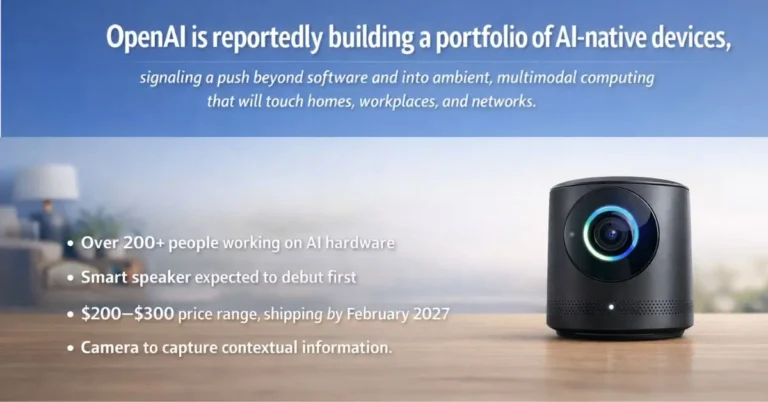
OpenAI is reportedly building a portfolio of AI-native devices, signaling a push beyond software and into ambient, multimodal computing that will touch homes, workplaces, and networks. Multiple reports indicate OpenAI has over 200 people developing a family of AI-enabled hardware, with a smart speaker expected to debut first. Early guidance points to a price in the $200–$300 range and a ship window no earlier than February 2027. The device is said to include a camera to capture contextual information about users and surroundings—an explicit bet on multimodal AI that fuses voice, vision, and environment for richer interactions.
Tech News & Insight
OpenAI is reportedly building a portfolio of AI-native devices, signaling a push beyond software and into ambient, multimodal computing that will touch homes, workplaces, and networks. Multiple reports indicate OpenAI has over 200 people developing a family of AI-enabled hardware, with a smart speaker expected to debut first. Early guidance points to a price in the $200–$300 range and a ship window no earlier than February 2027. The device is said to include a camera to capture contextual information about users and surroundings—an explicit bet on multimodal AI that fuses voice, vision, and environment for richer interactions.
Tech News & Insight
Ericsson and Mistral AI are aligning telecom-grade engineering with customizable foundation models to push AI deeper into network operations and RAN automation. The pairing marries Mistral AI’s fast-evolving model stack with Ericsson’s domain expertise across radio, cloud-native networking, and service management. For European operators, it signals a path to AI capabilities that respect data residency, security, and compliance expectations under the EU AI Act without ceding control to generic, hyperscaler-led platforms. The outcome operators want is simple: measurable gains in performance, efficiency, and resiliency with governance baked in.
Tech News & Insight
Ericsson and Mistral AI are aligning telecom-grade engineering with customizable foundation models to push AI deeper into network operations and RAN automation. The pairing marries Mistral AI’s fast-evolving model stack with Ericsson’s domain expertise across radio, cloud-native networking, and service management. For European operators, it signals a path to AI capabilities that respect data residency, security, and compliance expectations under the EU AI Act without ceding control to generic, hyperscaler-led platforms. The outcome operators want is simple: measurable gains in performance, efficiency, and resiliency with governance baked in.
Tech News & Insight
Private LTE, 5G, and CBRS networks are becoming the backbone of industrial operations. This article maps private network security vendors to a Four Pillars framework—Core Controls, Device Visibility, Detection & Response, and Orchestration—revealing where structural gaps emerge in real-world industrial deployments. From slice isolation and SIM lifecycle governance to OT micro-segmentation and SOC integration, it explains why layered enforcement—not vendor breadth—determines private 5G security resilience.
Tech News & Insight
Private LTE, 5G, and CBRS networks are becoming the backbone of industrial operations. This article maps private network security vendors to a Four Pillars framework—Core Controls, Device Visibility, Detection & Response, and Orchestration—revealing where structural gaps emerge in real-world industrial deployments. From slice isolation and SIM lifecycle governance to OT micro-segmentation and SOC integration, it explains why layered enforcement—not vendor breadth—determines private 5G security resilience.
Tech News & Insight
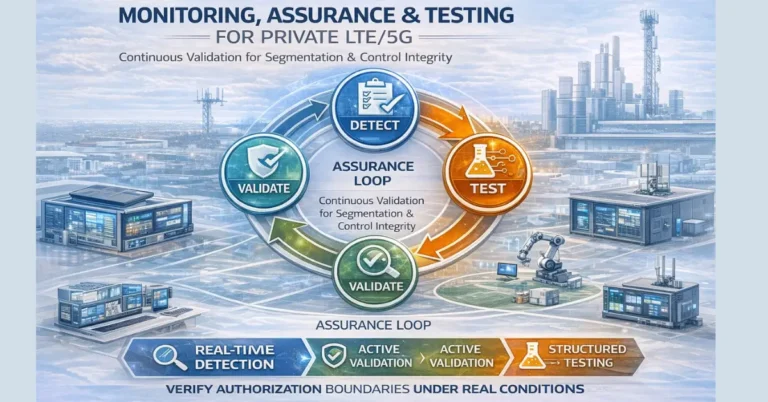
Private LTE and 5G security does not fail because of flawed architecture—it fails when enforcement controls degrade silently. This guide explains how enterprises implement continuous monitoring, assurance, and testing loops across control-plane signaling, user-plane routing, identity governance, and industrial OT environments. Learn how to validate segmentation integrity, detect policy drift, test Zero Trust enforcement, and produce audit-ready evidence across multi-site private cellular deployments.
Tech News & Insight
Private LTE and 5G security does not fail because of flawed architecture—it fails when enforcement controls degrade silently. This guide explains how enterprises implement continuous monitoring, assurance, and testing loops across control-plane signaling, user-plane routing, identity governance, and industrial OT environments. Learn how to validate segmentation integrity, detect policy drift, test Zero Trust enforcement, and produce audit-ready evidence across multi-site private cellular deployments.
Tech News & Insight
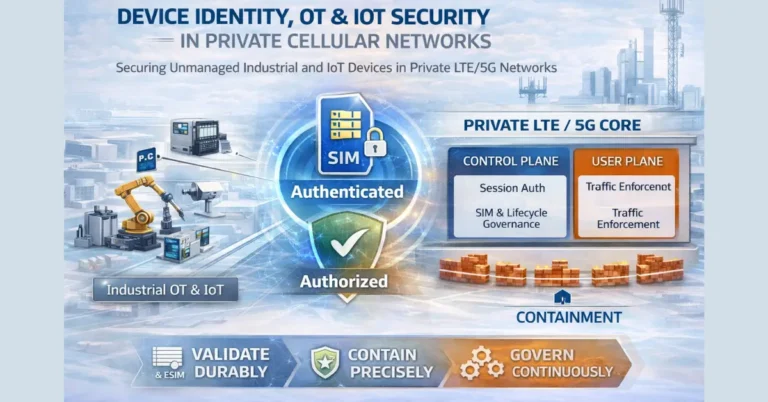
Private LTE and 5G networks strengthen authentication at the transport layer—but device identity, lifecycle governance, and OT/IoT realities determine whether containment holds. This in-depth guide explains SIM and eSIM authentication models, service-profile authorization, identity drift risks, industrial gateway mediation, and Zero Trust containment strategies across multi-site private cellular deployments.
Tech News & Insight
Private LTE and 5G networks strengthen authentication at the transport layer—but device identity, lifecycle governance, and OT/IoT realities determine whether containment holds. This in-depth guide explains SIM and eSIM authentication models, service-profile authorization, identity drift risks, industrial gateway mediation, and Zero Trust containment strategies across multi-site private cellular deployments.
Tech News & Insight
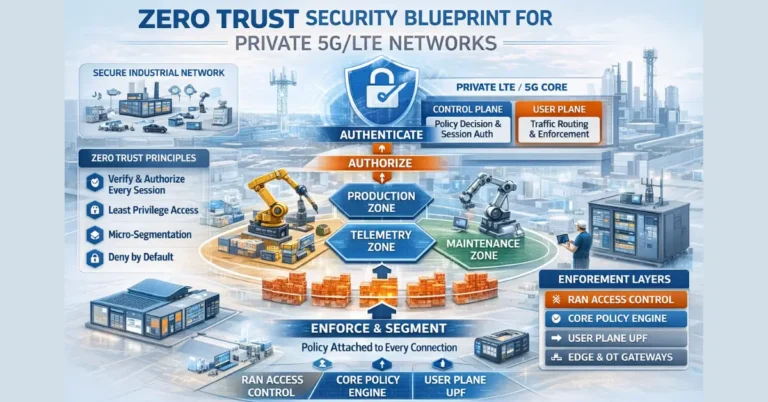
This Zero Trust security blueprint for Private LTE and 5G networks explains how session-based authorization, control-plane policy decisions, and user-plane enforcement create deterministic micro-segmentation across industrial and OT environments. Mapping private cellular architecture to NIST SP 800-207, the article details how operational zones, service profiles, and containment principles protect production-critical systems under mobility and scale.
Tech News & Insight
This Zero Trust security blueprint for Private LTE and 5G networks explains how session-based authorization, control-plane policy decisions, and user-plane enforcement create deterministic micro-segmentation across industrial and OT environments. Mapping private cellular architecture to NIST SP 800-207, the article details how operational zones, service profiles, and containment principles protect production-critical systems under mobility and scale.
Tech News & Insight
The UK government signalled a rapid escalation of online safety measures that will bring AI chatbots squarely under the Online Safety Act and could introduce an under‑16 social media ban as early as this year. Ministers plan to amend the Online Safety Act 2023 so one‑to‑one interactions with AI systems fall within scope of illegal and harmful content controls. The government wants providers of large language model (LLM) assistants and agentic chatbots to implement safety‑by‑design, including stronger filtering, red‑teaming, abuse detection, and rapid takedown procedures for sexualised or otherwise illegal outputs.
Tech News & Insight
The UK government signalled a rapid escalation of online safety measures that will bring AI chatbots squarely under the Online Safety Act and could introduce an under‑16 social media ban as early as this year. Ministers plan to amend the Online Safety Act 2023 so one‑to‑one interactions with AI systems fall within scope of illegal and harmful content controls. The government wants providers of large language model (LLM) assistants and agentic chatbots to implement safety‑by‑design, including stronger filtering, red‑teaming, abuse detection, and rapid takedown procedures for sexualised or otherwise illegal outputs.
Tech News & Insight
Boldyn Networks is rolling out a neutral host 5G upgrade at Silverstone that shifts the circuit from seasonal stopgaps to a year-round, high-capacity mobile platform for fans, teams, and broadcasters. The architecture spans 25 locations, with 57 sectors engineered across 87 DAS zones to handle concentrated traffic and maintain performance under crowd pressure. The design anticipates surges in uplink and signaling, supports concurrent sessions at scale, and smooths throughput across hotspots. A permanent, multi-operator 5G foundation unlocks new revenue, better service metrics, and more efficient event delivery. When connectivity works, dwell time, spend, and satisfaction rise.
Tech News & Insight
Boldyn Networks is rolling out a neutral host 5G upgrade at Silverstone that shifts the circuit from seasonal stopgaps to a year-round, high-capacity mobile platform for fans, teams, and broadcasters. The architecture spans 25 locations, with 57 sectors engineered across 87 DAS zones to handle concentrated traffic and maintain performance under crowd pressure. The design anticipates surges in uplink and signaling, supports concurrent sessions at scale, and smooths throughput across hotspots. A permanent, multi-operator 5G foundation unlocks new revenue, better service metrics, and more efficient event delivery. When connectivity works, dwell time, spend, and satisfaction rise.
Tech News & Insight
India is moving to anchor a larger slice of global AI compute by pairing policy incentives with large-scale private capital and renewable power. New Delhi has outlined plans to attract more than $200 billion for AI infrastructure over the next two years, positioning the country as a production base for compute, data, and advanced applications rather than a pure consumer market. The policy stack aims to reduce friction for export-oriented AI services while widening access to shared compute for startups and enterprises. Adani Group plans to invest $100 billion through 2035 to build renewable-powered, AI-optimized data centers across India.
Tech News & Insight
India is moving to anchor a larger slice of global AI compute by pairing policy incentives with large-scale private capital and renewable power. New Delhi has outlined plans to attract more than $200 billion for AI infrastructure over the next two years, positioning the country as a production base for compute, data, and advanced applications rather than a pure consumer market. The policy stack aims to reduce friction for export-oriented AI services while widening access to shared compute for startups and enterprises. Adani Group plans to invest $100 billion through 2035 to build renewable-powered, AI-optimized data centers across India.
Tech News & Insight
Ericsson has introduced an agentic rApp delivered as a cloud service on Amazon Web Services (AWS), aiming to speed operators’ shift from manual automation toward truly autonomous networks. By offering an “Agentic rApp as a Service” on AWS, Ericsson is packaging policy-driven and AI-assisted RAN optimization as a managed, cloud-delivered capability. Agentic capabilities bring reasoning, planning, and action-taking to operations. Running rApps on AWS offers elasticity, global reach, and faster release cadence. The goal: faster onboarding, lower integration friction, and a more repeatable path to closed-loop assurance across multi-vendor 4G/5G networks.
Tech News & Insight
Ericsson has introduced an agentic rApp delivered as a cloud service on Amazon Web Services (AWS), aiming to speed operators’ shift from manual automation toward truly autonomous networks. By offering an “Agentic rApp as a Service” on AWS, Ericsson is packaging policy-driven and AI-assisted RAN optimization as a managed, cloud-delivered capability. Agentic capabilities bring reasoning, planning, and action-taking to operations. Running rApps on AWS offers elasticity, global reach, and faster release cadence. The goal: faster onboarding, lower integration friction, and a more repeatable path to closed-loop assurance across multi-vendor 4G/5G networks.
Tech News & Insight
Cognizant is expanding its partnership with Google Cloud around Gemini Enterprise and Google Workspace, and it is putting real skin in the game by rolling out this stack internally to boost productivity and delivery velocity. The company is forming a dedicated Gemini Enterprise Center of Excellence and codifying repeatable delivery with an Agent Development Lifecycle that embeds AI across design, build, validation, and production. It is also packaging accelerators—Cognizant Ignition for discovery and data readiness and Cognizant Agent Foundry for no-code, pre-configured agents targeting use cases like AI-powered contact centers and intelligent order management.
Tech News & Insight
Cognizant is expanding its partnership with Google Cloud around Gemini Enterprise and Google Workspace, and it is putting real skin in the game by rolling out this stack internally to boost productivity and delivery velocity. The company is forming a dedicated Gemini Enterprise Center of Excellence and codifying repeatable delivery with an Agent Development Lifecycle that embeds AI across design, build, validation, and production. It is also packaging accelerators—Cognizant Ignition for discovery and data readiness and Cognizant Agent Foundry for no-code, pre-configured agents targeting use cases like AI-powered contact centers and intelligent order management.
Tech News & Insight
Ericsson is introducing an AI-first approach to building networks with the latest RAN hardware, engineered to meet AI-driven network demands, delivering greater uplink performance, improved TCO, and enhanced energy efficiency
Ericsson’s RAN software enhancements include AI-managed Beamforming, AI-powered Outdoor Positioning, and a best-in-class AI model for instant coverage prediction
New AI‑ready radios, featuring Ericsson Silicon with neural network accelerators, boost on‑site AI inference capabilities in Massive MIMO radios, enabling real‑time optimization and full stack, fully distributed AI
Tech News & Insight
Ericsson is introducing an AI-first approach to building networks with the latest RAN hardware, engineered to meet AI-driven network demands, delivering greater uplink performance, improved TCO, and enhanced energy efficiency
Ericsson’s RAN software enhancements include AI-managed Beamforming, AI-powered Outdoor Positioning, and a best-in-class AI model for instant coverage prediction
New AI‑ready radios, featuring Ericsson Silicon with neural network accelerators, boost on‑site AI inference capabilities in Massive MIMO radios, enabling real‑time optimization and full stack, fully distributed AI
Tech News & Insight
SpaceX’s anticipated 2026 IPO is not just a space-launch story; it is a capital and scale inflection that could reorder parts of the mobile and broadband value chain. Market chatter pegs SpaceX’s IPO valuation around the trillion-plus mark with a potential multibillion-dollar primary raise, a war chest that would dwarf most rivals’ balance sheets. For telecom, the same cash advantage accelerates Starlink’s network deployment, ground infrastructure, and device partnerships—compressing the window for incumbents to respond. Starlink reports more than 9,000 satellites in orbit, 9.2 million paying customers, and over $10 billion in annual revenue.
Tech News & Insight
SpaceX’s anticipated 2026 IPO is not just a space-launch story; it is a capital and scale inflection that could reorder parts of the mobile and broadband value chain. Market chatter pegs SpaceX’s IPO valuation around the trillion-plus mark with a potential multibillion-dollar primary raise, a war chest that would dwarf most rivals’ balance sheets. For telecom, the same cash advantage accelerates Starlink’s network deployment, ground infrastructure, and device partnerships—compressing the window for incumbents to respond. Starlink reports more than 9,000 satellites in orbit, 9.2 million paying customers, and over $10 billion in annual revenue.
Tech News & Insight
A new cross-industry consortium is forming to codify how trusted technology should be built, operated, and governed across borders. On February 13, 2026, fifteen companies spanning cloud, networks, semiconductors, software, and AI launched the Trusted Tech Alliance during the Munich Security Conference. The goal: define verifiable, provider-agnostic practices for a trustworthy technology stack—from connectivity and cloud infrastructure to chips, software, and AI—so customers and governments can rely on secure, resilient services regardless of where solutions are developed or deployed. Trust, sovereignty, and resilience are now gating factors for growth as AI scales and geopolitical risk reshapes supply chains.
Tech News & Insight
A new cross-industry consortium is forming to codify how trusted technology should be built, operated, and governed across borders. On February 13, 2026, fifteen companies spanning cloud, networks, semiconductors, software, and AI launched the Trusted Tech Alliance during the Munich Security Conference. The goal: define verifiable, provider-agnostic practices for a trustworthy technology stack—from connectivity and cloud infrastructure to chips, software, and AI—so customers and governments can rely on secure, resilient services regardless of where solutions are developed or deployed. Trust, sovereignty, and resilience are now gating factors for growth as AI scales and geopolitical risk reshapes supply chains.
Tech News & Insight
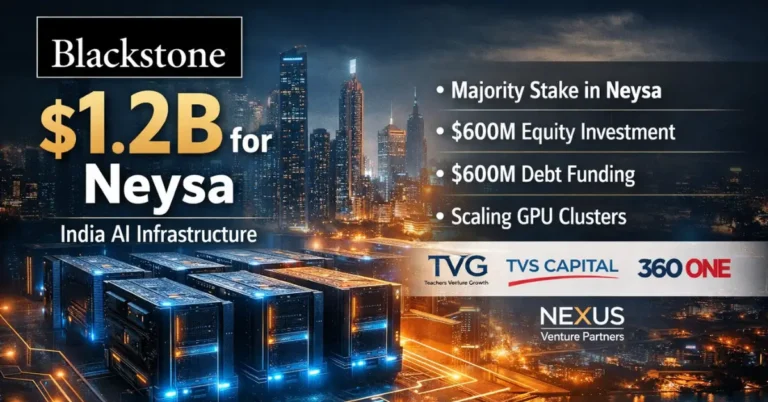
Blackstone will take a majority stake in Neysa through up to $600 million in primary equity, alongside Teachers’ Venture Growth, TVS Capital, 360 ONE Asset, and Nexus Venture Partners; the company also plans up to $600 million in debt to accelerate buildout. The raise is a step change from Neysa’s earlier $50 million and positions the Mumbai-headquartered startup to scale domestic GPU clusters for enterprises, public sector agencies, and AI developers.
Tech News & Insight
Blackstone will take a majority stake in Neysa through up to $600 million in primary equity, alongside Teachers’ Venture Growth, TVS Capital, 360 ONE Asset, and Nexus Venture Partners; the company also plans up to $600 million in debt to accelerate buildout. The raise is a step change from Neysa’s earlier $50 million and positions the Mumbai-headquartered startup to scale domestic GPU clusters for enterprises, public sector agencies, and AI developers.
Tech News & Insight
The plan centers on Visakhapatnam, a port city on India’s east coast, as a tightly coupled zone for data centers, subsea cable landings, power, water, and the digital supply chain. State leadership wants the cluster to be more than rack space. It aims to bring in server assemblers, power and cooling vendors, and specialized logistics to create end-to-end capability. The city is also being pitched as a landing point for new subsea systems toward Singapore, which would diversify India’s international connectivity beyond Chennai and Mumbai and lower latency into Southeast Asia.
Tech News & Insight
The plan centers on Visakhapatnam, a port city on India’s east coast, as a tightly coupled zone for data centers, subsea cable landings, power, water, and the digital supply chain. State leadership wants the cluster to be more than rack space. It aims to bring in server assemblers, power and cooling vendors, and specialized logistics to create end-to-end capability. The city is also being pitched as a landing point for new subsea systems toward Singapore, which would diversify India’s international connectivity beyond Chennai and Mumbai and lower latency into Southeast Asia.
Tech News & Insight
Telefónica and Nokia are piloting agentic AI to make network APIs easier to expose, discover, and consume, aligning with GSMA Open Gateway’s push for interoperable, developer-ready telecom capabilities. Industry efforts like GSMA Open Gateway and CAMARA have raised awareness of standardized network APIs, but uptake hinges on practical tooling that abstracts network complexity while preserving telco-grade security and control. Telefónica and Nokia are now testing agent-to-agent orchestration and context-sharing protocols to let AI “agents” reliably find, chain, and call network functions in a repeatable way.
Tech News & Insight
Telefónica and Nokia are piloting agentic AI to make network APIs easier to expose, discover, and consume, aligning with GSMA Open Gateway’s push for interoperable, developer-ready telecom capabilities. Industry efforts like GSMA Open Gateway and CAMARA have raised awareness of standardized network APIs, but uptake hinges on practical tooling that abstracts network complexity while preserving telco-grade security and control. Telefónica and Nokia are now testing agent-to-agent orchestration and context-sharing protocols to let AI “agents” reliably find, chain, and call network functions in a repeatable way.
Tech News & Insight
T-Mobile is introducing a network-native AI translation service that activates during voice calls, signaling a new phase where AI runs inside the mobile network rather than on apps or devices. T-Mobile announced a beta of Live Translation, a voice-call feature that translates conversations in over 50 languages by activating an AI agent within its 5G Advanced network. The service is initiated by the T-Mobile subscriber using *87* during a call; only one caller needs to be on T-Mobile, and it also works while roaming on supported networks.
Tech News & Insight
T-Mobile is introducing a network-native AI translation service that activates during voice calls, signaling a new phase where AI runs inside the mobile network rather than on apps or devices. T-Mobile announced a beta of Live Translation, a voice-call feature that translates conversations in over 50 languages by activating an AI agent within its 5G Advanced network. The service is initiated by the T-Mobile subscriber using *87* during a call; only one caller needs to be on T-Mobile, and it also works while roaming on supported networks.
Tech News & Insight
Charter introduced Spectrum Invincible WiFi, a package built around its Advanced Wi‑Fi 7 router paired with an integrated backup battery and an embedded 5G cellular pathway. The system automatically rides through local power interruptions for up to eight hours and, if the wired broadband link drops, switches to cellular with unlimited data until the primary connection returns. The offer targets households running multigig internet and dozens of smart devices, and is positioned as a simple add-on for existing Spectrum customers. Home connectivity has become mission‑critical for work, school, security and telehealth while weather-related disruptions and grid instability are rising.
Tech News & Insight
Charter introduced Spectrum Invincible WiFi, a package built around its Advanced Wi‑Fi 7 router paired with an integrated backup battery and an embedded 5G cellular pathway. The system automatically rides through local power interruptions for up to eight hours and, if the wired broadband link drops, switches to cellular with unlimited data until the primary connection returns. The offer targets households running multigig internet and dozens of smart devices, and is positioned as a simple add-on for existing Spectrum customers. Home connectivity has become mission‑critical for work, school, security and telehealth while weather-related disruptions and grid instability are rising.
Tech News & Insight
Anthropic’s latest financing round resets the competitive map for enterprise AI and raises the stakes for telecom, cloud, and large-scale IT buyers planning agentic automation. Anthropic closed a $30 billion Series G at a $380 billion post-money valuation, led by GIC and Coatue with participation from D. E. Shaw Ventures, Dragoneer, Founders Fund, ICONIQ, and MGX, alongside a broad cohort that includes Accel, General Catalyst, Jane Street, and the Qatar Investment Authority. The raise follows sustained commercial momentum and arrives as competitive intensity with OpenAI deepens, signaling that AI platform consolidation and scale economics will define the next phase of the market.
Tech News & Insight
Anthropic’s latest financing round resets the competitive map for enterprise AI and raises the stakes for telecom, cloud, and large-scale IT buyers planning agentic automation. Anthropic closed a $30 billion Series G at a $380 billion post-money valuation, led by GIC and Coatue with participation from D. E. Shaw Ventures, Dragoneer, Founders Fund, ICONIQ, and MGX, alongside a broad cohort that includes Accel, General Catalyst, Jane Street, and the Qatar Investment Authority. The raise follows sustained commercial momentum and arrives as competitive intensity with OpenAI deepens, signaling that AI platform consolidation and scale economics will define the next phase of the market.
Tech News & Insight
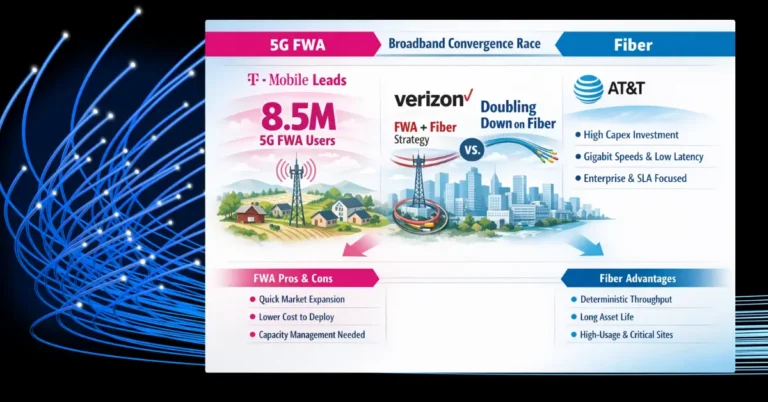
FWA is capex-light and fast to deploy, especially in mid-band-rich markets, which makes it ideal for quick share gains, addressable market expansion, and rural or underserved pockets. Its constraint is shared capacity: as mobile traffic grows, operators must manage prioritization, peak congestion, and plan mix to preserve experience. Fiber demands higher upfront capital but delivers deterministic throughput, low latency, and long asset life that underpins premium ARPU, enterprise SLAs, and wholesale opportunities. Expect operators to steer FWA toward segments with favorable traffic profiles and use fiber for high-usage clusters and enterprise-critical sites.
Tech News & Insight
FWA is capex-light and fast to deploy, especially in mid-band-rich markets, which makes it ideal for quick share gains, addressable market expansion, and rural or underserved pockets. Its constraint is shared capacity: as mobile traffic grows, operators must manage prioritization, peak congestion, and plan mix to preserve experience. Fiber demands higher upfront capital but delivers deterministic throughput, low latency, and long asset life that underpins premium ARPU, enterprise SLAs, and wholesale opportunities. Expect operators to steer FWA toward segments with favorable traffic profiles and use fiber for high-usage clusters and enterprise-critical sites.
Tech News & Insight
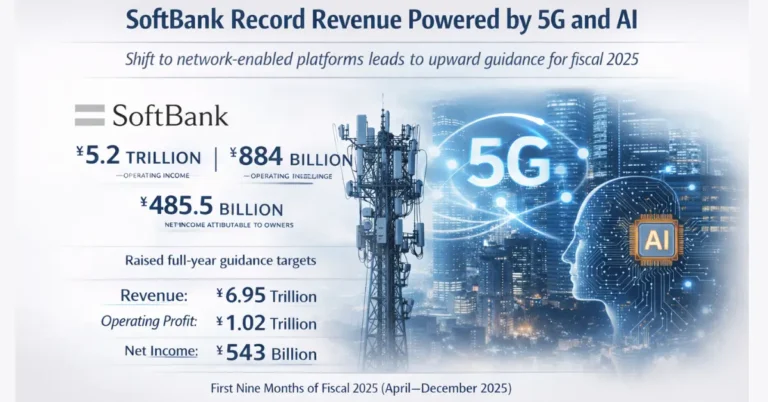
SoftBank Corp. delivered its strongest nine-month performance on record and lifted full-year guidance, underscoring a strategic shift from connectivity-only services to network-enabled platforms in AI, cloud, and edge. Through the first nine months of fiscal 2025 (April–December 2025), SoftBank reported revenue of ¥5.2 trillion, up 8% year over year, and operating income of ¥884 billion, also up 8%, with net income attributable to owners rising 11% to ¥485.5 billion. Management raised full-year targets to ¥6.95 trillion in revenue, ¥1.02 trillion in operating profit, and ¥543 billion in net income, signaling confidence heading into the March 31, 2026 year end.
Tech News & Insight
SoftBank Corp. delivered its strongest nine-month performance on record and lifted full-year guidance, underscoring a strategic shift from connectivity-only services to network-enabled platforms in AI, cloud, and edge. Through the first nine months of fiscal 2025 (April–December 2025), SoftBank reported revenue of ¥5.2 trillion, up 8% year over year, and operating income of ¥884 billion, also up 8%, with net income attributable to owners rising 11% to ¥485.5 billion. Management raised full-year targets to ¥6.95 trillion in revenue, ¥1.02 trillion in operating profit, and ¥543 billion in net income, signaling confidence heading into the March 31, 2026 year end.

Your Brand. Our Intelligence Tools.

Capture leads at the point of evaluation. Talk to Us →

Sponsored by Palo Alto Networks
⚡ Utilities ⏱ 8 min ✓ Free
This tool is built and hosted by TeckNexus.
Launch Tool →
Whitepaper
This whitepaper explains how utilities can use secure AI-enabled private mobile networks to modernize operations, support distributed intelligence, improve resilience, and strengthen cybersecurity across critical infrastructure. It covers AI applications, private network advantages, zero trust principles, multilayered security architecture, and governance considerations for AI-ready utility environments....
Palo Alto Networks
Whitepaper
Non-terrestrial networks are rapidly evolving from experimental satellite systems into an increasingly important part of the global 5G connectivity landscape. This eBook, developed by Radisys in collaboration with TeckNexus, explores how 3GPP standardization, satellite architecture innovation, and software-driven network design are reshaping NTN deployment models. It examines the transition from...
Whitepaper
Private cellular networks are transforming industrial operations, but securing private 5G, LTE, and CBRS infrastructure requires more than legacy IT/OT tools. This whitepaper by TeckNexus and sponsored by OneLayer outlines a 4-pillar framework to protect critical systems, offering clear guidance for evaluating security vendors, deploying zero trust, and integrating IT,...

It seems we can't find what you're looking for.

Featured Content

Article & Insights
Article & Insights
Article & Insights
Article & Insights
Scroll to Top