Introduction — Device Identity as the Foundation of Controlled Connectivity
Private LTE and 5G networks shift security responsibility closer to the enterprise. Identity validation, authorization mapping, and traffic enforcement are embedded directly into the transport architecture. Yet the most persistent and complex security challenge in private cellular environments is not the radio, the core, or the user plane — it is the device.

Devices determine how identity is established, how authorization scope is assigned, and how containment boundaries behave under real operational conditions. In industrial and mission-critical environments, devices are often unmanaged, vendor-owned, and deeply embedded in physical processes. Many were never designed to support modern security assumptions, yet they now participate in IP-connected, policy-driven networks.

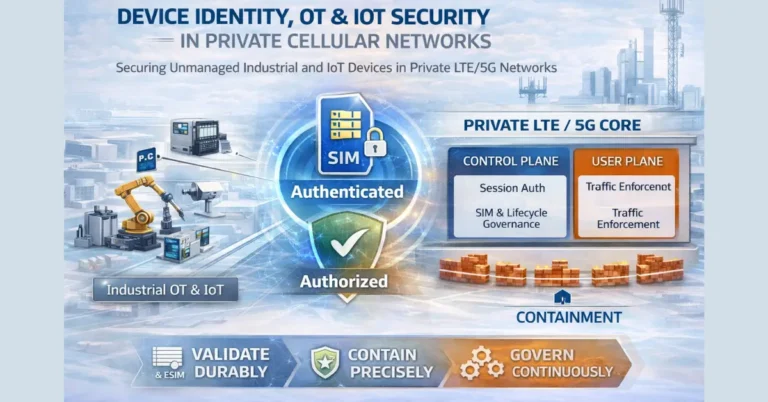
This article builds on the Architecture and Zero Trust pillars by examining the identity layer of private LTE/5G security. It explores how device identity is established, how SIM and eSIM credentials function as durable identity anchors, how lifecycle governance prevents identity drift, and how containment must compensate for OT and IoT realities.
If architecture defines trust boundaries and Zero Trust defines enforcement logic, device identity determines who may enter and how long they remain aligned with operational intent.T
1. Device Identity as the First Trust Boundary in Private LTE/5G
In private LTE and 5G environments, device identity represents the first structural trust boundary. Before segmentation, Zero Trust enforcement, or traffic steering can occur, the network must determine whether a device is permitted to attach and establish a session. Identity validation is therefore not an inventory exercise — it is the architectural gate through which all connectivity begins.
Private cellular networks embed authentication directly into the control-plane attachment process. SIM and eSIM credentials provide cryptographic validation that a device is recognized by the network. This mechanism is fundamentally stronger than many traditional enterprise onboarding models because identity verification is integrated into session establishment rather than delegated to downstream application layers.
However, identity validation alone does not define operational trust. Authentication confirms that a device may attach to the network. It does not determine what that device may access, which operational zone it belongs to, or how far its traffic may traverse. Those decisions occur after authentication, during session authorization and service-profile mapping.
This distinction is critical in industrial and enterprise deployments where private LTE/5G supports production systems, safety controls, autonomous assets, and distributed field equipment. A successfully authenticated device must still be constrained to a narrowly defined authorization scope aligned with its operational role.
Device identity, therefore, serves as:
- A prerequisite for session establishment
- A cryptographic anchor for device recognition
- A mapping input for service-profile assignment
- A governance artifact requiring lifecycle discipline
When identity is treated as equivalent to trust, segmentation weakens. When identity is treated as an entry condition rather than an access grant, containment remains enforceable.
Private LTE/5G architectures provide the mechanisms for strong identity validation. The architectural responsibility lies in ensuring that identity is tightly coupled to a controlled authorization scope. Establishing identity as the first trust boundary clarifies the next critical distinction: authentication alone does not define authorization scope.
2. Identity Validates Presence; Authorization Defines Reach
A recurring failure in network security design is conflating authentication with authorization. In private LTE/5G environments, this distinction must remain explicit and enforced structurally.
Identity validation occurs during control-plane attachment. The network verifies that the device’s SIM or eSIM credential is legitimate and authorized to establish a session. At this stage, the device has demonstrated presence — not privilege.
Authorization begins when the network assigns the device to a specific service profile aligned with an operational zone. The service profile determines:
- Which destinations the device may reach
- Whether traffic may traverse east–west between operational domains
- Where breakout to enterprise or cloud networks is permitted
- What quality-of-service and policy constraints apply
This separation between authentication and authorization is not optional. It is the foundation of containment in private cellular networks.
Industrial and IoT environments make this distinction even more important. Many devices cannot support sophisticated endpoint agents or dynamic posture assessment. The network must therefore assume that authentication success does not guarantee device integrity or correct operational context.
In well-architected deployments:
- Authentication confirms identity legitimacy
- Service-profile mapping defines operational scope
- User-plane enforcement constrains traffic to authorized paths
- Cross-domain communication requires explicit policy definition
- Deny-by-default routing prevents unintended lateral visibility
When identity and authorization are conflated, credential compromise or improper lifecycle management can result in excessive access across multiple zones. When the two are separated and governed consistently, private LTE/5G environments preserve deterministic containment even under scale and mobility. Device identity establishes who may enter. Authorization determines how far they may go. With authentication and authorization structurally separated, the durability and governance of identity artifacts become central architectural concerns.
3. SIM and eSIM as Durable Identity Anchors
In private LTE and 5G deployments, SIM and eSIM credentials function as durable identity anchors embedded into the device onboarding process. Unlike software-based credentials that may rely on application-layer authentication or network access control overlays, SIM-based identity is integrated directly into the cellular control-plane architecture.
This integration provides several structural advantages.
First, authentication is cryptographically enforced during session establishment. The device must prove possession of valid credentials before the network allocates resources or assigns service scope. This reduces dependency on downstream authentication mechanisms and limits unauthorized attachment attempts.
Second, SIM and eSIM artifacts provide hardware-bound or profile-bound identity continuity. The credential persists across reboots, mobility events, and session re-establishment. In distributed industrial environments—such as manufacturing floors, utility grids, mining operations, or ports—this durability simplifies identity validation across heterogeneous device fleets.
Third, identity is standardized across device classes. Whether the endpoint is a sensor, robotic controller, industrial gateway, or autonomous vehicle, SIM-based authentication follows consistent control-plane logic.
However, durability introduces governance responsibility.
SIM and eSIM credentials are long-lived identity artifacts. If improperly provisioned, reassigned without validation, or left active after decommissioning, they can persist beyond their intended operational role. Because authentication is embedded at the transport layer, an active credential can continue to establish sessions unless explicitly revoked.
SIM-based identity therefore represents:
- Cryptographic validation integrated into control-plane attachment
- Persistent identity independent of application-layer credentials
- Standardized authentication across heterogeneous device classes
- Durable credential artifacts requiring lifecycle governance
- A structural entry point into session authorization
SIM and eSIM mechanisms strengthen identity assurance at the network boundary. But without disciplined lifecycle alignment, they can also create persistent exposure that is difficult to detect at higher layers.
Identity durability must be matched by governance durability.
4. Lifecycle Governance and the Risk of Identity Drift
Identity in private LTE/5G environments does not remain static. Devices are deployed, repurposed, relocated, replaced, or decommissioned. Operational roles evolve. Vendors change. Sites expand. Without disciplined lifecycle governance, identity artifacts can become misaligned with operational intent—a condition best described as identity drift.
Identity drift occurs when the credential attached to a device no longer reflects its current role, authorization scope, or operational context. A sensor reassigned to a new production line may retain access privileges from its previous deployment. A contractor device may remain provisioned long after project completion. A decommissioned asset may still possess an active SIM profile capable of session establishment. In large-scale industrial deployments, identity drift is rarely visible in real time. Its impact emerges gradually as authorization boundaries expand without deliberate intent.
These conditions rarely produce immediate alarms. Instead, they create silent expansion of authorization boundaries over time.
Lifecycle governance must therefore extend beyond basic provisioning. It must ensure continuous alignment between:
- Credential issuance and defined service profiles
- Operational role changes and authorization scope updates
- Device decommissioning and credential revocation
- Inventory records and active session mapping
- Cross-site deployments and centralized identity control
In large-scale industrial environments, thousands of devices may operate concurrently across multiple zones and sites. Even small governance inconsistencies can compound rapidly.
Zero Trust principles reinforce the importance of lifecycle discipline. Authentication success should never imply permanent or static authorization scope. Identity artifacts must be reviewed, updated, and revoked in alignment with operational change.
When lifecycle governance is weak, segmentation remains formally defined but practically diluted. When lifecycle governance is disciplined, identity becomes a controlled entry condition rather than a persistent exposure vector. The governance challenge becomes more complex when applied to heterogeneous OT and IoT device environments.
5. OT and IoT Device Realities in Private Cellular Environments
Private LTE and 5G deployments frequently operate in environments where endpoint security assumptions do not align with traditional IT models. Industrial and IoT devices are often purpose-built, resource-constrained, and designed for operational continuity rather than cybersecurity agility. Many lack support for modern endpoint agents, advanced posture validation, or frequent firmware updates.
These realities fundamentally shape how device identity must be governed.
Unlike enterprise laptops or managed servers, industrial controllers, sensors, robotic systems, and telemetry devices may:
- Operate on fixed firmware with limited patch cycles
- Support legacy protocols without strong embedded authentication
- Remain in production for years without hardware refresh
- Be maintained by third-party vendors rather than internal teams
- Prioritize availability and safety over dynamic security instrumentation
In such environments, device identity cannot rely solely on endpoint integrity signals. Authentication must be anchored in transport-layer mechanisms such as SIM or eSIM credentials, while containment must be enforced structurally through session authorization and user-plane traffic controls.
Private LTE/5G architectures provide a consistent identity validation mechanism across heterogeneous device classes. However, identity validation does not compensate for inherent device fragility.
The network must therefore assume:
- Authenticated devices may still be vulnerable
- Endpoint posture may not be dynamically verifiable
- Operational continuity constraints limit intrusive security controls
- Segmentation must compensate for limited endpoint security maturity
OT and IoT device realities reinforce a core principle: identity establishes entry, but containment must be architectural.
When endpoint sophistication is limited, enforcement responsibility shifts decisively to the network fabric. Service-profile discipline, zone alignment, and breakout control become the primary mechanisms for preserving operational integrity.
6. Rogue, Cloned, and Misbehaving Devices: Containment Over Prevention
No identity system can guarantee absolute prevention of credential misuse. SIM cloning, unauthorized SIM relocation, misconfiguration, or insider error are all plausible risk vectors in distributed industrial environments. Zero Trust principles, therefore, emphasize containment over absolute prevention. A successfully authenticated device should not automatically inherit a broad authorization scope. Even if a credential is compromised or reassigned improperly, session-based authorization and user-plane enforcement must restrict the device’s operational reach. Identity governance reinforces Zero Trust enforcement by ensuring that session authorization reflects current operational reality.
Effective containment requires:
- Narrow service-profile assignment aligned to operational role
- Isolation from management and orchestration domains
- Explicit restriction of cross-zone east–west communication
- Controlled breakout paths to enterprise or cloud environments
- Rate and session constraints limiting abnormal traffic behavior
This architectural posture ensures that a rogue or cloned device, even if authenticated, cannot traverse unrelated operational domains or access safety-critical systems. Containment also reduces the systemic impact of human error. If a credential is mistakenly provisioned to incorrect hardware, enforcement boundaries should prevent unintended cross-domain visibility.
The objective is not to assume compromise is inevitable, but to ensure that compromise does not translate into unrestricted lateral movement or privilege escalation. In private LTE/5G environments, identity validation is the first boundary. Authorization scope and traffic enforcement define the blast radius. While rogue or misbehaving devices can be contained through authorization discipline, identity boundaries can also expand indirectly through intermediary systems.
7. Industrial Gateways as Trust Translation and Boundary Amplification Points
Industrial gateways occupy a uniquely sensitive position in private LTE and 5G environments. These systems frequently bridge cellular connectivity with legacy OT networks, translating between modern IP-based traffic and industrial control protocols that were not designed with strong authentication or segmentation assumptions.
In effect, gateways become identity translation layers.
A device authenticated at the cellular layer may communicate through a gateway into a legacy domain where protocol-level identity validation is minimal or absent. If containment boundaries are not explicitly defined, the gateway can unintentionally expand the trust boundary from a tightly governed cellular session into a flat or weakly segmented OT environment.
This creates structural risk.
Gateways must not be treated as neutral pass-through devices. They are policy amplification points. If a session authorized at the cellular layer is overly broad, the gateway can extend that scope into industrial control systems, supervisory networks, or safety-related domains.
Architecturally disciplined deployments require:
- Explicit service-profile restriction for gateway-attached sessions
- Segmentation between gateway traffic and core orchestration systems
- Controlled mediation between cellular and legacy protocol domains
- Isolation of safety-critical control networks from generalized data paths
- Continuous validation of gateway configuration and role alignment
Industrial gateways should operate as controlled mediation zones, not as implicit trust bridges.
Because gateways often sit at the intersection of vendor-managed devices, legacy infrastructure, and modern cellular identity systems, governance clarity is essential. Without strict containment, gateways can amplify minor authorization errors into multi-domain exposure.
Private LTE/5G strengthens identity validation at the network boundary. Gateways determine whether that boundary remains intact when traffic enters legacy domains.
8. Identity Governance at Scale: Multi-Site and Multi-Tenant Realities
Private LTE/5G deployments rarely remain confined to a single site. Manufacturing enterprises expand across facilities, utilities operate distributed field assets, ports and airports manage geographically segmented zones, and neutral-host environments may support multiple tenants simultaneously. As deployments scale, identity governance complexity increases exponentially.
What is manageable at one site can become inconsistent across many.
Identity governance at scale must ensure that credential provisioning, service-profile mapping, and lifecycle management remain consistent across locations and organizational boundaries. Divergence in provisioning standards or zone definitions introduces uneven containment and hidden exposure paths.
Multi-site deployments require:
- Centralized provisioning standards aligned to defined operational roles
- Uniform service-profile templates across facilities
- Cross-site audit of active credentials and session mappings
- Coordinated decommissioning and reassignment processes
- Consistent mapping between identity classes and operational zones
Multi-tenant environments introduce additional complexity. Shared infrastructure does not imply shared trust. Each tenant’s devices must remain isolated within clearly defined authorization boundaries, and management-plane visibility must not cross organizational lines without explicit mediation.
At scale, identity governance becomes a structural discipline rather than a configuration task. Without centralized oversight and consistent validation, small variations in credential management can compound into systemic segmentation drift. Identity artifacts that remain aligned at one site may become misaligned across others if governance is fragmented. Scale does not weaken identity controls by default. Inconsistent governance does.
Private LTE/5G architectures provide the mechanisms for standardized identity enforcement. Organizational discipline determines whether those mechanisms remain consistent under growth. Identity that is tightly governed at deployment must remain tightly governed under expansion. As deployments expand across sites and organizational boundaries, identity governance must move from operational practice to architectural doctrine.
9. Non-Negotiable Device Identity Principles in Private LTE/5G
Device identity in private LTE/5G environments must function as a controlled entry condition, not as a blanket trust grant. When identity governance weakens, segmentation and Zero Trust enforcement degrade regardless of how well they are architected. Certain structural principles must therefore remain intact for identity to support secure operations at scale.
- Identity validation must remain separate from authorization scope
- Authentication must never imply unrestricted operational reach
- Service-profile mapping must align to defined operational zones
- Credential lifecycle must track operational role changes
- Decommissioned or reassigned devices must lose prior authorization immediately
- Industrial gateways must remain explicit mediation boundaries
- Rogue or cloned credentials must be architecturally contained
- Identity governance must persist consistently across sites and tenants
These principles are not implementation preferences — they are structural safeguards.
When identity and authorization are tightly coupled through disciplined service-profile mapping, containment remains enforceable even in heterogeneous and mobile industrial environments. When identity artifacts are treated as static or self-validating, authorization boundaries expand silently.
Private LTE/5G strengthens authentication at the transport layer. It does not eliminate the need for governance rigor.
Identity must be continuously aligned to operational intent, or it becomes a latent exposure vector.
Conclusion: Identity as Entry Condition, Not Access Grant
Device identity is foundational to private LTE and 5G security architectures. It determines who may attach to the network and establishes the cryptographic anchor for session creation. However, identity alone does not define trust.
In industrial and enterprise deployments, identity must be tightly integrated with authorization scope, lifecycle governance, and structural containment controls. SIM and eSIM credentials provide durable authentication primitives, but their persistence requires disciplined management. OT and IoT realities demand that enforcement responsibility shift toward network-based containment. Industrial gateways must operate as controlled mediation domains rather than implicit trust bridges. Multi-site and multi-tenant environments require consistent identity governance under scale.
Private LTE/5G environments embed identity validation directly into the transport architecture, creating a stronger foundation than overlay-based enterprise models. The architectural challenge is ensuring that identity remains an entry condition — not a pathway to broad, implicit access.
When identity governance is disciplined, and authorization boundaries are precise, private cellular networks can maintain segmentation integrity even as deployments expand in scale, complexity, and operational criticality.
The next post Monitoring, Assurance & Testing for Private LTE/5G moves from design assumptions to proof:
- What to monitor across signaling, traffic, and behavior
- How to validate identity and Zero Trust controls continuously
- How to test private cellular security without disrupting operations
- What regulators and critical infrastructure stakeholders expect