Introduction — From Design to Proof
Private LTE and 5G security architectures do not fail because they are poorly designed. They fail when enforcement assumptions degrade silently, visibility gaps expand, and organizations cannot demonstrate that segmentation and authorization controls still function under real operational conditions.
In private cellular environments — especially those supporting industrial automation, safety systems, and regulated infrastructure — security must be observable, testable, and provable. Identity validation and Zero Trust enforcement define containment intent. Monitoring and assurance determine whether that intent persists over time.

Private LTE/5G introduces operational dynamics that differ from traditional IT networks. Signaling behavior may indicate misuse before payload traffic flows. User-plane routing decisions may break out locally rather than traverse centralized inspection points. Devices may remain static for years yet drift out of policy alignment through lifecycle mismanagement or configuration variance.
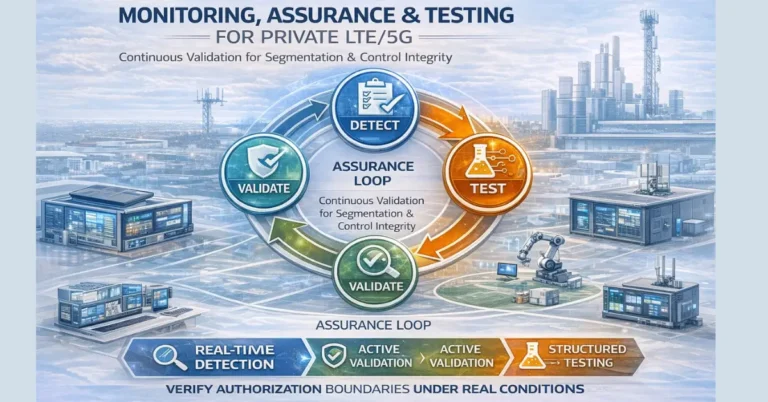
This article completes the security architecture series by defining the assurance layer of private LTE/5G. It explains how enterprises build a continuous validation loop of:
Detect → Validate → Test → Prove

The objective is not log collection or compliance reporting. It is structural verification — ensuring that authorization boundaries, identity governance, and containment assumptions remain intact under scale, mobility, and operational change.
1. Monitoring as the Assurance Layer of Private LTE/5G Security
Private LTE and 5G security architecture does not end with segmentation, Zero Trust enforcement, or identity validation. Those mechanisms define how trust should function. Monitoring, assurance, and testing determine whether it continues to function as designed.
In private cellular environments, monitoring is not merely log aggregation or alert generation. It is the continuous validation layer that verifies the integrity of control-plane decisions, user-plane enforcement, identity governance, and cross-domain containment. Without structured assurance, segmentation assumptions and authorization boundaries can degrade silently under operational change.
Private LTE/5G networks introduce distinct telemetry domains:
- Control-plane signaling
- User-plane traffic routing
- Session establishment and service mapping
- Device mobility and behavioral patterns
- Gateway mediation between cellular and legacy domains
Each domain reflects a different layer of architectural trust. Monitoring must therefore answer architectural questions:
- Are authentication and authorization aligned?
- Does user-plane routing reflect defined service profiles?
- Are cross-zone boundaries being respected?
- Is mobility preserving the authorization scope?
- Are gateway mediation points behaving predictably?
Security architecture defines containment intent. Monitoring validates containment reality. As private cellular deployments expand across sites and operational domains, assurance becomes increasingly important. Policy drift, configuration inconsistency, or operational shortcuts can erode segmentation integrity without triggering obvious failures. Monitoring is the mechanism that detects this erosion before it becomes systemic exposure.
Monitoring does not replace enforcement. It verifies that enforcement still holds.
2. Control Plane Visibility: Protecting Signaling Integrity
In private LTE and 5G environments, the control plane governs session establishment, authentication, and service-profile assignment. If the control plane is compromised, misconfigured, or misaligned with operational policy, user-plane enforcement becomes unreliable.
Control-plane monitoring must therefore focus on signaling integrity rather than generic network statistics.
Architecturally relevant control-plane indicators include:
- Authentication anomalies and repeated attachment failures
- Unexpected session creation patterns
- Unusual service-profile assignments
- Attach/detach irregularities across zones
- Signaling storms or abnormal registration bursts
These signals indicate more than a device malfunction. They may reflect credential misuse, provisioning inconsistencies, automation misconfiguration, or attempted exploitation of session-establishment logic.
Because identity validation and authorization mapping occur during control-plane processes, visibility into signaling behavior is foundational. Monitoring must confirm that:
- Authentication outcomes align with credential inventory
- Service-profile assignments reflect defined operational zones
- Session authorization does not exceed the expected scope
- Control-plane decisions remain consistent across sites
In industrial environments, control-plane anomalies can be subtle. A misassigned service profile or incorrectly provisioned device may not trigger immediate alarms, yet can expand authorization boundaries beyond intended zones.
Control-plane monitoring, therefore, acts as an early integrity check for identity governance and authorization discipline.
If control-plane visibility is weak, segmentation cannot be trusted — even if user-plane enforcement appears intact.
3. User Plane Monitoring: Detecting Policy Drift and Lateral Movement
If the control plane defines authorization intent, the user plane reflects enforcement reality. In private LTE and 5G environments, user-plane monitoring verifies that traffic flows align with defined service profiles, zone boundaries, and breakout constraints.
Segmentation and Zero Trust enforcement are only as strong as the traffic steering that implements them. Over time, configuration changes, site expansion, automation updates, or operational shortcuts can introduce subtle deviations in routing behavior. These deviations may not interrupt service, but they can expand authorization scope beyond its intended boundary.
User-plane monitoring must therefore validate:
- Breakout paths to enterprise or cloud domains
- East–west traffic between operational zones
- Traffic steering rules tied to service profiles
- Unexpected cross-domain communication attempts
- Changes in traffic destinations are inconsistent with the device role
Unlike perimeter-based enterprise networks, private LTE/5G environments rely heavily on centralized traffic steering logic within the user plane. This centralization improves enforcement predictability, but it also concentrates risk. A misconfigured breakout rule or improperly scoped service profile can propagate across multiple sites simultaneously.
Monitoring should continuously confirm that:
- User-plane routing decisions reflect control-plane authorization
- Cross-zone communication remains explicitly defined
- No unintended lateral visibility emerges over time
- Traffic segmentation persists under mobility and scale
In industrial deployments, east–west visibility is particularly sensitive. Production systems, safety networks, maintenance domains, and analytics platforms may coexist within the same private cellular infrastructure. If user-plane enforcement drifts, segmentation integrity can degrade without obvious failure indicators.
User-plane monitoring is therefore not optional telemetry. It is a structural validation of containment boundaries.
4. Device Behavior and Operational Anomaly Detection
Private LTE/5G deployments often support devices that lack advanced endpoint instrumentation. In such environments, network-level behavioral monitoring becomes a primary mechanism for detecting misuse, malfunction, or compromise.
Device behavior monitoring should focus on deviations from expected operational patterns rather than signature-based threat detection.
Architecturally relevant indicators include:
- Unexpected changes in traffic destination
- Abnormal session duration or frequency
- Unusual data volume relative to device role
- Mobility patterns are inconsistent with the operational context
- Repeated reconnection or attachment cycles
For example, a telemetry sensor that begins initiating sustained sessions to enterprise IT systems represents more than a configuration anomaly. It may signal credential misuse, firmware compromise, or improper service-profile assignment.
Because many industrial and IoT devices operate with fixed roles and predictable communication patterns, deviations can be detected at the network layer even when endpoint agents are absent. Behavioral monitoring complements identity governance by validating that authenticated devices continue to act within their expected operational scope. It is important, however, to distinguish between anomaly detection and over-instrumentation. Industrial environments prioritize availability and stability. Monitoring systems must avoid introducing excessive inspection overhead that disrupts deterministic traffic flows.
In private cellular networks, device behavior monitoring should reinforce containment assumptions, not replace them. Authentication establishes presence. Authorization defines reach. Behavioral monitoring validates continued alignment with operational role.
5. Industrial and OT Monitoring Realities
Monitoring strategies that work in enterprise IT environments do not translate directly into industrial and OT domains. Private LTE and 5G deployments frequently support safety systems, production controllers, field sensors, and legacy equipment where availability and determinism outweigh aggressive inspection. Monitoring in these environments must respect operational constraints while still preserving architectural integrity.
Several realities shape OT-focused assurance:
- Legacy protocols may lack strong telemetry or authentication
- Deep packet inspection may introduce unacceptable latency
- Devices may not support endpoint instrumentation
- Maintenance windows are limited and tightly controlled
- Safety systems cannot tolerate intrusive scanning
Because of these constraints, monitoring in private LTE/5G industrial deployments must rely more heavily on network-layer validation than endpoint visibility.
Architectural monitoring priorities in OT environments include:
- Verification that service profiles remain aligned with operational zones
- Confirmation that cross-zone traffic remains explicitly defined
- Validation that gateways mediate, rather than bridge, domains
- Detection of unexpected breakout paths from production networks
- Consistency of policy enforcement across safety and analytics systems
Industrial gateways require particular attention. As translation points between modern cellular traffic and legacy control protocols, they represent amplified trust boundaries. Monitoring must confirm that gateway mediation remains constrained to defined traffic paths and does not introduce lateral visibility into unrelated domains. Monitoring in OT environments is therefore less about exhaustive inspection and more about validating that architectural containment assumptions continue to hold.
Security in private LTE/5G industrial environments depends not on intrusive endpoint surveillance, but on predictable enforcement at the network boundary.
6. Continuous Testing vs Passive Monitoring
Passive monitoring detects anomalies. Continuous testing validates architectural resilience.
In private LTE/5G environments, assurance must extend beyond telemetry observation to structured validation exercises that confirm containment assumptions under stress.
Testing should not be reduced to compliance audits or annual assessments. Instead, it should simulate realistic failure and compromise scenarios.
Architecturally relevant testing domains include:
- Controlled cross-zone communication attempts
- Validation of service-profile enforcement boundaries
- Simulation of credential misuse or rogue device scenarios
- Verification of breakout path restrictions
- Configuration consistency checks across sites
- Mobility-based authorization continuity validation
For example, deliberately attempting unauthorized east–west communication between production and analytics zones can confirm whether segmentation boundaries remain intact. Simulated credential reassignment can validate lifecycle governance controls. Testing breakout policies can confirm that enterprise or cloud access remains explicitly scoped. Continuous validation becomes increasingly important as deployments scale. Automation, template replication, and site expansion introduce configuration drift risk. Testing ensures that policy intent continues to align with enforcement behavior.
Private LTE/5G architectures centralize many control and user-plane functions. This centralization simplifies enforcement but increases the impact of configuration errors. Testing must therefore focus on systemic validation, not isolated device behavior. Monitoring observes the network. Testing challenges it.
Together, they provide assurance that segmentation, identity governance, and Zero Trust enforcement continue to function under operational pressure.
7. Multi-Site and Scale Assurance
Private LTE and 5G deployments rarely remain static. As organizations expand from pilot environments to production-scale, multi-site deployments, assurance complexity increases significantly. What was once a localized monitoring exercise becomes a distributed integrity discipline.
Scale introduces new forms of risk:
- Configuration template divergence between sites
- Inconsistent service-profile mapping across facilities
- Uneven lifecycle governance practices
- Localized policy overrides that bypass global standards
- Drift in gateway mediation rules across regions
These inconsistencies may not disrupt connectivity. Instead, they introduce uneven containment boundaries that accumulate over time. Assurance at scale must therefore validate not only traffic behavior, but configuration integrity and policy consistency.
Multi-site assurance should confirm:
- Service-profile templates remain consistent across deployments
- Authorization logic is uniformly applied across facilities
- Breakout policies reflect centralized governance standards
- Credential lifecycle practices align across operational domains
- Monitoring telemetry is aggregated for cross-site anomaly detection
In distributed industrial environments—such as utilities, manufacturing enterprises, ports, and mining operations—small configuration deviations can compound rapidly. A permissive rule introduced at one facility can become replicated unintentionally through automation or template reuse. Scale does not weaken identity or segmentation controls by default. Inconsistent governance does.
Assurance must evolve from site-level observation to architectural consistency validation across the deployment footprint.
8. Non-Negotiable Monitoring and Assurance Principles for Private LTE/5G
Monitoring and testing in private LTE/5G environments must uphold a set of structural principles. Without disciplined assurance, even well-architected segmentation and identity controls can erode under operational change.
- Monitoring must validate enforcement assumptions, not just generate alerts
- Control-plane signaling integrity must be continuously visible
- User-plane routing must reflect defined authorization scope
- Cross-domain traffic must be explicitly defined and periodically tested
- Gateway mediation boundaries must remain constrained and verifiable
- Policy drift must be detected early across sites and zones
- Testing must simulate realistic misuse, not assume compliance
- Assurance must scale with deployment growth and automation
These principles reinforce a fundamental reality: enforcement mechanisms are only as reliable as the visibility and validation processes that surround them. Monitoring is not a passive safety net. It is an active confirmation that segmentation integrity, identity governance, and Zero Trust enforcement continue to function as designed.
Conclusion: Monitoring as Continuous Integrity Verification
Private LTE and 5G security architecture is built upon identity validation, session-based authorization, user-plane enforcement, and structured segmentation. Monitoring, assurance, and testing provide the continuous validation layer that confirms those mechanisms remain intact under operational pressure.
Control-plane visibility protects signaling integrity. User-plane monitoring validates containment boundaries. Device behavior analysis detects deviations from the operational role. Industrial-aware assurance respects OT constraints while preserving enforcement integrity. Structured testing confirms that segmentation holds under realistic misuse scenarios. Multi-site governance ensures consistency under scale.
Monitoring does not secure private LTE/5G environments by itself. It verifies that security architecture continues to operate as intended. As private cellular deployments expand in scope, mobility, and operational criticality, assurance becomes the mechanism that preserves trust over time.
Security architecture defines containment.
Monitoring confirms it.
Testing proves it.
Together with the series below, this completes the shift from secure-by-design to secure-in-operation.
Private Network Security: Architecture, Threat Surfaces & Controls
Zero Trust Security Blueprint for Private 5G/LTE Networks
Device Identity, OT & IoT Security in Private Cellular Networks