1. Why Private LTE/5G Security Is an Architectural Discipline
Private LTE and 5G networks are no longer incremental upgrades to enterprise connectivity. They are becoming the operational backbone of industrial automation, critical infrastructure, smart facilities, and distributed field environments. These networks connect machines, production systems, autonomous vehicles, safety infrastructure, and latency-sensitive applications that directly influence physical processes.

In such environments, security is not merely about protecting information. A misconfiguration, compromised control plane, or poorly isolated traffic domain can disrupt production, affect worker safety, trigger regulatory exposure, or halt autonomous operations. The consequences extend beyond data loss to operational continuity and physical impact.

Private cellular deployments also blur traditional boundaries. They combine telecom infrastructure, enterprise IT systems, and operational technology into a single programmable environment. Radio access components, cloud-native core functions, edge compute workloads, industrial gateways, and orchestration platforms must operate as a coordinated system. Each domain introduces its own exposure points and trust relationships.
Because of this convergence, private LTE/5G security cannot be treated as a set of add-on controls layered onto an existing enterprise network. Security outcomes are shaped by deployment architecture itself—by how trust boundaries are defined, how traffic is segmented, how management access is governed, and how policy enforcement is implemented across radio, core, edge, and operational domains.
Early deployment decisions, whether around Standalone versus Non-Standalone architecture, ownership model, edge breakout strategy, segmentation approach, or operational governance, create long-term security consequences. Designing for a pilot without accounting for production-scale governance and observability often results in architectural debt that becomes costly to unwind.

Private network security must therefore be approached as an architectural discipline. It requires understanding how cellular control planes, data planes, management systems, industrial endpoints, and deployment models interact. Only after this architectural foundation is defined does it make sense to apply specific frameworks such as Zero Trust, device identity models, or continuous monitoring strategies.
This article establishes that foundation. It defines the core architectural domains of a private LTE/5G deployment, clarifies where trust boundaries exist, and outlines what secure-by-design means in a production-grade private cellular environment.
2. The Private Cellular Deployment Architecture Model
Unlike traditional enterprise networks—where infrastructure layers are often abstracted away from business systems—private LTE/5G deployments tightly couple network functions with operational processes. As a result, architectural clarity becomes essential. Each domain carries its own security assumptions, operational dependencies, and scaling implications.
In practice, many deployment failures stem not from missing controls, but from poorly defined boundaries between domains. When management interfaces overlap with production traffic, when breakout policies are inconsistently enforced, or when edge workloads operate outside centralized governance, architectural risk compounds quickly—particularly as networks expand across sites or tenants.
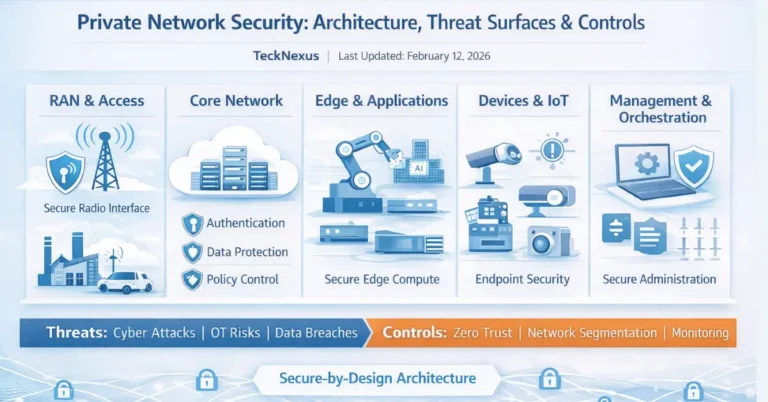
For this reason, evaluating private cellular security requires a structured domain model. The following architectural domains provide a practical lens for understanding where risk originates, how responsibility is distributed, and which decisions influence long-term resilience.
2.1 Radio and Access Domain (RAN)
The Radio Access Network forms the physical and logical entry point into the private cellular environment. It includes radios, distributed units, centralized units, spectrum usage, and site-level infrastructure.
From a security perspective, the RAN introduces both cyber and physical exposure. Risks include rogue radio interference, spectrum misuse, weak site hardening, misconfigured baseband software, and inadequate isolation between access layers. Deployment considerations extend beyond signal integrity. Enterprises must consider how RAN components are:
- Physically secured
- Logically segmented from core functions
- Managed and patched
- Monitored for abnormal signaling behavior
Availability risk in the RAN is often operational risk. In industrial environments, radio disruption can directly halt production systems.
2.2 Core and Control Plane Domain
The core network governs authentication, mobility, policy enforcement, and session management. In Standalone (SA) architectures, it is typically cloud-native and API-driven. In Non-Standalone (NSA) deployments, it inherits dependencies from LTE control structures.
This domain represents one of the highest concentration points of architectural authority. Compromise of control-plane functions can impact every connected device. Key exposure areas include:
- Signaling abuse or overload
- Misconfigured network functions
- Privileged administrative access
- Weak API protection
- Inadequate isolation between network slices or tenants
Deployment strategy strongly influences risk. A cloud-native SA core introduces flexibility and scale but requires mature configuration governance and API security discipline. NSA architectures may reduce architectural complexity but inherit legacy signaling constraints.
2.3 Traffic and Breakout Domain (User Plane)
User-plane functions determine how traffic flows between devices, applications, and external networks. Local breakout (UL CL) improves latency and enables edge processing but increases segmentation and policy enforcement complexity.
Improperly governed traffic breakout can enable lateral movement between OT and IT environments or expose industrial systems to broader enterprise networks. From a deployment standpoint, enterprises must evaluate:
- Where traffic exits the core
- Whether policy enforcement is centralized or distributed
- How east–west traffic is monitored
- Whether segmentation aligns with operational zones
Traffic governance is not just a routing decision; it is a risk boundary decision.
2.4 Edge and Application Domain
Private cellular deployments increasingly incorporate edge compute environments to host latency-sensitive workloads, AI inference engines, or industrial control applications.
While edge platforms improve performance, they also introduce workload isolation and container security considerations. In many environments, edge nodes operate outside traditional enterprise data center controls. Risks include:
- Exposed APIs
- Weak container isolation
- Insufficient patching discipline
- Inconsistent policy enforcement across sites
Deployment teams must treat edge security as an extension of network architecture, not merely application infrastructure.
2.5 Device and Gateway Domain
Industrial endpoints, sensors, PLCs, robotics systems, and gateways represent one of the most heterogeneous elements of private LTE/5G deployments. Many OT devices cannot support modern security agents or strong cryptographic enforcement.
Gateways that translate industrial protocols into IP traffic often become concentration points of risk. Architecture decisions must account for:
- Device identity model
- Lifecycle management discipline
- Network-level containment mechanisms
- Protocol translation exposure
- Physical access risks in remote sites
Security at this layer depends heavily on network-enforced policy, not device-native controls.
2.6 Management and Orchestration Domain
The management plane controls configuration, provisioning, automation, and policy changes across the entire private network stack.
This domain typically carries broad administrative privileges and, if compromised, can result in full network takeover. Security in this domain depends on:
- Strict separation from production traffic
- Least-privilege access controls
- Multi-factor authentication
- Change management governance
- Comprehensive logging and auditability
In scaled deployments, configuration drift and inconsistent policy enforcement become systemic risks if governance mechanisms are weak.
Architectural Interdependence
These domains do not operate in isolation. Decisions in one layer influence exposure in others. For example:
- Weak management-plane isolation can undermine strong core controls.
- Poor traffic segmentation can negate device identity enforcement.
- Inadequate RAN hardening can disrupt otherwise secure control-plane design.
Private network security must therefore be evaluated as an interconnected deployment architecture, not a collection of discrete safeguards.
Understanding these architectural domains establishes the foundation for defining trust boundaries and applying consistent enforcement models across the network.
3. Architectural Trust Boundaries in Private Cellular Deployments
Private LTE/5G security is defined as much by boundaries as by controls. The most significant risks emerge where trust assumptions are unclear or enforcement responsibilities are ambiguous. In production environments, clearly defined architectural trust boundaries are essential to prevent lateral movement, privilege escalation, and cross-domain compromise.
Unlike flat enterprise networks, private cellular deployments introduce multiple logical and operational boundaries that must be intentionally separated and monitored.
3.1 Air Interface Boundary
The air interface represents the transition from unmanaged physical space to authenticated network access. While cellular authentication mechanisms are stronger than many Wi-Fi deployments, radio access remains exposed to interference, spoofing attempts, and physical tampering.
Enterprises must ensure that radio access does not implicitly grant broader trust. Authentication should be treated as the start of policy enforcement—not its conclusion.
3.2 Control Plane Boundary
The control plane governs authentication, mobility, and session orchestration. It represents a high-value target because compromise can affect the entire network.
Strict separation between control-plane functions and user-plane traffic is critical. Administrative access to control-plane systems should be tightly governed, logged, and isolated from operational domains.
3.3 User Plane and Segmentation Boundary
The user plane determines how traffic moves between devices, applications, and external systems. Local breakout and edge routing introduce powerful flexibility—but also segmentation complexity.
Trust boundaries must align with operational zones (e.g., OT, IT, safety systems, tenant networks). Weak or inconsistent enforcement at this boundary often enables lateral movement and cross-domain exposure.
3.4 Edge and Application Boundary
Edge compute environments introduce another trust layer between network enforcement and application logic. APIs, container workloads, and local services must be isolated from direct control-plane exposure and governed consistently across sites.
Edge nodes should not become informal extensions of enterprise IT without defined segmentation and monitoring controls.
3.5 Management Boundary
The management and orchestration plane is frequently the most sensitive boundary in private cellular deployments. It controls configuration, provisioning, and automation across all other domains. Management systems must be:
- Logically separated from production traffic
- Protected by strong identity controls
- Governed by least-privilege access
- Monitored for configuration drift
Failure to isolate the management boundary can negate even well-designed segmentation elsewhere.
3.6 Tenant and Ownership Boundaries
In operator-managed or neutral-host environments, trust boundaries extend beyond technical segmentation into contractual and governance domains. Responsibility clarity is essential:
- Who patches RAN software?
- Who governs identity provisioning?
- Who monitors signaling anomalies?
- Who validates policy enforcement?
Ambiguity at ownership boundaries creates operational blind spots that can become security gaps during incidents.
Boundary Discipline as Deployment Strategy
Clear trust boundaries are not simply security best practices, they are deployment accelerators. Networks designed with explicit separation and governance clarity scale more predictably across sites and use cases. Those without boundary discipline accumulate architectural debt that surfaces during expansion.
Understanding these boundaries prepares the ground for applying structured enforcement models such as Zero Trust and continuous validation mechanisms.
4. Deployment Risk Modifiers in Private LTE/5G Architectures
While the architectural domains and trust boundaries define where risk exists, deployment context determines how that risk manifests. The same private cellular design can produce very different security outcomes depending on deployment model, operational maturity, and scaling strategy.
Private LTE/5G security is therefore not static. It is influenced by structural “risk modifiers” that shape exposure, governance complexity, and operational resilience.
Understanding these modifiers is essential before moving from pilot to production.
4.1 Standalone (SA) vs Non-Standalone (NSA) Architectures
The choice between NSA and SA significantly alters the architectural responsibility model.
Non-Standalone (NSA) deployments rely on LTE control-plane components while introducing 5G data-plane capabilities. This approach may simplify early deployment but inherits legacy signaling structures and integration complexity. Visibility and enforcement mechanisms may remain fragmented across LTE and 5G domains.
Standalone (SA) deployments introduce a cloud-native 5G core with service-based interfaces and API-driven functions. While this unlocks advanced capabilities such as slicing and enhanced mobility, it expands the control-plane attack surface and introduces configuration governance challenges typical of cloud-native systems.
The tradeoff is not simply performance versus modernization. It is legacy exposure versus architectural responsibility. NSA carries inherited constraints; SA demands mature operational discipline.
4.2 Ownership and Operating Model
Security accountability shifts significantly depending on who operates the network.
Enterprise-Managed Deployments
The enterprise controls RAN, core, edge, and management functions. This provides architectural control but requires internal capability for patching, monitoring, governance, and incident response.
Operator-Managed Deployments
Responsibilities are shared. Operators may secure RAN and core functions, while enterprises govern devices, applications, and OT integration. Misalignment in visibility or contractual clarity can create boundary gaps.
Neutral Host Models
Multi-tenant environments increase segmentation and governance complexity. Isolation failures can propagate across tenants, making trust boundary enforcement and auditability critical.
Ownership clarity is as important as technical segmentation. Ambiguity in responsibility often becomes the root cause of deployment-stage security failures.
4.3 Pilot vs Production Scale
Many private network deployments begin as limited pilots focused on coverage validation and performance benchmarking. Security controls in pilot environments are often simplified or deferred.
However, scaling from pilot to multi-site production introduces new architectural pressures:
- Configuration drift across sites
- Inconsistent segmentation enforcement
- Expansion of management privileges
- Increased telemetry volume
- Greater blast radius in case of failure
Design decisions that are acceptable for a contained pilot can become systemic vulnerabilities when replicated across distributed facilities. Deployment strategy must therefore anticipate production-scale governance from the outset.
4.4 Local Breakout and Edge Proliferation
Local breakout improves latency and enables edge processing, but it also distributes policy enforcement points. Each additional breakout path or edge node increases segmentation complexity and monitoring requirements.
Without centralized policy validation and consistent configuration controls, distributed breakout models can introduce uneven enforcement across sites.
Edge proliferation without governance discipline often becomes an architectural weak point during expansion.
4.5 Multi-Site and Distributed Operations
Private cellular networks deployed across multiple facilities or remote environments face additional scaling risks:
- Inconsistent patching cadence
- Uneven telemetry coverage
- Local configuration changes without centralized oversight
- Varying physical security controls
Deployment maturity must account for geographic distribution. What is secure at one site may not be secure at scale.
Deployment Context Determines Risk Posture
Architectural domains define where security controls operate. Trust boundaries define how domains are separated. Deployment risk modifiers determine how resilient those controls remain under real-world conditions.
Ignoring these modifiers is one of the most common causes of security regression during network expansion.
Understanding deployment context prepares enterprises to move from static architectural design toward secure-by-design operational strategy.
5. Secure-by-Design Deployment Principles for Private LTE/5G
Defining architectural domains and trust boundaries is necessary but not sufficient. Secure private cellular deployments require intentional design choices that align technical enforcement with operational realities. Secure-by-design in this context means embedding governance, segmentation, and observability into the deployment model before scale introduces complexity.
In private LTE/5G environments, security controls must function reliably under conditions of mobility, automation, multi-tenancy, and distributed operations. The following principles form the foundation of production-grade deployment strategy.
5.1 Explicit Trust Boundary Definition
Every private cellular deployment must define where trust begins and ends. RAN, core, user plane, edge, device, and management domains should not rely on implicit trust assumptions. Authentication at the radio layer does not automatically grant application-layer access. Management access should never overlap with production traffic domains. Tenant isolation must be deliberate, not assumed.
When trust boundaries are explicitly documented and enforced, lateral movement risk decreases and incident containment improves.
5.2 Minimal Exposure by Default
Private LTE/5G architectures often include powerful capabilities such as local breakout, API-driven core functions, and distributed edge nodes. Secure-by-design deployment restricts exposure to only what is operationally required.
Unused interfaces, open APIs, broad administrative privileges, and overly permissive routing policies expand attack surface unnecessarily. Minimizing exposed services and enforcing strict interface control from day one reduces long-term remediation effort.
5.3 Deterministic Segmentation Aligned with Operational Zones
Segmentation in private cellular networks must align with real operational boundaries, not just logical network constructs. OT systems, safety domains, enterprise IT systems, and tenant environments require intentional isolation.
User-plane policies, slice configurations, and routing decisions should reinforce these separations consistently across sites. Segmentation that varies by location or deployment phase introduces drift and uneven enforcement.
Consistent segmentation architecture is one of the strongest predictors of long-term resilience.
5.4 Hardened Baseline Configuration
Cloud-native cores, virtualized network functions, and edge workloads introduce configuration flexibility. That flexibility must be governed by hardened baselines. Secure-by-design deployment includes:
- Defined configuration templates
- Standardized access controls
- Controlled change management workflows
- Documented privilege models
Baseline hardening prevents small deviations from accumulating into systemic exposure.
5.5 Governance and Responsibility Clarity
Security architecture is weakened when operational ownership is unclear. Enterprises, operators, and integrators must define responsibility boundaries for patching, monitoring, identity provisioning, and policy enforcement.
In shared or neutral-host models, governance clarity becomes as important as technical isolation. Without clear accountability, incident response slows and enforcement gaps widen.
Secure-by-design requires responsibility mapping as part of architectural planning.
5.6 Observability from Day One
Monitoring cannot be retrofitted after deployment. Telemetry collection across RAN, control plane, user plane, edge, and management domains must be considered during architectural design. Production-grade deployments require:
- Logging across domains
- Correlation capability
- Defined alert thresholds
- Evidence generation for audit and compliance
Observability ensures that architectural assumptions can be validated continuously rather than assumed indefinitely.
Secure-by-design in private LTE/5G is therefore not a single configuration step. It is a deployment philosophy that integrates segmentation, governance, exposure management, and monitoring into the architecture before scale magnifies risk.
6. Private Network Deployment Architecture Maturity Model
Private LTE/5G security does not transition from insecure to secure in a single step. It evolves as deployment complexity increases, governance processes mature, and operational discipline strengthens.
Understanding architectural maturity helps enterprises evaluate whether their deployment model is appropriate for their operational scale. It also highlights where architectural debt may accumulate during expansion.
The following maturity levels describe how private cellular deployments typically progress from pilot environments to production-grade infrastructure.
Level 1 – Foundational Deployment
At this stage, the private network is often deployed as a limited pilot or contained site environment. Core functionality is operational, and basic authentication and segmentation controls are in place.
However, trust boundaries may be loosely defined, management access may overlap with production domains, and monitoring capabilities are minimal. Governance processes are often informal, and configuration controls rely heavily on vendor defaults.
This level is suitable for contained experimentation but introduces risk if scaled without architectural reinforcement.
Level 2 – Structured Deployment
Trust boundaries are intentionally defined across architectural domains. Segmentation aligns with operational zones, and management-plane access is logically separated from production traffic.
Baseline configuration standards are documented, and monitoring is enabled across primary domains. Responsibility for patching, identity provisioning, and policy enforcement is clarified.
At this stage, the deployment is stable and scalable within a limited operational footprint, though governance processes may still be evolving.
Level 3 – Hardened Deployment
Cross-domain enforcement becomes consistent and deliberate. Segmentation policies are standardized across sites, and management privileges are tightly governed.
Telemetry from RAN, core, user plane, edge, and management systems is correlated to support detection and validation. Configuration drift is actively managed, and change control processes are formalized.
This level reflects production-grade discipline capable of supporting multi-site operations and critical workloads.
Level 4 – Operationalized and Validated Deployment
Security architecture is continuously validated rather than assumed. Policy enforcement is monitored for drift, segmentation consistency is maintained across distributed environments, and governance processes are auditable.
Configuration changes are traceable, enforcement gaps are detected proactively, and architecture documentation reflects real-world deployment state.
At this level, private LTE/5G security becomes an operational capability rather than a static design.
Architectural maturity does not necessarily correspond to network size. A small but disciplined deployment may achieve higher maturity than a larger but loosely governed environment. The key differentiator is consistency of enforcement, clarity of responsibility, and validation of architectural assumptions.
Understanding maturity progression prepares enterprises to apply structured trust models such as Zero Trust and continuous monitoring frameworks, which build on these foundational architectural capabilities.
7. Architectural Failure Patterns in Private LTE/5G Deployments
Many private network security failures do not result from sophisticated attacks. They stem from architectural shortcuts, unclear responsibility, or deployment decisions made without long-term scale in mind.
The following failure patterns repeatedly emerge in private LTE/5G environments transitioning from pilot to production.
Designing for Pilot, Not for Scale
Pilot deployments often prioritize coverage validation and performance testing over governance and segmentation rigor. Management access may be simplified, monitoring deferred, and configuration discipline relaxed.
When such designs are replicated across multiple sites without reinforcement, architectural weaknesses compound. What is tolerable in a contained environment becomes systemic risk at scale.
Implicit Trust Between Domains
Assuming that authentication at the radio layer implies broader application trust is a common mistake. Weak separation between control plane, user plane, edge workloads, and management domains allows lateral movement when a single boundary is compromised.
Private cellular networks must treat each architectural domain as a distinct trust zone with deliberate enforcement policies.
Over-Reliance on Vendor Defaults
Private LTE/5G solutions often ship with secure baseline configurations. However, default policies rarely account for specific operational zones, multi-tenant segmentation, or distributed edge breakout models.
Failing to customize segmentation and governance models to match deployment context introduces exposure gaps that may not be visible during early testing.
Mixing Management and Production Access
The management and orchestration domain carries broad administrative authority. When management access paths overlap with production traffic domains, compromise in one layer can cascade rapidly across the environment.
Logical and operational separation of management systems is essential to preserve containment.
Ignoring Traffic Breakout Governance
Local breakout and edge routing decisions significantly influence segmentation and exposure. Treating routing purely as a performance optimization rather than a trust boundary decision can introduce lateral risk between OT and IT environments.
Breakout governance must align with operational isolation requirements.
Delaying Observability
Deployments that postpone comprehensive logging and telemetry integration often discover visibility gaps only after incidents occur. Without cross-domain observability, validating segmentation and policy enforcement becomes difficult.
Observability is not an enhancement; it is a structural component of secure deployment.
Private LTE/5G security failures are rarely the result of missing technology. They are usually the result of incomplete architectural discipline. Clear trust boundaries, consistent governance, and deployment-aware segmentation prevent most structural vulnerabilities before they materialize. Recognizing these failure patterns allows enterprises to strengthen architecture before scale magnifies their impact.
8. Executive Takeaways and the Transition to Zero Trust
Private LTE and 5G networks represent a structural shift in how enterprises deploy connectivity. They are no longer passive transport layers; they are programmable infrastructure platforms that connect operational systems, industrial assets, edge applications, and distributed field environments.
Security in this context is inseparable from deployment architecture.
This article established several core principles:
- Private cellular security must be approached as an architectural discipline rather than a collection of add-on controls.
- A production-grade deployment spans multiple domains—RAN, core, user plane, edge, devices, and management—each with distinct exposure characteristics.
- Clear trust boundaries are foundational. Weak or implicit separation between domains introduces systemic risk.
- Deployment context—SA versus NSA, ownership model, scaling strategy, and breakout architecture—significantly modifies risk posture.
- Secure-by-design principles and governance clarity determine whether a network can scale without accumulating architectural debt.
- Maturity progression reflects operational discipline, not just network size.
Enterprises that treat private LTE/5G as a faster alternative to Wi-Fi often overlook these structural considerations. Those that treat it as a programmable, mission-critical platform design segmentation, governance, and observability into the architecture from the outset.
Architecture alone, however, does not define trust. As deployments scale, connect unmanaged devices, and support multi-tenant or distributed operations, enterprises require consistent enforcement models that validate identity, restrict access, and prevent lateral movement across domains.
This is where Zero Trust becomes foundational.
The next article in this series examines how Zero Trust principles map specifically to private LTE/5G architectures—clarifying how identity, policy enforcement, segmentation, and continuous verification operate across RAN, core, user plane, edge, and management domains in production-grade deployments.
Together, these pillars form a practical framework for enterprises moving from private network pilots to secure, scalable, mission-critical infrastructure.