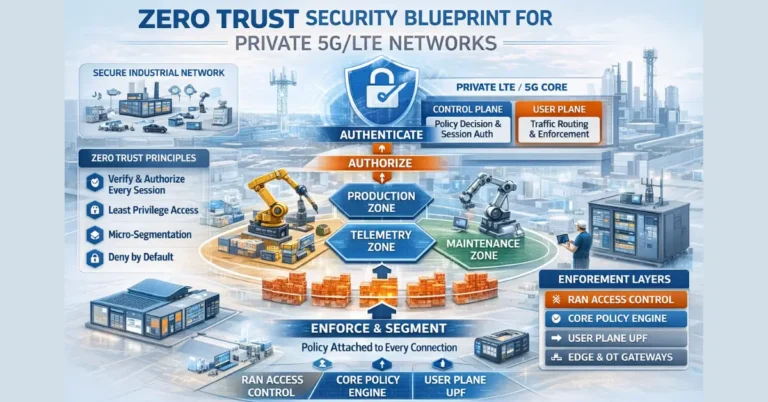
Private LTE and 5G networks are not simply faster wireless connectivity layers. In industrial environments, enterprise campuses, utilities, ports, and manufacturing facilities, they increasingly serve as the operational backbone for automation systems, robotics, telemetry platforms, and safety infrastructure. When private cellular networks carry production-critical workloads, security cannot be treated as an overlay.
In the previous article, Private Network Security: Architecture, Threat Surfaces & Controls, we examined the structural domains of private LTE/5G deployments—RAN, core, user plane, edge, devices, and management—and identified where risk accumulates across these trust boundaries. That discussion established security as an architectural discipline rather than a perimeter control.

This article builds on that foundation by moving from architectural exposure to a formal Zero Trust blueprint for private LTE/5G environments. It explains how Zero Trust principles are enforced natively within private cellular networks, where policy decisions are applied across the control and user planes, and what structural controls matter most for operational containment.
To preserve clarity and depth across the series, this discussion does not duplicate identity management, SIM lifecycle governance, core hardening, or monitoring and assurance frameworks. Those topics will be addressed in subsequent posts. Here, the focus is the architectural mechanics of Zero Trust inside private cellular deployments.
Unlike traditional enterprise environments—where Zero Trust is often layered onto legacy infrastructure—private LTE/5G embeds authorization and traffic governance directly into session establishment and traffic steering. That structural integration makes Zero Trust not only achievable but foundational when engineered deliberately.
Key terminology referenced across this article:
- Session authorization: Policy decision applied at control-plane session establishment.
- Service profile: Set of permitted destinations, breakout paths, and domain boundaries assigned to a session.
- Operational zone: Defined architectural domain with specific security and functional boundaries.
- Containment: Structural restriction of traffic and access, per Zero Trust principle.
1. Network-Native Zero Trust in Private LTE/5G
Zero Trust is often described as a security philosophy that eliminates implicit trust and requires continuous verification. In enterprise IT environments, this philosophy is typically implemented through identity overlays, endpoint agents, software-defined perimeters, and distributed policy engines layered on top of existing network infrastructure.
Private LTE and 5G introduce a materially different structural foundation.
In private cellular deployments, authentication, session establishment, and traffic steering are inherently centralized within the network’s control and user planes. Authorization decisions are embedded directly into the mechanics of how connectivity is created. Rather than relying on distributed switch configurations or perimeter firewalls, private LTE/5G attaches policy to the session itself.
This creates what can be described as network-native Zero Trust.
In this model, authorization is not an afterthought applied once connectivity is established. It is inseparable from the process of session creation. When a device attaches to the network, it does not simply gain access to a transport medium. Instead, a control-plane decision determines the scope of that device’s reach before traffic is permitted to flow.
The implications are structural:
- Authentication validates identity, but authorization defines scope.
- Traffic routing reflects explicit policy rather than inferred trust.
- Segmentation is bound to session state rather than physical topology.
- Mobility does not dissolve containment boundaries.
- Physical proximity does not imply privilege.
In industrial and enterprise environments where private LTE/5G supports production-critical systems, this structural integration is transformative. It enables segmentation and containment to be enforced consistently, even in highly mobile or distributed deployments.
However, embedding authorization into the network fabric also increases architectural responsibility. If session policies are loosely defined or service mappings are overly broad, exposure becomes systemic rather than localized. Determinism amplifies both strength and weakness.
Network-native Zero Trust is therefore not an automatic benefit of private LTE/5G. It is a capability that must be deliberately engineered.
2. What Zero Trust Means in a Private Cellular Environment
Zero Trust in private LTE/5G environments should not be reduced to a compliance objective or marketing label. It is a structural discipline governing how sessions are authorized, how traffic is steered, and how operational domains are isolated.
In practical terms, Zero Trust in private cellular deployments rests on several interdependent principles.
Connectivity and Authorization Are Distinct
In traditional networks, devices often receive broad access once connected to the internal network. Private LTE/5G decouples these concepts. A device may authenticate successfully yet remain constrained to a narrowly defined service profile. Authorization determines which systems, applications, or zones are reachable—not authentication alone.
Failing to maintain this distinction reintroduces implicit trust into an environment designed to eliminate it.
Policy Is Assigned at Session Establishment
When a session is created in the control plane, it is mapped to a service profile aligned with an operational role or zone. That mapping determines how the user plane will steer traffic. Rather than relying on static IP segmentation or distributed firewall rules, policy is attached to the session context itself.
This model enables segmentation that is independent of physical topology. It also requires precision. Broad service profiles undermine containment even if authentication remains strong.
Trust Is Anchored in Operational Context
Private LTE/5G deployments frequently operate in environments where endpoint posture validation is limited or impractical. Industrial devices may lack agent support or advanced security controls. Instead of relying exclusively on endpoint signals, private cellular environments can anchor trust decisions in service type, operational role, and network context.
This shift aligns Zero Trust enforcement with the realities of OT and distributed industrial systems.
Deny-by-Default Must Be Structural, Not Aspirational
Zero Trust depends on explicit authorization. Lateral communication between operational zones should not occur automatically. Traffic must match defined policy paths before it is permitted to flow.
If deny-by-default principles are relaxed during pilot phases or for operational convenience, containment degrades gradually. Informal exceptions become embedded pathways.
Zero Trust in private LTE/5G therefore requires more than feature enablement. It demands disciplined service definition, zone mapping, and enforcement consistency across the network fabric.
3. Private LTE/5G Zero Trust vs Traditional IT Zero Trust
Zero Trust originated within enterprise IT environments as a response to perimeter collapse. As remote work expanded and applications moved to cloud platforms, the concept of a hardened internal network separated from an untrusted external internet became increasingly unrealistic. Zero Trust sought to eliminate implicit trust by verifying identity continuously and restricting access through centralized policy engines.
Private LTE and 5G deployments operate under fundamentally different structural conditions.
In enterprise IT networks, segmentation frequently depends on distributed switching constructs, VLAN assignments, firewall rules, and endpoint enforcement agents. Mobility often requires re-authentication or policy re-evaluation as devices move between network segments. Enforcement logic may reside in external gateways rather than in the transport fabric itself.
In contrast, private LTE/5G centralizes session establishment and traffic steering within the network core. Policy is not an overlay—it is attached to the session context that defines how traffic flows. Mobility is inherent to the architecture, and policy continuity persists as devices transition between radio cells.
This structural distinction produces several important differences.
In traditional IT environments, identity systems act as the primary trust anchor. In private LTE/5G, the session itself becomes the anchor of authorization and segmentation. While identity remains essential, enforcement is embedded directly into the network’s operational logic.
Segmentation in enterprise IT networks is often topology-driven. In private LTE/5G, segmentation is session-driven. This reduces dependency on distributed configuration and improves determinism, provided service mappings are precise.
Mobility in IT environments can introduce segmentation complexity. In private cellular deployments, mobility is native and does not inherently weaken policy enforcement.
However, this centralization also concentrates responsibility. Weakly defined service profiles or misaligned user-plane enforcement can introduce systemic exposure across the deployment. Where IT networks may experience localized segmentation errors, private LTE/5G misconfiguration can propagate broadly if governance discipline is insufficient. Private LTE/5G therefore does not simplify Zero Trust—it operationalizes it at the network layer.
Because private LTE/5G centralizes session establishment within the network fabric — unlike distributed enforcement models in traditional IT — the mechanism that determines trust boundaries shifts from topology-driven segmentation to session-driven authorization. The next section explains how this structural shift becomes the core enforcement mechanism for Zero Trust.
4. Mapping Private LTE/5G Zero Trust to NIST SP 800-207
The National Institute of Standards and Technology (NIST) defines Zero Trust Architecture (ZTA) in SP 800-207 as a model built around centralized policy decision and enforcement components rather than implicit network trust. While the NIST framework is technology-agnostic, its logical components provide a useful reference model for understanding how Zero Trust operates structurally.
In the NIST ZTA model, several core elements are defined:
- Policy Decision Point (PDP)
The PDP evaluates access requests. It determines whether a subject (user, device, or workload) should be granted access to a resource based on defined policy, contextual attributes, and trust signals. - Policy Enforcement Point (PEP)
The PEP enforces the decision made by the PDP. It allows, denies, or constrains traffic according to the policy outcome. - Policy Engine and Policy Administrator
The policy engine evaluates policy rules, contextual data, and trust attributes. The policy administrator translates the decision into actionable configuration for enforcement components. - Identity Systems and Data Sources
These provide the contextual information—identity, posture, behavioral signals, or environmental context—that inform policy decisions.
In traditional enterprise IT environments, these components are often implemented through gateways, identity brokers, endpoint agents, and centralized policy controllers layered on top of the network.
Private LTE/5G deployments distribute these logical functions directly into the cellular architecture.
How Private LTE/5G Maps to NIST ZTA Components
Although private cellular networks are not designed as IT policy overlays, their structural architecture inherently maps to NIST’s Zero Trust model:
- Control Plane → Policy Decision Authority
The cellular control plane performs the core authorization function during session establishment. It validates identity, assigns service profiles, and maps sessions to operational zones. In effect, it acts as a distributed policy decision authority embedded in the network fabric. - User Plane / UPF → Policy Enforcement Points
The user plane enforces traffic steering, breakout control, and zone isolation according to the policy attached to the session. It operates as the deterministic enforcement layer that translates authorization decisions into traffic reality. - RAN → Initial Admission Control Boundary
The Radio Access Network governs admission into the system. While it does not perform fine-grained authorization, it represents the first structural boundary and establishes contextual attachment to the network. - Edge Compute and Gateways → Mediation Domain
Edge systems mediate interactions between OT and IT domains. They often host application workloads, protocol translators, and analytics platforms. In Zero Trust terms, they function as controlled mediation zones between distinct operational domains. - Management and Orchestration Plane → High-Risk Policy Control Layer
Management systems define configuration state, service mappings, and enforcement logic across the deployment. Because they control policy definition and distribution, they represent concentrated authority within the architecture. Compromise at this layer can override enforcement decisions system-wide.
Architectural Implication
Private LTE/5G does not replace the NIST Zero Trust model. Rather, it operationalizes it within the transport fabric itself. Instead of relying exclusively on external policy gateways, private cellular networks embed decision and enforcement logic directly into session establishment and traffic routing.
This structural integration reduces reliance on distributed endpoint agents and perimeter devices, but it increases the importance of precise service mapping, user-plane alignment, and management-plane governance.
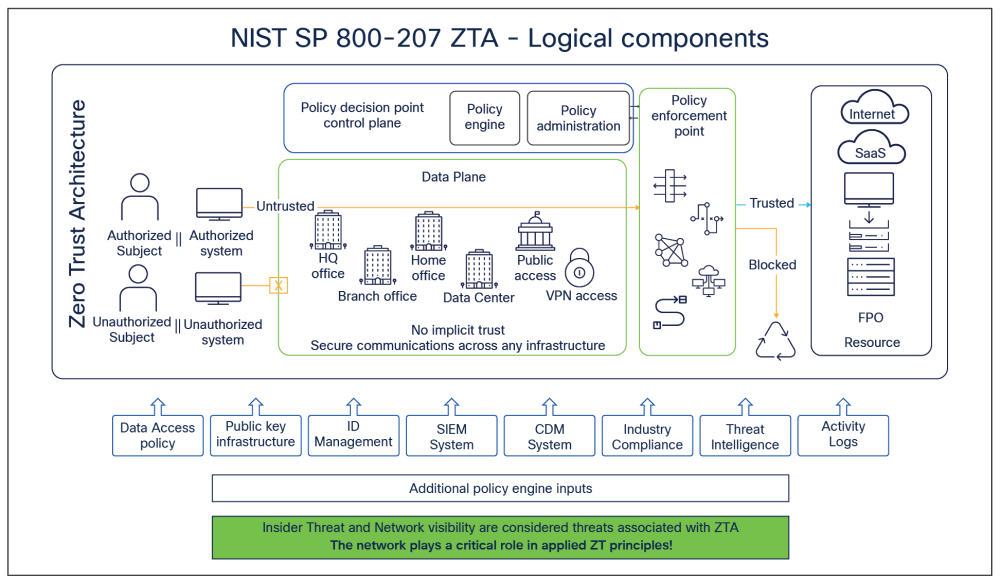
In private LTE/5G environments, this mapping is not conceptual — it is structural. Policy decision and enforcement are embedded directly into session establishment and traffic routing, rather than layered externally through perimeter gateways.
5. Session-Based Authorization as the Structural Anchor
Session-based authorization is the mechanism that enables Zero Trust to function deterministically in private LTE/5G deployments. It is the structural pivot point between authentication and traffic enforcement.
When a device attaches to the network, authentication validates its identity using cellular mechanisms. This step confirms that the device is recognized and permitted to establish connectivity. However, authentication alone does not determine what the device may access.
Upon successful authentication, the control plane establishes a session. This session is then mapped to a service profile that defines its operational scope. The service profile reflects architectural intent—such as whether the device belongs to a production cell, a telemetry domain, a maintenance zone, or a tenant environment.
This mapping determines how the user plane will steer traffic. Traffic routing decisions—such as breakout location, permitted destinations, and cross-zone visibility—are enforced according to the parameters attached to the session. The policy is therefore bound to session state rather than to static network constructs.
This model offers several structural advantages.
- First, segmentation follows the device regardless of physical movement. In mobile industrial environments—such as manufacturing facilities with autonomous vehicles or utilities with field-deployed assets—devices may move frequently. Because policy is attached to the session rather than the physical interface, containment remains intact during mobility events.
- Second, authorization scope can be precisely defined. A device assigned to telemetry collection can be restricted to specific data ingestion services without exposure to production control systems or management domains.
- Third, session state can be re-evaluated when context changes. While this article does not delve into dynamic trust scoring or monitoring frameworks, the architecture supports policy reassessment when conditions shift.
However, session-based authorization is only as strong as its definition. Overly broad service profiles, loosely defined operational zones, or inconsistent policy application across sites undermine containment. Strong authentication does not compensate for weak authorization scope.
Session-based authorization is therefore not merely a technical feature. It is the structural anchor that determines whether Zero Trust remains enforceable under real-world conditions.
6. Control Plane vs User Plane: Dual Enforcement Responsibility
Zero Trust in private LTE/5G depends on coordinated enforcement across two structurally distinct domains: the control plane and the user plane. These layers serve different functions, but their alignment determines whether containment is theoretical or operational. The control plane is responsible for establishing session context. It validates identity, creates the session, assigns service profiles, and maps the device to a defined operational role. In essence, the control plane defines intent. It determines what a device is authorized to access.
The user plane enforces reality. It governs how traffic is routed, where breakout occurs, and whether east–west communication between operational zones is permitted. Traffic steering decisions reflect the policy parameters attached to the session.
For Zero Trust to function structurally, these two planes must operate in precise alignment.
If the control plane assigns a restricted service profile but the user plane permits permissive routing, containment fails. Conversely, if the user plane enforces strict routing but session definitions are overly broad, segmentation remains imprecise. Authorization intent and traffic enforcement must mirror one another.
This dual responsibility is particularly significant in distributed industrial environments. For example:
- A robotics controller authorized only for production-line coordination should not gain lateral visibility into safety systems.
- A telemetry device should not be able to traverse east–west into unrelated operational zones.
- A maintenance session should not inherit privileges intended for production workloads.
These containment boundaries are defined in the control plane but enforced in the user plane. Any divergence between the two layers introduces structural weakness. This network-native approach is especially significant in environments where connectivity supports production-critical OT systems that cannot tolerate segmentation drift or inconsistent enforcement.
Private LTE/5G architectures enable deterministic enforcement because session establishment and traffic steering are centralized within the network core. However, this centralization increases architectural accountability. Policy consistency, service mapping discipline, and breakout governance must remain synchronized across both planes.
Zero Trust in private cellular environments is therefore not anchored in a single enforcement point. It is sustained through coordinated behavior between control-plane authorization and user-plane routing logic. When these layers align, segmentation remains predictable even under mobility and scale. When they diverge, containment degrades silently. Because many industrial endpoints cannot support modern security agents, private LTE/5G Zero Trust places more emphasis on session and network context rather than endpoint posture.
Now that we understand how session authorization and traffic enforcement align across planes, we can examine how these mechanisms make micro-segmentation practical in OT contexts — a capability that historically has been elusive in industrial networks.
7. Zero Trust Enforcement Across the Private LTE/5G Stack
With enforcement responsibility distributed across architectural domains, segmentation becomes the practical expression of Zero Trust within operational environments.
Zero Trust in private LTE/5G does not exist at a single enforcement point. Unlike traditional enterprise environments that rely heavily on perimeter gateways, private cellular architectures distribute enforcement responsibility across multiple structural layers. Each domain contributes a distinct containment function, and the integrity of Zero Trust depends on how these domains interlock.
Understanding this layered enforcement model is critical. Zero Trust is not activated by enabling a feature; it emerges from coordinated behavior across the RAN, core, user plane, edge, and management systems.
RAN: The Initial Trust Boundary
The Radio Access Network represents the first structural boundary. While it does not determine fine-grained authorization, it governs admission and establishes the contextual starting point for the session. In industrial deployments, radios may be physically accessible or distributed across large operational areas. Misconfiguration, weak credential discipline, or compromised radio infrastructure can introduce instability before control-plane policy logic is even invoked.
The RAN therefore acts as a controlled entry point. Its integrity underpins all subsequent enforcement decisions.
Core Network (Control Plane): Defining Authorization Scope
The control plane is the architectural center of Zero Trust enforcement. It does more than authenticate devices; it establishes the parameters of what a device is allowed to do. When a session is created, it is mapped to a service profile that reflects operational boundaries. That mapping determines how the user plane will steer traffic.
If session definitions are broad, ambiguous, or inconsistently applied, segmentation erodes structurally. The core does not simply forward connectivity—it defines authorization scope. Precision at this layer determines whether containment is granular or superficial.
User Plane and UPF: Enforcing Traffic Reality
Where the control plane defines intent, the user plane enforces it. Traffic steering decisions, breakout paths, and zone isolation are implemented here. A device that is authorized for telemetry access should not be able to traverse laterally into production controllers or management systems. The UPF enforces these restrictions deterministically. For example, in a smart factory, a quality-inspection sensor’s traffic should be routed only to analytics servers and not to robotics controllers — and the user plane enforces this boundary regardless of cell location.
Zero Trust fails when user-plane enforcement drifts from control-plane policy. Inconsistent breakout configuration across sites or permissive east–west routing can silently undermine otherwise strong authorization logic.
Edge Compute: The Convergence Layer
Edge environments often host workloads that bridge OT and IT domains. They represent convergence zones where operational data, automation systems, and enterprise analytics intersect. Because of this convergence, the edge becomes a high-value enforcement layer.
Workload isolation, API exposure control, and explicit service mediation must be engineered deliberately. Weak governance at the edge can create indirect pathways that bypass upstream segmentation controls.
Management and Orchestration: Concentrated Authority
If the core defines authorization and the user plane enforces containment, the management plane governs both. It controls configuration, service mapping, and operational state. Because of this authority concentration, it represents the highest-risk domain in the architecture.
Persistent administrative access, shared credentials, or overlapping production and management domains can override segmentation logic instantly. Zero Trust must treat operational access as part of the attack surface, not as an internal exception.
8. OT Micro-Segmentation in Private Cellular Environments
Micro-segmentation has long been a challenge in operational technology (OT) environments. Traditional approaches rely on VLAN constructs, distributed firewall rules, and manual configuration across switches and routers. Over time, these constructs accumulate complexity. Exceptions are introduced to maintain uptime, documentation drifts from deployed reality, and segmentation boundaries become increasingly fragile.
Private LTE/5G changes how segmentation can be enforced.
Because policy is attached to session establishment rather than to physical topology, segmentation becomes independent of switch ports or static IP assignments. When a device attaches to the network, its session is mapped to a service profile aligned with a defined operational zone. That zone may represent a production line, a robotics cluster, a telemetry domain, a safety system, or a tenant boundary in shared deployments.
This shift is particularly significant in mobile industrial environments. Autonomous guided vehicles, inspection drones, robotic arms, and field-deployed energy infrastructure routinely change physical location. In traditional networks, movement can introduce segmentation ambiguity. In private cellular deployments, segmentation follows the session state rather than the cable.
However, deterministic micro-segmentation does not occur automatically. It depends on disciplined zone definition and strict cross-zone governance.
Operational zones must be defined according to functional risk boundaries, not convenience. Production systems should be isolated from safety-critical infrastructure. Telemetry platforms should not have implicit reach into control systems. Maintenance domains should not possess lateral visibility into unrelated production cells.
Equally important, cross-zone communication must be intentional and explicitly authorized. Informal exceptions introduced during pilots often become permanent pathways. Over time, these pathways erode the structural integrity of segmentation. Private LTE/5G enables deterministic containment. But segmentation discipline remains an architectural responsibility.
Having defined how micro-segmentation anchors containment for operational zones, the next critical dimension in Zero Trust is how administrative, automated, and API authorities are governed — because structural segmentation loses integrity when governance boundaries are unclear.
9. Least Privilege for Administrators, Automation, and APIs
Zero Trust principles extend beyond device sessions and traffic routing. In private LTE/5G environments, operational authority is concentrated in management and orchestration systems. These systems define service profiles, enforce policy mappings, and control configuration state across distributed sites.
As a result, administrative access represents one of the highest-risk exposure domains in the architecture.
Least privilege in private cellular environments must be applied with precision. Roles should reflect operational function rather than broad administrative categories. Design engineers, operations teams, troubleshooting personnel, and compliance reviewers require different scopes of authority. Assigning blanket “network administrator” access undermines structural containment.
Time-bound privilege further reduces systemic exposure. Persistent elevated access—especially in environments that support remote operations—creates durable attack surfaces. Temporary privilege tied to approved operational windows introduces containment even at the governance layer.
Automation platforms introduce additional complexity. Orchestration systems accelerate scaling, reduce manual error, and improve operational consistency. However, automation also amplifies misconfiguration. If an orchestration platform holds unrestricted authority across sites, a single incorrect policy push can propagate instantly.
Workflow-restricted execution and narrowly scoped automation permissions reduce blast radius. Automation should execute predefined, auditable tasks rather than operate with generalized authority.
API exposure must also be governed deliberately. Private LTE/5G deployments frequently integrate with enterprise systems, analytics platforms, and industrial controllers. Each integration expands the policy surface. Zero Trust requires that API functions be limited strictly to necessary operations. Implicit trust between internal systems should not be assumed.
In industrial environments, operational access is production access. Treating it as exempt from Zero Trust discipline creates systemic vulnerability.
10. Zero Trust for Unmanaged and Vendor-Owned Devices
Industrial and enterprise private LTE/5G deployments rarely operate in homogeneous device environments. Legacy PLCs, contractor-managed systems, specialized industrial machines, temporary vendor equipment, and third-party gateways are common. Many of these devices cannot support endpoint agents, advanced encryption modules, or posture validation frameworks typical in IT environments.
Zero Trust in private cellular networks must therefore function independently of endpoint sophistication.
Rather than relying on device-side controls, enforcement shifts decisively to the network. Session-based authorization defines what services a device may access, while user-plane enforcement restricts where its traffic can flow. Even if endpoint hardening is minimal, containment can still be preserved. This network-centric containment model becomes particularly important in environments where vendor-owned devices require periodic remote access. Without strict mediation, such access can create persistent exposure paths into operational domains.
Function-based authorization is critical. Devices should be granted access according to their operational role—telemetry collection, maintenance diagnostics, robotics control—not according to physical location or assumed trust. Location-based trust is structurally fragile in mobile environments. Directional traffic control further limits blast radius. A telemetry device may send data northbound to analytics systems but should not have east–west visibility into unrelated production zones. Similarly, vendor systems should not have implicit access to management or orchestration layers. Network policy enforcement should be mirrored in vendor contracts so that access scopes are technically and contractually bounded.
Zero Trust assumes compromise is possible. The objective is not to prove endpoint integrity; it is to contain risk before it propagates across architectural domains.
11. Zero Trust in NSA vs SA Architectures
Private LTE/5G deployments may operate in Non-Standalone (NSA) or Standalone (SA) configurations. While both models can support Zero Trust principles, their structural characteristics influence enforcement responsibilities.
NSA deployments integrate 5G radio capabilities with LTE core infrastructure. Policy enforcement and session management may depend partially on EPC constructs. This hybrid model can constrain service mapping flexibility and introduce integration complexity between LTE and 5G control functions. In NSA environments, Zero Trust enforcement must account for inherited architectural limitations. Segmentation precision may depend on EPC configuration discipline and integration clarity between legacy and new components.
Standalone (SA) deployments, by contrast, rely on a cloud-native 5G core with service-based architecture (SBA). This introduces expanded API surfaces and microservice interactions within the core itself. While SA enables more granular service mapping and advanced slicing capabilities, it also increases governance responsibility. In SA environments, network slicing can further isolate operational domains — but slicing discipline must align with service profile governance to prevent cross-slice exposure. Cloud-native control planes require disciplined configuration management, API exposure governance, and version control. Misconfigured service interfaces in SA environments can create exposure at scale if architectural oversight is weak.
SA does not simplify Zero Trust. It redistributes enforcement logic into a more dynamic environment. Architectural maturity must evolve accordingly.
12. Zero Trust Under Scale and Drift
Zero Trust policies often appear robust in controlled pilot environments. Containment boundaries are clearly defined, service profiles are few, and administrative oversight is concentrated.
The structural challenge emerges during expansion.
As deployments scale across sites:
- Service profiles multiply.
- Operational zones vary by facility.
- Breakout requirements differ.
- Administrative teams expand.
- Configuration changes occur more frequently.
Without disciplined governance, subtle inconsistencies begin to accumulate. A slightly broader service profile at one site, a permissive breakout rule introduced temporarily, an administrative privilege extended “for convenience”—each may appear minor in isolation. Collectively, they erode structural containment.
Zero Trust degradation rarely manifests as a single catastrophic failure. More often, it emerges gradually through configuration drift.
Drift detection mechanisms, standardized policy templates, version control discipline, and periodic enforcement validation become critical as scale increases. Governance must preserve policy integrity across expansion phases.
Zero Trust is not a one-time architectural milestone. It is a continuous enforcement discipline.
13. Common Zero Trust Pitfalls in Private LTE/5G
Several recurring patterns undermine Zero Trust initiatives in private cellular environments.
One common mistake is treating Zero Trust as a product acquisition rather than a design discipline. Enabling security features within network components does not automatically produce deterministic containment.
Another frequent error is importing IT-centric Zero Trust models without adjusting for OT realities. Industrial systems prioritize uptime and safety. Enforcement models must align with operational boundaries rather than corporate IT constructs.
Pilot deployments introduce additional risk. In early stages, teams may broaden service profiles to accelerate testing or relax segmentation to simplify troubleshooting. When these provisional configurations are scaled without redesign, structural weaknesses propagate across sites.
Overlooking user-plane enforcement consistency is another subtle failure point. Authorization logic in the control plane must be mirrored precisely in traffic steering decisions. Any mismatch weakens containment.
Finally, management-plane isolation is often underestimated. Because operational teams require broad visibility, management domains are sometimes exposed more widely than necessary. This concentration of authority increases systemic risk.
Zero Trust must be engineered deliberately, validated continuously, and governed rigorously. Convenience-driven exceptions are the primary source of erosion.
Conclusion: Zero Trust as the Operating Model for Private Cellular
Private LTE and 5G networks fundamentally alter where and how trust is enforced. In these environments, authorization and segmentation are not overlays—they are embedded into session establishment and traffic steering logic.
This structural integration enables deterministic containment across mobile, distributed, and industrial deployments. When session authorization aligns with operational zones and user-plane enforcement reflects control-plane intent, segmentation can remain stable even under mobility and scale.
However, determinism does not eliminate responsibility. Poorly defined service mappings, unmanaged privilege sprawl, inconsistent enforcement across sites, or configuration drift can undermine containment just as effectively as external threats.
Zero Trust in private LTE/5G is therefore not a feature set. It is an operating model—designed architecturally, enforced structurally, and governed continuously.
When implemented with discipline, it allows private cellular networks to move confidently from pilot experimentation to production-scale deployment without sacrificing containment integrity. As private LTE/5G deployments scale into multi-tenant, multi-site, and safety-critical environments, Zero Trust will not merely secure connectivity — it will govern operational integrity.
Coming Next in the Series
The next blog will dive into identity, device trust, and SIM/eSIM strategy for private LTE/5G, including:
- How identity is established and validated at scale
- Managing device lifecycle and trust without agents
- Reducing risk from rogue, cloned, or misbehaving devices
- Securing industrial gateways and protocol bridges
That post will move from policy and trust models to the mechanisms that anchor trust in private cellular networks.