Why 5G network simplification is now essential for 5G efficiency and agility
NGMN’s latest operator-led guidance frames simplification as a precondition for 5G efficiency, sustainability and service agility—not an optional clean-up exercise.
TCO and complexity pressures in 5G RAN, core and transport
As 5G scales, operators face a widening gap between architectural ambition and operational reality: multi-generation RAN footprints, dual-core modes (NSA/SA), fragmented transport, and proliferating platforms drive up total cost of ownership (TCO) and slow change. NGMN’s new Framework for Network Simplification – An Operator View argues for targeted simplification across radio, core and transport to contain this sprawl while preserving the ability to launch differentiated services. The alliance places cloud‑native design, federated service exposure and AI-driven operations at the center of that shift, supported by agile ways of working.

Cut energy and cost while accelerating 5G service agility
Energy is now a board-level KPI; unnecessary variants in RAN hardware, overlapping feature sets and poorly rationalized transport layers all waste power and labor. At the same time, enterprise 5G and premium consumer experiences depend on faster service creation and assurance. NGMN’s message: simplification is how operators square the circle—cut carbon and cost, while accelerating innovation.
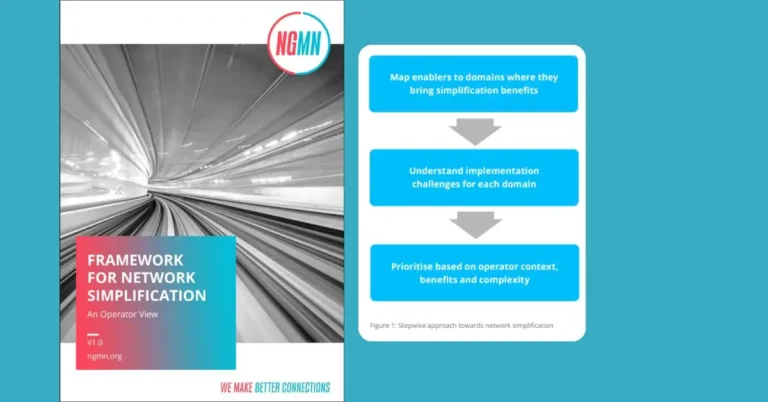
NGMN’s three-step 5G simplification framework
The publication offers a practical, non-prescriptive method to decide where simplification delivers the most benefit, and when complexity risk outweighs near-term gains.
Step 1: Map cloud-native, AI, APIs and fiber to each domain
NGMN highlights four technology vectors to unlock simplification: cloud‑native architectures across core and service platforms; agentic and generative AI to drive closed-loop operations and service assurance; exposure of federated network services through standardized APIs; and accelerated fiber evolution for transport. It also elevates non-technology change—agile delivery and product-centric teams—as necessary to convert platform investments into time-to-market gains.

Step 2: Address RAN, core and transport simplification hurdles
In radio, legacy bands, 2G/3G dependencies and site-level hardware diversity derail consolidation and drive energy overheads; in the core, partial cloudification and overlapping EPC/5GC modes complicate lifecycle management and service assurance; in transport, mixed microwave–fiber estates, siloed tooling and inconsistent quality classes impede deterministic performance. NGMN calls for a realistic assessment of ecosystem maturity, vendor roadmaps, regulatory constraints and change-readiness before committing to major simplification moves.
Step 3: Prioritize by operator maturity (SA, NSA, LTE)
The framework differentiates by deployment maturity: advanced 5G SA operators, mid-stage NSA-to-SA operators, and early-stage LTE-centric operators. Each should sequence enablers where they produce the highest near-term value and lowest integration risk, rather than chasing a uniform target architecture.
Simplification priorities by operator archetype
NGMN tailors guidance to where operators sit on the 5G curve, aligning investments to measurable outcomes in cost, energy and agility.
Advanced 5G SA: unify observability, AI assurance and API exposure
With cloud‑native cores in place, the biggest simplification gains shift to cross-domain orchestration, data readiness and AI-driven service assurance. Priorities include unifying observability across RAN–core–transport, operationalizing NWDAF-like analytics for closed loops, standardizing service exposure, and pushing fiber deeper to reduce backhaul variability. Focus less on adding more RAN hardware features and more on productizing network capabilities (e.g., slicing, latency tiers) with robust lifecycle automation.
NSA-to-SA: rationalize RAN, prep VoNR and migrate to cloud-native 5GC
For operators still transitioning, data hygiene and AI-assisted planning can materially reduce rollout friction and energy cost. Rationalize RAN variants, simplify site configurations and prepare VoNR/VoLTE readiness to enable orderly 3G sunset where feasible. Establish a migration runway toward cloud‑native 5GC, minimizing “halfway” platforms that increase operational burden. Organizationally, move from project to product models so SA launches and feature onboarding become iterative and automated.
LTE-centric: standardize RAN, adopt dual 4G/5G core and prioritize fiber
Foundational choices now will determine tomorrow’s complexity. Where possible, skip interim virtualized cores in favor of cloud‑native dual 4G/5G core platforms to avoid double migrations. Standardize on fewer RAN configurations, prioritize fiber as the transport default, and embed agile practices early to speed future service introduction. Keep a strict line of sight to decommissioning milestones to prevent long-running multi-generation dependencies.
12–24 month actions for 5G simplification
Operators can translate the framework into a concrete 12–24 month plan anchored in platforms, data and operating model.
Cloud-native architecture, GitOps and RAN/transport consolidation
Adopt a cloud‑native reference for core and service platforms, with declarative automation and GitOps practices to tame lifecycle complexity. Consolidate RAN hardware and software variants, aligning energy-saving features across vendors and bands. In transport, bias to fiber where economics allow, and harmonize QoS classes and telemetry to support deterministic services.
Shared data layer, high-ROI AI and closed-loop automation
Build a shared, governed data layer spanning RAN, core and transport—complete with metadata, lineage and access controls—to enable trustworthy AI. Prioritize AI use cases with clear ROI: AI-assisted RAN planning, closed-loop anomaly detection and energy optimization, and intent-driven service assurance. Prepare for federated exposure with standardized APIs so capabilities can be productized and monetized across partners.
Product teams, OKRs and decommissioning roadmaps
Create cross-functional product teams responsible for business outcomes (not just technology outputs), and wire OKRs to simplification metrics—energy per site, time-to-market, mean time to repair, and unit cost per GB. Make platform teams accountable for reusable automation, not bespoke scripts, and formalize decommissioning roadmaps for legacy domains.
Strategic implications and ecosystems shaping 5G simplification
NGMN’s work aligns with broader industry shifts toward cloud‑native, automation-first networks and standardized exposure layers.
3GPP, ETSI ZSM, GSMA Open Gateway and CAMARA
Track 3GPP advances in analytics and exposure, ETSI ZSM for end-to-end automation, and the momentum behind API federations such as GSMA Open Gateway and CAMARA for service exposure. Align internal roadmaps to NGMN’s ongoing projects in cloud‑native, network automation and 6G, where simplification targets will be embedded. Operator leadership from Orange and peers within NGMN signals strong momentum for execution.
KPIs: TCO, energy per cluster, activation lead times, change failure rates, SLA
Benchmark progress with a small set of business-aligned KPIs: TCO reduction per domain, energy savings per RAN cluster, service activation lead times, change failure rates, and SLA adherence for premium services. Use these to guide iterative prioritization rather than one-off transformation waves.
The road ahead to AI-native, cloud-first 5G and 6G
Simplification is not a one-time redesign; it is a disciplined operating principle that informs every architectural decision as 5G matures and 6G research ramps. Operators that pair cloud‑native foundations with agentic AI, federated exposure and agile delivery will cut cost and carbon while creating a platform for faster, more reliable service innovation. NGMN’s framework offers the common language—and the sequencing logic—to get there faster, with fewer detours.