Google AI Plus in India: pricing, features, and what’s next
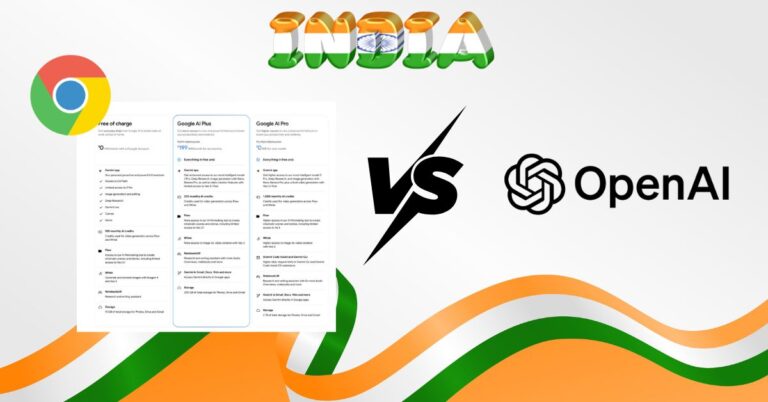
Google has introduced a sharply priced AI Plus subscription in India to push generative AI into the mass market and counter OpenAI’s ChatGPT Go.
Pricing, features, and storage bundle
The AI Plus plan launches at ₹199 per month for new users for six months, then moves to ₹399 per month. That undercuts Google’s previous entry tier in India by an order of magnitude, replacing a ₹1,950-per-month AI Pro as the cheapest option. The bundle raises usage limits for Gemini 3 Pro, unlocks video generation within Google’s apps, expands NotebookLM’s “deep research” capabilities, and adds 200GB of storage across Google Photos, Drive, and Gmail. Family sharing is included, signaling a household-centric growth strategy.

How Google stacks up to ChatGPT Go
The move targets OpenAI’s sub-$5 ChatGPT Go, which arrived earlier in India with aggressive free-year promotions and higher message, image, and file-upload limits than the free tier. Google’s response leans on ecosystem value rather than raw message caps: creation tools, research workflows, and Google One–style storage baked into a single subscription. It is a classic Google playbook—bundle AI utility with everyday services to reduce churn and increase daily active use.
Rollout timing and India-specific pricing
Google rolled out this lower-priced plan in other markets earlier, making India the latest stop in its localized pricing strategy. OpenAI moved sooner in India’s budget segment, and Perplexity piled on via operator partnerships. The shift by Google is a necessary recalibration to India’s extreme price sensitivity and its scale dynamics.
Why sub-$5 AI matters for adoption and telcos
Sub-$5 pricing changes the addressable market overnight and creates new levers for telcos and device makers.
Mass-market adoption drivers
At under $5, AI is priced like a value-added service rather than a premium SaaS seat. That expands the target base from urban professionals to students, gig workers, and SMB owners. Video generation and image editing will broaden the use cases beyond chat, pulling in creators and micro-entrepreneurs. Expect a surge in trial, habit formation, and family-level sharing.
Network load and device implications
Richer media outputs will increase data consumption and create spikier traffic profiles on 4G and 5G networks. Operators will need better traffic classification, caching, and peering for AI-heavy content, plus a roadmap for edge GPU capacity where latency matters. On the device side, continued improvements in on-device inference (e.g., Gemini Nano class models) can offload cloud costs and reduce network strain, but they require OEM optimization and silicon support.
Payments friction and churn in India
Recurring billing in India still contends with RBI e-mandate rules and variable card success rates, even as UPI Autopay adoption grows. That makes telco billing and bundles more attractive on day two of growth. Family sharing can stabilize retention across multi-SIM households.
Competition: pricing, partnerships, and bundles
Google, OpenAI, and Perplexity are racing on three vectors—price points, product bundles, and operator alliances.
OpenAI and Perplexity strategies
OpenAI’s ChatGPT Go set the sub-$5 bar and used extended free periods in India to seed usage. Perplexity partnered with Bharti Airtel to offer its Pro tier free for a year to eligible customers, a pure acquisition play that leans on carrier billing and marketing reach.
Google’s ecosystem edge in India
Google counters with breadth. NotebookLM suits students and researchers. Storage ties into daily photo and file workflows. Video features expand creative use. The plan is designed to meet users where they already spend time and to leverage Google’s installed base across Android, Search, and Workspace.
Telco bundles as the growth engine
Google also teamed with Reliance Jio to bundle its higher-tier AI Pro plan at no cost for qualifying mobile plans, illustrating how operator subsidies can prime the pump. In a low-ARPU market, these bundles convert marketing budgets into long-lived billing relationships and provide powerful distribution at scale.
What telcos, OEMs, and enterprises should do next
With consumer AI nearing the price of a data add-on, stakeholders should pivot from experimentation to scaled distribution and governance.
Actions for telecom operators
Bundle AI across postpaid, family, and student plans with UPI Autopay and card e-mandate support to reduce friction. Co-create vernacular experiences and customer care bots to drive daily utility. Monitor AI traffic patterns to plan 5G edge and CDN investments, and evaluate GPU-as-a-service partnerships with hyperscalers for low-latency workloads. Align offers with India’s net neutrality rules to avoid differential pricing pitfalls.
Actions for device OEMs
Preload AI clients and notebooks, optimize for on-device inference, and align memory and NPU specs in mid-range devices. Promote family sharing bundles at point of sale to lift attachment rates. Work with Google on battery, privacy, and model-switching UX to keep latency down and trust high.
Actions for enterprises and ISVs
Leverage the low-cost tiers for field workers and frontline staff, but gate sensitive workflows to enterprise-grade controls. Use retrieval-augmented generation and data-loss prevention to keep customer and regulated data compliant with India’s DPDP Act. Expect upsell paths into productivity suites; negotiate portability and auditability to avoid lock-in across model providers.
Risks, constraints, and key watchouts
Ultra-low pricing will expand usage, but it also introduces cost, regulatory, and quality risks that leaders must track.
Costs, metering, and throttling
Inference remains costly. Sustaining sub-$5 in a high-usage market will push providers to meter features, compress context windows, or offload more to devices. Watch for policy changes, peak-hour limits, and model tiering.
Regulation and payment friction
Compliance with the DPDP Act, data localization expectations, and age-appropriate design will shape feature rollouts. Payments remain a chokepoint; operator billing and UPI Autopay can help, but churn will be higher than in card-dominant markets.
Quality, language support, and safety
Accuracy in Indian languages and domain-specific tasks is uneven. Providers that invest in evaluation, safety, and localized datasets will win trust in education, healthcare, and public services. Expect more campus, SME, and government-facing bundles.
Bottom line
Google’s AI Plus at sub-$5 converts generative AI from a premium product into a utility in India. The next phase of competition will be won on distribution through telcos, on-device performance, and trustworthy, localized experiences—not just on headline model benchmarks.