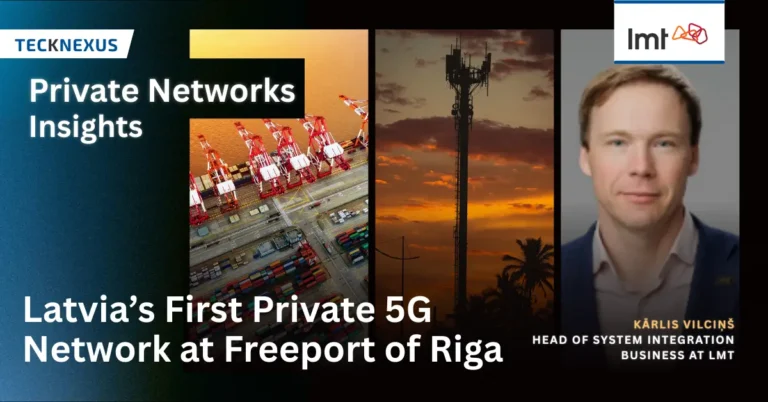
LMT’s Shift from Telecom to Private 5G Leadership in Latvia
Karlis Vilciņš, Head of Systems Integration Business at Latvijas Mobilais Telefons (LMT), explains that the company, once solely focused on the domestic mobile network operator (MNO) business, has significantly expanded its scope. Today, LMT positions itself as a leader in private 5G networks both in Latvia and abroad.

Over the past five years, LMT has been diversifying beyond its traditional telecom services. One key area of focus has been the deployment of 5G private networks to meet industrial connectivity needs, particularly for enterprises seeking reliable and scalable wireless solutions.

Collaborating with Druid Software to Launch Latvia’s First Private 5G Network
The opportunity to work with Druid Software arose when Baltic Container Terminal (BCT) sought a solution to its legacy Wi-Fi limitations at the Freeport of Riga. The terminal faced operational challenges due to connectivity issues. Rather than reinvest in outdated Wi-Fi infrastructure, BCT partnered with LMT to deploy a private 5G solution to support automation, robotics, and more reliable communication.
This business-driven demand — a real-world challenge, not just a tech showcase – became the catalyst for Latvia’s first private 5G network implementation.
Why Wi-Fi Was No Longer Enough at the Port
Operating over a 50-hectare area, BCT had deployed around 22 Wi-Fi masts with fiber and power. Despite this infrastructure, coverage gaps were common, causing operational downtime and workflow delays.
As Vilciņš recalls, some operators reported losing signal mid-operation, forcing them to “drive around the yard” searching for connectivity just to receive their next instruction.
These black spots highlighted the inadequacies of Wi-Fi in large-scale industrial environments, pushing BCT to adopt a private 5G network for consistent, high-performance connectivity.
How LMT Designed Reliable 5G Coverage for Complex Port Operations
In early 2024, LMT initiated test deployments based on precise coverage and capacity calculations. The solution was tailored to the port’s unique operational environment — from yard equipment to cranes and vehicles.
The LMT team explored various radio and core network options, finally integrating the selected 5G system with BCT’s existing enterprise IT infrastructure. The technical planning was deeply collaborative, ensuring the network would be both reliable and tailored to actual business workflows.
Why Druid Software’s Raemis™ Core Was Chosen
LMT selected Druid Software and its Raemis™ platform due to its maturity, ease of integration, and long-standing focus on private networks.
Vilciņš highlights how other vendors often locked users into restrictive ecosystems. In contrast, Druid offered flexibility, speed, and a platform scalable enough to grow with the customer’s needs — from basic deployments to more advanced setups with capabilities like network slicing.
Although the Freeport deployment was simple (two radios, no slicing), Raemis™ provided a reliable core for mission-critical operations while supporting future expansions.
Seamless Integration Without Disrupting Port Operations
To ensure a smooth transition, LMT kept the existing Wi-Fi infrastructure active during the private 5G deployment. Devices and systems were gradually migrated in phases.
This incremental migration strategy allowed the port to maintain full operational continuity, minimizing risk and ensuring a steady shift from legacy systems to next-gen 5G connectivity.
Private 5G as a Foundation for Sustainability and Digital Transformation
Private 5G lays the foundation for digital transformation in industries like shipping and logistics. According to Vilciņš, technologies such as AI, robotics, and autonomous vehicles depend on robust, low-latency connectivity.
At BCT, even in these early stages, the private 5G deployment has led to:
-
Reduced downtime for heavy equipment like reach stackers
-
Faster crane-to-database data transfers
-
Improved loading/unloading efficiency
While it’s too early to report full-year KPIs, the improvements are already clear, both in terms of daily operations and the readiness for future innovation.
Lessons Learned: Device Compatibility Is Still a Hurdle
One key takeaway is the challenge of device compatibility with 5G standalone (SA) networks. Many enterprise devices, especially in smaller markets, lack full support for 5G SA or require custom firmware.
To mitigate this, LMT focused on extensive device testing to ensure all hardware was production-ready. This effort continues today, underscoring the importance of validating equipment before scaling any private 5G solution.
The Growth of Private 5G in the Baltics and Beyond
LMT’s private 5G journey is just beginning. The company recently launched another 5G private network at a Latvian sawmill — proving that even smaller industrial sites have strong use cases.
Vilciņš sees manufacturing and agriculture as major drivers of private 5G in the Baltics. Use cases include robotics, autonomous farming equipment, and connected production systems.
Another area of innovation is distributed core networks, developed in partnership with Druid. These allow localized deployments with improved resilience, scalability, and flexibility, providing a viable alternative to enterprise Wi-Fi systems.
However, Vilciņš emphasizes that spectrum availability will determine the pace of 5G adoption. Latvia currently uses LMT’s licensed frequencies, but as more countries open local or shared spectrum, the market is expected to accelerate.
LMT’s Global Strategy: Exporting Integration Expertise
Looking ahead, LMT is actively expanding into export markets, especially in Western Europe and Latin America. The company is seeking partners specializing in enterprise networking, focusing on design, planning, and integration — rather than hands-on deployment.
Their goal is to replicate Latvia’s private 5G success by enabling global enterprises with the right infrastructure and support.
LMT invites international partners to collaborate and co-develop high-performance, scalable 5G private networks for diverse industries.
Private 5G Is No Longer Optional — It’s the Future of Industrial Connectivity
The Freeport of Riga project marks a pivotal moment for private 5G in the Baltic region. For LMT, it’s not just a case study — it’s a model for how industrial connectivity, digital transformation, and operational efficiency intersect.
Whether in ports, manufacturing plants, or farms, private 5G is no longer a theoretical opportunity — it’s a practical tool reshaping how industries connect and operate.
And for LMT, the mission is clear: export that expertise, enable innovation, and support the next wave of enterprise wireless connectivity — in Latvia and around the world.