Why Baltic Container Terminal Switched from Wi-Fi to Private 5G

At the Baltic Container Terminal, Wi-Fi coverage black spots caused downtime for operators and equipment. LMT’s private 5G network resolved these challenges, ensuring seamless connectivity across the 50-hectare port.

Question:
Ports are some of the most demanding industrial environments. What were the main operational challenges that convinced BCT to move from Wi-Fi to a private 5G solution?

Karlis Vilciņš (Head of Systems Integration Business, LMT):

Yes, they actually had a special project covering around 50 hectares, which is the total area of the container terminal.

They operate very efficiently and require strong, reliable connectivity everywhere. They had installed approximately 22 masts, each equipped with fiber-optic connections and electrical power, and every mast hosted Wi-Fi access points.

Even with this significant infrastructure, they still experienced coverage black spots across certain areas of the terminal. This created real operational issues — even downtime — for equipment like reach stackers, operators, and yard clerks.

Workers often shared humorous but telling examples: one operator mentioned, “I pick up the container, but then I lose the connection and don’t see where I’m supposed to bring it. So I drive around the yard trying to find coverage just to get the next instruction from the terminal operating center.”

It was a very real business and operational challenge, illustrating the limits of Wi-Fi and the critical need for consistent, high-performance connectivity, which ultimately led BCT to adopt private 5G.

Related Content

Your Brand. Our Intelligence Tools.

Capture leads at the point of evaluation. Talk to Us →

Sponsored by Palo Alto Networks
⚡ Utilities ⏱ 8 min ✓ Free
This tool is built and hosted by TeckNexus.
Launch Tool →
Whitepaper
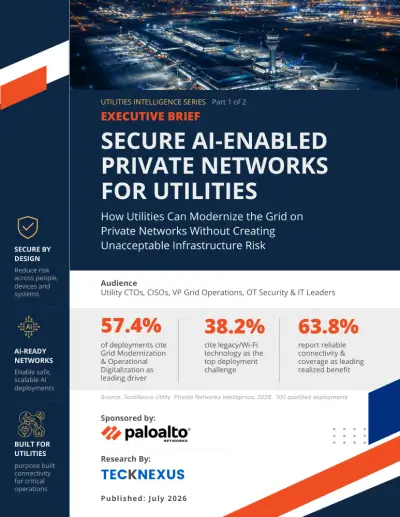
This whitepaper explains how utilities can use secure AI-enabled private mobile networks to modernize operations, support distributed intelligence, improve resilience, and strengthen cybersecurity across critical infrastructure. It covers AI applications, private network advantages, zero trust principles, multilayered security architecture, and governance considerations for AI-ready utility environments....
Whitepaper
Non-terrestrial networks are rapidly evolving from experimental satellite systems into an increasingly important part of the global 5G connectivity landscape. This eBook, developed by Radisys in collaboration with TeckNexus, explores how 3GPP standardization, satellite architecture innovation, and software-driven network design are reshaping NTN deployment models. It examines the transition from...
Whitepaper
Private cellular networks are transforming industrial operations, but securing private 5G, LTE, and CBRS infrastructure requires more than legacy IT/OT tools. This whitepaper by TeckNexus and sponsored by OneLayer outlines a 4-pillar framework to protect critical systems, offering clear guidance for evaluating security vendors, deploying zero trust, and integrating IT,...

Feature Your Brand in Upcoming Magazines

Showcase your expertise through a sponsored article or executive interview in TeckNexus magazines, reaching enterprise and industry decision-makers.

Private Network Solutions - TeckNexus

Subscribe To Our Newsletter

Tech News & Insight
Scroll to Top

Map your security gaps to real threat scenarios – including Salt Typhoon, Volt Typhoon, AI data poisoning, rogue devices, and unencrypted OT traffic.

Take the free 8-minute assessment built for utility operators evaluating AI-enabled private mobile networks. Get a readiness score across five critical domains, see where your gaps are, and receive a prioritized action plan for what to fix first.

Free • 8 minutes • Built for private network security