What operational and safety challenges at the GMR plant led to adopting a software-defined private 5G and edge AI approach?
Speaker: Abhijit Chaudhary (Niral Networks)
The GMR site where we deployed the private 5G network spans roughly 3 to 4 square kilometers and includes several large buildings supporting energy and power generation operations, as well as an extensive coal-handling area outdoors. It is a massive industrial campus with both indoor and large outdoor zones that require reliable connectivity. At the time, they were using Wi-Fi primarily within the buildings for IT operations, but it could not scale to the outdoor environment. Public 4G and 5G coverage from operators was also unreliable due to the plant’s remote location on the outskirts.
Need for Secure, Air-Gapped, Industrial-Grade Connectivity
A major requirement for GMR was establishing an air-gapped, private, captive network that would not connect to any public networks. This was essential to ensure that operational data remained completely secure and private. The energy sector is frequently targeted by cybersecurity threats, so the network had to be resilient, mission-proof, and isolated from external vulnerabilities. Their objective was to eliminate exposure to public networks and create a secure-by-design communications layer for all critical infrastructure.
Operational Use Cases Requiring Mobility, Uplink Capacity, and Real-Time Performance
The operational use cases they wanted to support included automation of the energy plant, worker safety systems, fleet management, and surveillance. Applications such as drone surveys and video-based inspections required continuous mobility across the large outdoor area. These use cases also demanded high uplink bandwidth, especially for video surveillance and real-time drone monitoring, which generate large volumes of video data that must be processed in real time. Existing Wi-Fi and public cellular networks could not deliver consistent uplink throughput, reliable mobility, or the low-latency performance needed for these applications.
Limitations of Existing Wi-Fi and Public Cellular Networks
Their existing Wi-Fi setup was restricted to indoor environments and could not extend across the full plant. Meanwhile, public cellular networks suffered from weak coverage, dead zones, EMI interference, high latency, and bandwidth drops when many devices connected. These issues created operational blind spots, hindered worker safety, impacted equipment uptime, and prevented real-time monitoring and control. The limited reliability also created gaps in surveillance and increased security risks.
Drivers for Choosing Private 5G and Edge AI
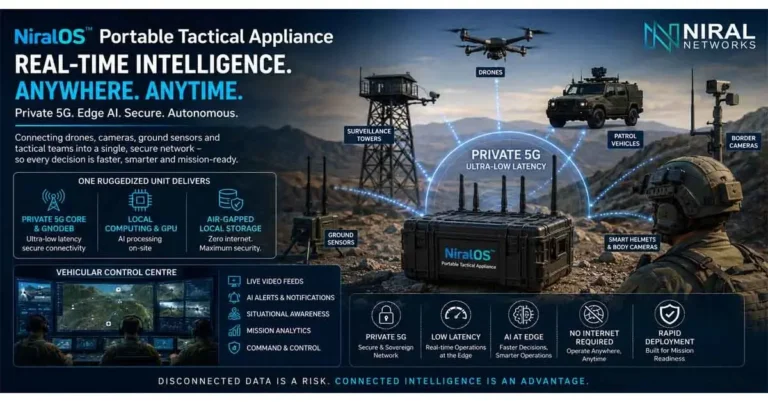
GMR conducted extensive research and concluded that only a private 5G network could provide the industrial mobility, wide-area outdoor coverage, strong uplink performance, and real-time responsiveness required for their operations. They also wanted on-premise compute capabilities for automation and AI-driven analytics, which led them to adopt an edge AI platform—a private cloud deployed locally at the site. This architecture enabled real-time video processing, automated workflows, and rapid decision-making across the plant.
Niral Networks emerged as their preferred partner after a competitive evaluation, due to the feature-rich, future-proof, cost-effective nature of our solution. Our software-defined private 5G core and integrated edge AI platform were specifically designed to address energy sector challenges, offering secure, high-performance connectivity tailored for industrial automation, worker safety, fleet management, surveillance, and real-time drone operations.