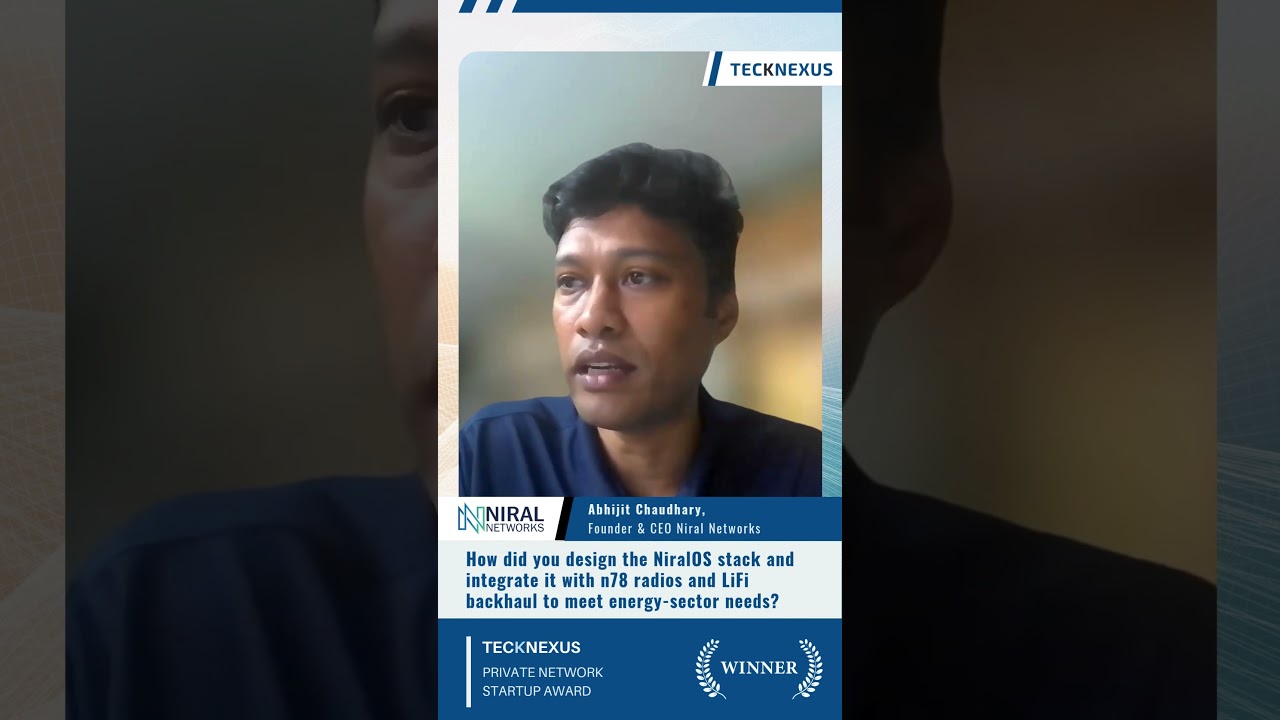
GMR requested a “no-fiber” setup using LiFi with Velmenni. What lessons did you learn about reliability and alignment in a high-EMI industrial zone?
Speaker: Abhijit Chaudhary (Niral Networks)
GMR specifically requested a no-fiber setup, and that requirement shaped the entire backhaul strategy. While wireless backhaul can technically be done over Wi-Fi, we found that Wi-Fi introduces significant interference, especially in a heavy industrial environment. That is where LiFi—an optical, light-based wireless technology—proved extremely valuable. LiFi is inherently immune to both traditional Wi-Fi interference and EMI-related disruptions, which are common in energy plants with large metallic machinery, motors, and heavy equipment.
Near Line-of-Sight Advantages and Performance
One of the key lessons was that LiFi does not require a completely clear line of sight. It only needs near line-of-sight conditions, which gives more flexibility during installation compared to traditional microwave links. In the GMR deployment, LiFi reliably supported backhaul distances in the 700-meter to 1-kilometer range and consistently delivered close to 1 Gbps throughput. This performance level was a significant learning experience, demonstrating that LiFi is a strong alternative where fiber trenching is difficult or disruptive.
Alignment, Stability, and Industrial Considerations
Accuracy in alignment between LiFi transmitters and receivers is critical. In an industrial setting with vibration, dust, or shifting equipment, mounts need to be stable and sometimes reinforced. Regular site surveys help ensure the alignment remains optimal. While LiFi is immune to EMI, it still operates best when the optical path is unobstructed, so careful planning around cranes, structures, or moving vehicles is essential. In some cases, adding redundant paths can increase reliability if the environment is highly dynamic.
Reliability and Operational Benefits
Despite the challenging conditions—metallic surroundings, high EMI, and constant vibration—we found LiFi to be extremely reliable. It provided stable, high-throughput backhaul without requiring any new fiber installation, enabling a fully zero-wire deployment. This significantly reduced installation complexity and avoided disruptions to plant operations. It also made the rollout faster and more flexible, aligning well with GMR’s requirement for a modernized, future-ready network built without physical cabling constraints.
The main lessons were the importance of precise alignment, understanding industrial obstacles, validating mounting stability, and leveraging LiFi’s immunity to EMI. Overall, the zero-fiber LiFi approach proved highly effective for backhaul in a large, EMI-heavy energy facility.