How did you design the NiralOS stack (5G SA core, IMS, controller, MEC) and integrate it with n78 radios and LiFi backhaul to meet energy-sector performance needs?
Speaker: Abhijit Chaudhary (Niral Networks)
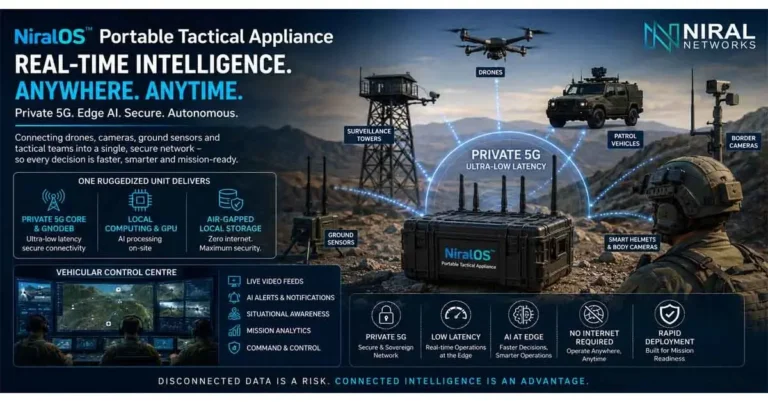
At the GMR plant, we deployed the NiralOS 5G core, which is a Release 16-compliant standalone (SA) core. Along with the core, we also deployed the IMS stack because they needed voice and video communication services to operate locally and securely. Since every workload had to run on-premise, the NiralOS platform also provided our HCompute hypervisor—this enables the creation of a private cloud on-premise that can run their operational applications.
On-Prem Cloud for Automation, Analytics, and AI
This private cloud was essential for running drone-survey applications, fleet management systems, video analytics, and their AI workloads. Our platform supports GPU monitoring and GPU slicing within the private cloud, which was important for their real-time AI and video processing needs. This combination of the 5G SA core, IMS, and HCompute-based private cloud created an ideal architecture tailored for energy-sector automation, safety monitoring, and operational intelligence.
Unified Management Through Software-Defined Controller
They also wanted simplified, centralized management. For that, we provided the NiralOS Controller, which is built on software-defined networking principles. Using this controller, they can manage the entire private 5G network as well as the private cloud from a single platform. During their technical evaluation, they found that our solution could compete with and outperform several global vendors, particularly because of our strong integration with edge AI and our private cloud capabilities. That is why our end-to-end architecture matched their requirements perfectly.
Integration with n78 Outdoor Radios and Mobility Support
The complete NiralOS stack—including the SA core, IMS, controller, and private cloud—had to be integrated with specific n78 band outdoor radios. These were 4T4R, 4x5W outdoor gNodeBs, designed to provide optimal coverage and capacity across the large energy plant. We deployed multiple radios to support seamless roaming across the entire facility. This ensured that worker safety tools, drones, IoT sensors, and surveillance devices could move across the site without losing connectivity.
Zero-Fiber Backhaul Using LiFi (Wireless Optical)
A key requirement from GMR was achieving a near-zero-fiber deployment. They did not want to dig or lay new fiber across the plant. To meet this requirement, all outdoor radios were backhauled using LiFi—wireless optical connectivity—rather than traditional fiber links. This allowed us to connect the radios to the data center room inside the office building without trenching fiber. LiFi backhaul also ensured high-speed, reliable links suitable for industrial applications.
End-to-End System Integration for Mission-Critical Use Cases
As the system integrator for the project, we designed the full end-to-end plan—radio placement, LiFi backhaul, private 5G core, controller, IMS, and private cloud—followed by complete implementation and integration of all use cases. The plant primarily needed support for voice, video, industrial IoT, camera feeds, and drone-based surveys. Our architecture delivered all of this with secure SIM-based authentication across 5G devices, CPEs, sensors, cameras, and drones.
The combination of NiralOS 5G SA core, IMS, SDN controller, MEC/private cloud, n78 radios, and LiFi backhaul gave the GMR plant a future-proof, energy-sector-optimized network that supports automation, mobility, AI, and mission-critical operations.