
The global telecom industry is entering a decisive transformation cycle. For decades, operators focused on scale, coverage, and cost efficiency—delivering connectivity as a largely uniform utility. Today, that model is no longer sufficient. Artificial intelligence (AI) is reshaping how networks are built, operated, monetized, and governed, pushing telecom operators toward a fundamentally different identity: intelligence infrastructure providers.
This shift is not driven by hype alone. AI is rapidly becoming embedded in enterprise workflows, public services, consumer applications, and industrial automation. As data volumes explode and latency expectations tighten, traditional cloud-centric models are being challenged. Networks must now support real-time inference, distributed compute, sovereign data requirements, and autonomous operations—at scale.

The result is a growing consensus across telecom operators, cloud providers, and infrastructure vendors: AI readiness is no longer optional infrastructure modernization—it is the next growth engine.
AI in Telecom: From Feature to Foundational Operating Model
One of the most important mindset changes underway is how AI is perceived inside telecom organizations. AI is no longer treated as a standalone tool, a pilot project, or a single department’s responsibility. Instead, leading operators are embedding AI across the entire enterprise—network operations, customer engagement, finance, marketing, HR, and product development.
This represents a profound cultural shift. Traditional telecom operations relied on static rules, manual optimization, and post-event analysis. AI introduces a fundamentally different operating model: continuous learning, prediction, and autonomous decision-making.
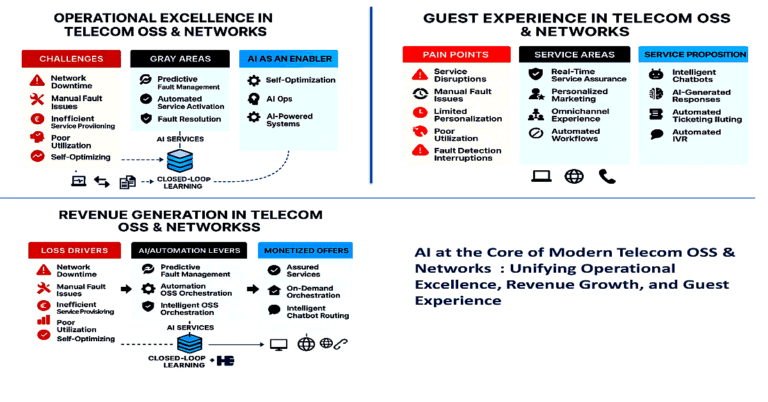
Modern networks are evolving into self-optimizing systems. Traffic patterns are predicted rather than reacted to. Faults are mitigated before customers notice. Energy consumption is dynamically adjusted in real time. Customer experience is inferred from telemetry rather than inferred after complaints arise.
In this model, AI is not “artificial” intelligence—it is augmented intelligence, amplifying human decision-making while automating routine complexity.
Building the Right Infrastructure to Unlock AI Value in Telecom
While AI ambitions are high, execution consistently runs into the same bottleneck: infrastructure.
Many operators begin their AI journey by investing in compute—particularly GPUs—expecting immediate gains. But compute alone does not unlock AI value. In practice, performance shortfalls often reveal deeper architectural constraints:
- Fragmented data pipelines
- Latency-heavy storage systems
- Network architectures designed for north-south traffic, not east-west data flows
- Siloed operational domains that prevent holistic insight
AI workloads demand high-performance data movement, not just raw processing power. Data must be collected, cleaned, contextualized, and delivered to algorithms in near real time. Storage and networking are no longer passive layers—they actively shape AI outcomes.
As a result, operators are rethinking their infrastructure stacks end-to-end:
- Moving from disk-centric storage to low-latency, high-IO architectures
- Flattening data access across network, IT, and business systems
- Enabling real-time telemetry ingestion from edge to core
- Designing for distributed inference, not centralized batch analytics
This architectural evolution is foundational. Without it, AI remains stuck in pilots.
From Cloud to Edge: The Rise of Distributed AI in Telecom
AI is forcing a rethink of where computation happens.
While hyperscale clouds continue to dominate large-scale training and analytics, inference is increasingly moving closer to where data is generated. Latency-sensitive use cases—network optimization, industrial automation, healthcare monitoring, smart cities—cannot tolerate round-trip delays to distant data centers.
This is driving a distributed AI continuum, spanning:
- On-device intelligence
- Edge and regional data centers
- National and hyperscale cloud platforms
Telecom operators are uniquely positioned in this landscape. They already operate geographically distributed sites with power, cooling, fiber connectivity, and physical security. These assets are increasingly being repurposed to support AI inference at the edge—particularly in markets where hyperscale capacity is limited or regulatory constraints require local processing.
The strategic question is no longer whether AI will be distributed, but who controls the distributed infrastructure.
GPU-as-a-Service in Telecom: Growth Engine or Risk?
One of the most debated topics in telecom AI strategy is GPU-as-a-Service.
On paper, telecom operators appear well-positioned: they have real estate, power diversity, low-latency networks, and proximity to users. Demand for AI compute is real and growing, driven by enterprises, public sector organizations, and sovereign AI initiatives.
Yet history offers caution. Previous attempts to monetize edge compute struggled due to unclear demand, immature ecosystems, and one-size-fits-all offerings.
What’s different this time?
First, AI demand is no longer speculative. Inference workloads are becoming integral to everyday operations across industries. Second, regulatory and sovereignty requirements are pushing compute closer to national borders. Third, AI workloads are increasingly event-driven and location-specific, favoring localized capacity rather than centralized scale.
Still, GPU-as-a-Service is unlikely to be universal. Successful models will be selective and vertical-driven, targeting:
- Public sector and defense workloads
- Healthcare, education, and agriculture
- Smart infrastructure and industrial automation
- Event-based or temporary high-compute scenarios
Rather than deploying compute everywhere, operators are identifying strategic islands of AI capacity aligned to real demand.
AIOps in Telecom: Driving Tangible Returns with AI
Among all AI use cases, AI-driven operations (AIOps) are delivering the fastest and most measurable returns.
Operators are deploying AI to:
- Predict network congestion and failures
- Automate ticket resolution and root-cause analysis
- Optimize energy consumption across sites
- Detect anomalies in security and performance
- Anticipate customer dissatisfaction before churn occurs
The most advanced implementations go further—combining network telemetry, geolocation data, and customer behavior to predict experience at a granular level. Instead of reacting to complaints, operators can proactively intervene, simulate corrective actions, and even personalize remediation offers.
These use cases succeed because they:
- Rely on existing data assets
- Deliver clear cost savings or churn reduction
- Can be deployed incrementally
- Scale across markets with adaptation
They also build internal confidence, creating momentum for more advanced AI initiatives.
Moving Beyond Bandwidth: Experience-Driven Monetization with AI
While cost optimization is critical, AI’s long-term value lies in revenue transformation.
AI enables hyper-personalization at scale—tailoring services, pricing, and experiences to individual users and enterprises. It also unlocks new digital services layered on top of connectivity, from industry-specific platforms to AI-enhanced applications.
In this model, telecom operators move beyond selling bandwidth to selling outcomes:
- Better healthcare delivery
- More efficient logistics
- Safer cities
- Smarter education
- More resilient enterprises
This transition requires new product thinking, closer ecosystem partnerships, and a willingness to experiment beyond traditional telecom boundaries.
Turning Data Governance into a Telecom Differentiator
As AI adoption accelerates, data governance moves from a compliance function to a competitive differentiator.
AI systems are only as effective as the data they consume. Poor data quality, duplicated datasets, and fragmented ownership undermine performance and inflate costs. Leading operators are investing in:
- Unified data governance frameworks
- Clear data ownership models
- Cost guardrails for inference and model usage
- Transparency across data pipelines
Equally important is trust, particularly as AI systems influence customer interactions, network behavior, and regulatory compliance. Responsible AI practices are becoming integral to brand credibility.
Why Culture and Skills Matter in Telecom’s AI Transformation
Technology is only half the challenge. The harder transformation is organizational.
AI requires faster decision cycles, cross-functional collaboration, and new skill sets. Traditional hierarchical approval models slow innovation. Siloed teams inhibit end-to-end optimization.
Successful operators are:
- Upskilling employees across all functions in AI literacy
- Embedding AI specialists within operational teams
- Creating centralized AI platforms with decentralized execution
- Encouraging experimentation while enforcing light-touch governance
AI transformation is not about replacing people, it is about enabling them to work differently.
The Future of Telecom: Becoming the Backbone of AI Infrastructure
The telecom industry is not becoming obsolete—it is being redefined.
As AI reshapes economies, telecom operators are evolving into foundational intelligence infrastructure providers, sitting at the intersection of connectivity, compute, data, and trust. Those that modernize their infrastructure, rethink their operating models, and embrace ecosystem collaboration will unlock new relevance and growth.
Those that hesitate risk being relegated to commodity connectivity providers in an AI-driven world.
The next era of telecom will not be measured by coverage maps alone—but by how intelligently networks sense, learn, and act.