

Ericsson layoffs continue as 5G RAN demand cools
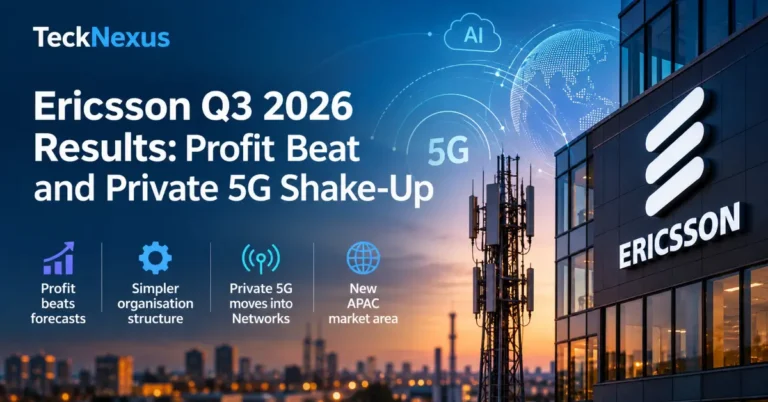
Ericsson signaled additional job reductions to defend margins as global 5G radio access network (RAN) demand stays subdued.

Ericsson headcount cuts and restructuring scope
CEO Börje Ekholm indicated the company will keep trimming headcount after cutting roughly 5,000 positions over the last year. In Sweden, Ericsson has notified authorities and begun union talks that could affect about 1,600 roles, part of a multi‑year restructuring program. The move follows a 2023 plan to remove around 8,500 jobs worldwide—about 8% of its workforce—with further reductions last year in markets such as Spain and Canada. The rationale remains consistent: reset the cost base, protect profitability, and keep investment firepower for strategic bets amid a slower operator capex cycle.
5G RAN demand drivers: capex slowdown and market headwinds
The post‑pandemic 5G buildout peaked early in several large markets, leaving operators in a digestion phase. Elevated interest rates and a turn toward cash preservation have pushed many carriers to defer RAN expansions, especially in Europe, while India normalizes after an accelerated 2023 ramp. 5G Standalone (SA) rollouts have lagged expectations in some regions, delaying use cases like network slicing at scale. At the same time, pricing pressure, elongated procurement cycles, and geopolitics—ranging from trade restrictions to supply chain re‑routing—have added friction. Independent trackers have flagged a multi‑quarter RAN contraction outside of China, confirming the cyclical headwinds Ericsson is navigating.
Margin protection and cash generation strategy
Against this backdrop, Ericsson continues to prioritize gross margin and cash generation. Cost actions span labor, services delivery, product mix, and footprint consolidation. The company is reallocating spend toward software, cloud‑native core, and enterprise platforms with better margin profiles, while keeping discipline in hardware-heavy segments. The message to investors and customers is clear: streamline now to stay competitive when spending re-accelerates.
Ericsson strategy: enterprise growth, network APIs, and Open RAN
With classic RAN volumes cycling down, Ericsson is leaning into enterprise solutions, network APIs, and disaggregated RAN to diversify growth.
Vonage-led CPaaS and GSMA Open Gateway APIs
Vonage sits at the center of Ericsson’s enterprise push, anchoring communications platform-as-a-service (CPaaS) and the emerging network API opportunity. Through initiatives aligned with GSMA Open Gateway, Ericsson aims to expose capabilities such as quality-on-demand, location verification, fraud prevention, and eventually slice/QoS controls to developers via standardized APIs. The strategy is to convert carriers’ 5G investments into B2B revenue by making network features consumable in software—and to do so across multiple operators for scale. Watch for tangible KPIs here: number of live APIs, operator coverage, developer adoption, and revenue-sharing models that align telco incentives with enterprise use cases.
Cloud RAN and Open RAN roadmap and execution risks
On the network side, Ericsson is doubling down on Cloud RAN and Open RAN. A marquee multi‑year award with a major U.S. operator underscores confidence in Ericsson’s ability to deliver performance and energy efficiency on commercial off‑the‑shelf (COTS) hardware while maintaining carrier-grade reliability. Partnerships across silicon, servers, and cloud software—think Intel, HPE, and Red Hat among others—support a disaggregated DU/CU roadmap. The execution challenges are real: multi‑vendor integration, lifecycle automation, and achieving parity with purpose‑built systems under tight TCO thresholds. Success will depend on robust reference designs, automated testing, and clear migration paths that limit operational risk for operators moving to open interfaces (e.g., O-RAN Alliance specs) and 3GPP Release 17/18 features.
What Ericsson’s restructuring means for operators and vendors
Ericsson’s restructuring affects procurement timing, vendor risk calculus, and price–performance dynamics across the telecom stack.
Operator guidance: pricing, SLAs, Open RAN benchmarks
Expect sharper pricing and commercial flexibility as vendors compete for a smaller pie, but scrutinize delivery timelines and support SLAs amid workforce reductions. If you are planning Open RAN, insist on outcome-based benchmarks—throughput, latency under load, energy per bit, automation maturity—and require hard commitments on interoperability. For brownfield expansions, dual‑vendor RAN strategies remain prudent to hedge supply and innovation risk. On the enterprise side, pilot network APIs with clear ROI hypotheses in sectors like logistics, fintech fraud prevention, and media QoS, and align internal product teams to monetize beyond connectivity.
Competitive landscape and partner opportunities
Nokia could benefit in Europe where swap costs are lower, while Samsung remains well positioned in the U.S. and selective Asian markets. Open RAN specialists (e.g., Mavenir, NEC) may see increased opportunity, but must prove scale and stability. Hyperscalers will keep pressing co-sell motions around private 5G and edge compute, potentially accelerating telco–cloud operating models. Component suppliers should prepare for uneven volumes by region as the U.S. and select Middle Eastern markets outpace Europe and parts of APAC.
Key 5G and RAN signals to watch
Key signals over the next few quarters will indicate whether Ericsson’s strategy can offset the RAN downturn and where the broader 5G cycle heads.
Capex recovery and 5G Standalone milestones
Track operator budgets in the U.S., Europe, and India for signs of a second 5G wave, particularly around SA core deployments that enable slicing, RedCap (NR-Light) for IoT, and uplink-centric enhancements. Release 18 milestones and device ecosystem support for RedCap will determine whether industrial and mid-tier IoT demand materializes at scale.
Enterprise API traction and margin outlook
Watch Vonage’s API consumption growth, cross-operator API availability under GSMA Open Gateway, and reference wins in private 5G across manufacturing, logistics, and campuses. On the network side, look for Cloud RAN wins beyond early U.S. deployments and evidence that energy efficiency and automation gains are holding margins. If these vectors progress while cost reductions stick, Ericsson can emerge leaner and better positioned when the next investment cycle begins.
Bottom line for telco leaders
The prudent move now is to push vendors on TCO and automation, stage Open RAN with clear performance gates, and fast-track enterprise pilots that monetize 5G features through APIs.
Action plan for telecom buyers
– Renegotiate multi-year RAN and services contracts with energy and automation targets tied to penalties/bonuses.
– Design dual-track roadmaps: maintain stability on legacy RAN while ring-fencing Open RAN trials with measurable KPIs.
– Stand up a cross-functional squad (network, security, product) to evaluate network APIs and prioritize 2–3 use cases with near-term revenue impact.
– Align private 5G with edge compute strategy; pre-qualify partners for on-prem and hybrid models with clear integration responsibilities.
– Reassess vendor concentration risk and ensure support coverage is contractually protected during workforce transitions.