AI Agent Competitive
Intelligence
Intelligence Journeys
AI Use Cases for Utilities
Private Broadband for Utilities

Automation

Network automation replaces manual configuration and operations with software-driven processes, ranging from scripted tasks to fully autonomous, self-optimizing networks. Driven by the complexity of 5G standalone, cloud-native architectures, and multi-vendor environments, operators are pursuing higher autonomy — often framed against the TM Forum’s autonomous networks levels — to cut costs, speed service delivery, and improve reliability. Automation increasingly relies on AI and closed-loop systems that sense, decide, and act with diminishing human intervention. For operators and enterprises, the practical path runs through incremental autonomy: automating well-defined tasks before attempting end-to-end self-operation. This channel covers network automation across RAN, core, and operations — including orchestration, closed-loop control, and the AI techniques behind autonomous networks — with analysis of where automation is delivering measurable results and how operators are progressing toward higher levels of autonomy.

Microsoft’s AI QuickStart, backed by IMDA and UOB, aims to turn generative AI intent into production outcomes in weeks, not years. AI QuickStart targets “Digital Leaders” in Singapore—SMEs and larger non-ICT enterprises that have already built basic digital capabilities and can fund transformation—by offering a fast, structured path to deploy enterprise AI. Each engagement is designed to finish within three months with a cost cap of up to S$20,000 per project, covering cloud, compute, and professional services, which directly addresses executive concerns over unpredictable pilot spend and elongated proofs-of-concept.

Start: April 21, 2026
End: April 22, 2026
Venue: Intercontinental O2 London
Location: London, UK
OpenAI introduced Frontier as an enterprise platform to build, govern, and monitor AI agents—positioning agent management as core infrastructure rather than a feature. Frontier is an end-to-end platform for creating and managing AI agents that can connect to external data and applications, execute tasks, and operate under enterprise controls. OpenAI is emphasizing an open architecture: organizations can manage agents built on Frontier and agents constructed with third-party frameworks.
Colombia has cleared a milestone consolidation: Tigo has taken operational control of Movistar, creating a second national-scale incumbent to challenge Claro. The Superintendence of Industry and Commerce (SIC) approved the integration through Resolution 94169 of 2025, capping months of scrutiny and pushback from rivals and ISPs. The merger compresses Colombia’s competitive field at a time when 5G rollouts, fiber densification, and cloud-native cores demand scale. It creates a stronger counterweight to Claro, but also raises real concerns about a two-horse race and the downstream effects on MVNOs, ISPs, and enterprise buyers.
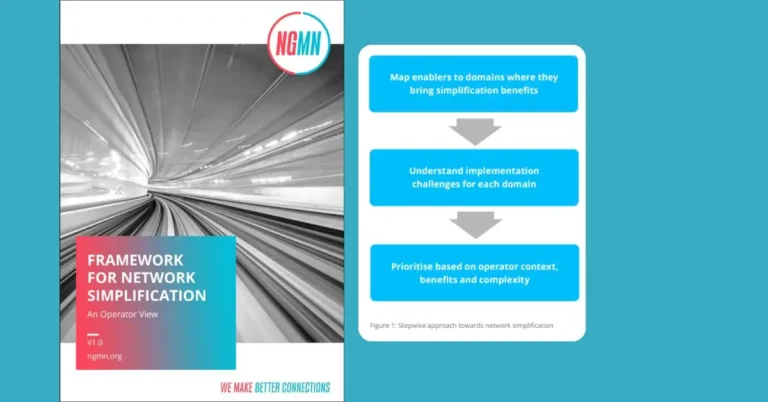
NGMN’s latest operator-led guidance frames simplification as a precondition for 5G efficiency, sustainability and service agility—not an optional clean-up exercise. NGMN’s new Framework for Network Simplification – An Operator View argues for targeted simplification across radio, core and transport to contain this sprawl while preserving the ability to launch differentiated services. The alliance places cloud‑native design, federated service exposure and AI‑driven operations at the center of that shift, supported by agile ways of working. Simplification is how operators square the circle—cut carbon and cost, while accelerating innovation. The publication offers a practical, non-prescriptive method to decide where simplification delivers the most benefit, and when complexity risk outweighs near-term gains.
Liberty Global and Google Cloud have signed a five-year agreement to deploy AI at scale across Liberty Global’s European footprint and to advance hybrid cloud, autonomous networks, and new go-to-market plays. The partnership spans roughly 80 million fixed and mobile connections across Liberty Global’s operating companies, including Virgin Media O2 in the UK, Telenet in Belgium, VodafoneZiggo in the Netherlands, Virgin Media in Ireland, and Sunrise in Switzerland. On the network side, the companies will co-develop AI-first programs aimed at reliability, security, scalability, and cost efficiency. Commercially, the parties will target SMEs with a joint portfolio that combines connectivity with cloud, cybersecurity, and AI services.
Amdocs is launching aOS, an agentic operating system for telecom, to move CSPs from AI pilots to production-scale, cross-domain automation. Amdocs’ aOS targets that gap with a multi-agent architecture that automates complex workflows while keeping humans in the loop for policy and final decisions. At the foundation is a “Cognitive Core” that manages telco-specific knowledge, agent libraries, and guardrails. aOS pricing will lean on outcome-based SLAs, tying spend to measurable business impact such as resolution rates, handle-time reductions, activation velocity, or assurance KPIs. aOS is Amdocs’ bid to make agentic AI the connective tissue of telco operations.
AT&T is deepening ties with Amazon by pairing its national fiber assets with AWS cloud and AI tooling while adding low Earth orbit connectivity from Amazon’s satellite network to fill coverage gaps for business customers. The collaboration has two pillars: cloud modernization on AWS and satellite-enabled reach via Amazon’s LEO network, with AT&T also supplying fiber capacity into AWS data centers to bolster high-performance infrastructure. Amazon’s LEO constellation will deliver fixed broadband connectivity for AT&T Business customers in areas where terrestrial options are limited, enabling primary service in hard-to-reach sites and resilient backup for SD‑WAN architectures.
ElevenLabs raised $500 million in Series D funding at an $11 billion valuation, led by Sequoia Capital with continued participation from Andreessen Horowitz and ICONIQ, and new backing from Lightspeed, Evantic Capital and BOND alongside existing investors. The company says it has surpassed key ARR milestones and reported strong enterprise adoption across sectors through 2025, with telecom emerging as a priority vertical as operators seek to modernize legacy IVR and contact center stacks. Conversational agents can replace keypad IVRs with natural dialogue that recognizes intent, confirms identity, retrieves context and executes actions across channels.
Boingo Wireless is integrating Globalstar’s XCOM RAN to accelerate private 5G across airports, stadiums, hospitals, convention centers, transit hubs, and military bases. Globalstar said Boingo will add XCOM RAN, a software-defined private 5G platform built around the Supercell architecture, to its private network portfolio. A highlighted approach is overlaying XCOM RAN on existing distributed antenna system (DAS) infrastructure to preserve DAS coverage advantages while boosting capacity and performance. Enterprises are moving beyond pilot projects to operational private 5G in high-traffic, RF-challenged environments. This aligns with rising demand for low-latency, secure connectivity for IoT, video, automation, and mission-critical operations.
AT&T has closed its $5.75 billion cash deal to acquire Lumen’s consumer fiber business across 11 states, reshaping competitive dynamics in U.S. fiber-to-the-home and sharpening Lumen’s enterprise focus. The transaction moves more than 1 million fiber subscribers and over 4 million enabled fiber locations, including the Quantum Fiber brand and related consumer access networks, into AT&T’s portfolio. AT&T’s fiber home internet footprint now spans 32 states, adding major metros such as Denver, Seattle, and Salt Lake City where it can bring multi-gig services to market at scale.
ABB has unveiled Automation Extended, an evolution of its distributed control systems designed to let plants add digital capabilities without disrupting mission-critical operations. The program extends ABB’s established DCS portfolio—Ability System 800xA, Symphony Plus, and Freelance—by introducing a framework to layer analytics, AI, and IoT capabilities on top of existing control assets. The core promise is modernization without downtime: operators can keep trusted control systems running while progressively adopting new functionality. Security and interoperability are central themes, with ABB positioning an open, modular ecosystem that scales across industrial domains and preserves prior investments.

Frequently Asked Questions

What’s the difference between automation and AI in a telecom context?
Automation, in its traditional form, generally follows pre-defined rules and scripted logic: a specific condition triggers a specific, predetermined response, with no real interpretation or judgment involved beyond what was explicitly programmed in advance. AI adds the capacity to learn from data, recognize patterns that weren’t explicitly anticipated, and make more nuanced decisions about what action makes sense in a given situation, even one the system hasn’t seen in exactly that form before. In practice, most modern telecom systems combine the two: AI analyzes a situation and decides what should happen, while automation infrastructure actually executes that decision reliably and consistently across the network, a combination often described as the foundation for agentic AI.
What is ‘zero-touch’ network operation, and how close is the industry to achieving it?
Zero-touch network operation describes the long-term industry goal of running networks with minimal direct human intervention, where the network itself handles configuration, fault recovery, and optimization automatically and continuously. It’s a meaningful aspiration rather than a fully achieved reality; the industry is progressing toward it in stages, with specific functions, like automated fault detection or dynamic capacity adjustment, achieving meaningful levels of automation well before the broader vision of an entirely self-managing network becomes reality. Standards bodies including ETSI have working groups specifically dedicated to defining the requirements for zero-touch network and service management, reflecting that this remains an active area of ongoing standardization rather than settled, widely deployed technology.
Why is automation considered essential for managing modern 5G networks specifically?
5G networks are substantially more complex than earlier generations for several compounding reasons: they rely heavily on virtualized network functions running across cloud infrastructure rather than fixed dedicated hardware, they support network slicing, meaning managing multiple distinct virtual networks with different performance guarantees simultaneously, and they often combine equipment and software from multiple different vendors rather than one integrated supplier. Traffic patterns also shift constantly and unpredictably as device density and application types continue to grow. Attempting to manually manage this level of complexity at the scale of a national or global network simply isn’t realistic, making automation effectively a practical requirement for operating a modern 5G network reliably at all.
How does automation relate to network orchestration?
Automation and orchestration are closely related but distinct concepts. Automation generally refers to executing a specific task without manual intervention, like automatically restarting a failed process or adjusting a configuration parameter. Orchestration refers to the broader coordination of multiple automated tasks and virtualized network components across their full lifecycle, deciding where different network functions should run, how they should scale, and how they interact with each other to deliver a complete service. In practice, orchestration systems often rely on underlying automation capabilities to actually carry out the individual tasks they coordinate, providing higher-level coordination while automation provides the lower-level mechanism for reliably executing decisions.
What are the risks of relying heavily on automated network systems?
Heavy reliance on automated systems introduces specific risks alongside its clear efficiency benefits. If an automated system makes an incorrect decision, that error can potentially propagate quickly and broadly across the network before a human notices and intervenes, compared to a manual process where mistakes tend to be more contained. There’s also a risk of reduced visibility and understanding among human staff over time, since heavily automated systems can create a gap between what the network is actually doing and what engineers fully understand about why, particularly as AI-driven decision-making becomes more involved. Operators generally manage these risks by maintaining careful guardrails for automated actions, expanding autonomous scope gradually as confidence grows.
How has automation changed the day-to-day role of network engineers?
Automation has shifted network engineers’ day-to-day work away from repetitive, manual configuration and troubleshooting tasks and toward higher-level responsibilities like designing automation policies, overseeing AI-driven systems, and handling more complex or novel problems that automated systems aren’t yet equipped to resolve independently. Rather than manually configuring each new service or personally diagnosing every fault, engineers increasingly spend time defining the rules, guardrails, and escalation criteria that govern how automated systems behave, then stepping in directly for situations that fall outside those parameters. This represents a meaningful skills shift, with growing demand for engineers comfortable working with automation platforms and AI systems alongside traditional networking expertise.
What’s ‘closed-loop automation,’ and why does it matter?
Closed-loop automation refers to systems that don’t just execute an automated action once, but continuously monitor the result of that action, compare it against the intended outcome, and adjust automatically if the result doesn’t match expectations, creating a self-correcting cycle without requiring a human to manually verify and re-trigger each step. A closed-loop system managing network capacity, for example, might automatically increase resources in response to rising traffic, then continuously monitor whether that adjustment actually resolved the congestion, and make further automatic adjustments if it didn’t. This concept is considered a meaningful step toward the zero-touch network vision, since it moves automation beyond simple one-off actions toward genuinely self-managing behavior based on real-world feedback.

Partner Hubs

Download content, access intelligence tools, and hear from executives.

Partner Events

  • Network X Vienna 2026
Scroll to Top